Event submissions
Published
This submission belongs to the session S7. Air Quality of the event The 7th International Electronic Conference on Atmospheric Sciences
Published date
30 May, 2025
Academic Editor
'%3e%3cpath%20d='M12.6657%2010.9104C12.4185%2010.325%2012.0599%209.79327%2011.6097%209.34482C11.1609%208.89508%2010.6293%208.5365%2010.0442%208.28888C10.0389%208.28626%2010.0337%208.28495%2010.0285%208.28233C10.8446%207.69279%2011.3752%206.73249%2011.3752%205.64904C11.3752%203.8542%209.92103%202.39999%208.1262%202.39999C6.33136%202.39999%204.87715%203.8542%204.87715%205.64904C4.87715%206.73249%205.40774%207.69279%206.22393%208.28364C6.21869%208.28626%206.21345%208.28757%206.20821%208.29019C5.62129%208.5378%205.09463%208.89284%204.64265%209.34613C4.1929%209.79493%203.83432%2010.3266%203.58671%2010.9117C3.34345%2011.4845%203.21226%2012.0987%203.20023%2012.7209C3.19988%2012.7349%203.20233%2012.7488%203.20744%2012.7619C3.21255%2012.7749%203.22022%2012.7867%203.22998%2012.7968C3.23975%2012.8068%203.25142%2012.8147%203.26431%2012.8202C3.2772%2012.8256%203.29105%2012.8284%203.30504%2012.8284H4.09109C4.14874%2012.8284%204.19459%2012.7825%204.1959%2012.7262C4.2221%2011.7148%204.62823%2010.7676%205.34617%2010.0497C6.08899%209.30683%207.0755%208.89808%208.1262%208.89808C9.17689%208.89808%2010.1634%209.30683%2010.9062%2010.0497C11.6242%2010.7676%2012.0303%2011.7148%2012.0565%2012.7262C12.0578%2012.7838%2012.1037%2012.8284%2012.1613%2012.8284H12.9474C12.9613%2012.8284%2012.9752%2012.8256%2012.9881%2012.8202C13.001%2012.8147%2013.0126%2012.8068%2013.0224%2012.7968C13.0322%2012.7867%2013.0398%2012.7749%2013.0449%2012.7619C13.0501%2012.7488%2013.0525%2012.7349%2013.0522%2012.7209C13.0391%2012.0947%2012.9094%2011.4855%2012.6657%2010.9104ZM8.1262%207.9024C7.52486%207.9024%206.9589%207.6679%206.53312%207.24211C6.10733%206.81633%205.87283%206.25037%205.87283%205.64904C5.87283%205.0477%206.10733%204.48174%206.53312%204.05596C6.9589%203.63018%207.52486%203.39567%208.1262%203.39567C8.72753%203.39567%209.29349%203.63018%209.71927%204.05596C10.1451%204.48174%2010.3796%205.0477%2010.3796%205.64904C10.3796%206.25037%2010.1451%206.81633%209.71927%207.24211C9.29349%207.6679%208.72753%207.9024%208.1262%207.9024Z'%20fill='%235D1EE1'/%3e%3c/g%3e%3c/svg%3e) Viney Aneja
Viney AnejaCitation
Raúl Arasa Agudo, Oscar Hernandez, Elisa Etzkorn, Milagros Herrera, David Fuertes, Eliot Llopis, Jesús De la Rosa, Ana Sánchez de la Campa, Francisco Vázquez, Emilio San Juan, Evaluation of modelling and remote sensing tools for improving air quality in surroundings of open-pit mines, in Proceedings of The 7th International Electronic Conference on Atmospheric Sciences, 4 June–6 June 2025, MDPI: Basel, Switzerland
Share
Email
Facebook
Twitter
LinkedIn
Evaluation of modelling and remote sensing tools for improving air quality in surroundings of open-pit mines

Raúl Arasa Agudo 1
'%3e%3cpath%20d='M12.6647%2010.9104C12.4176%2010.325%2012.0589%209.7933%2011.6088%209.34485C11.16%208.89511%2010.6283%208.53653%2010.0432%208.28891C10.038%208.28629%2010.0327%208.28498%2010.0275%208.28236C10.8437%207.69282%2011.3743%206.73252%2011.3743%205.64907C11.3743%203.85423%209.92005%202.40002%208.12522%202.40002C6.33038%202.40002%204.87618%203.85423%204.87618%205.64907C4.87618%206.73252%205.40677%207.69282%206.22296%208.28367C6.21772%208.28629%206.21248%208.2876%206.20724%208.29022C5.62031%208.53783%205.09365%208.89287%204.64167%209.34616C4.19192%209.79496%203.83334%2010.3266%203.58573%2010.9117C3.34247%2011.4846%203.21128%2012.0987%203.19925%2012.721C3.1989%2012.735%203.20135%2012.7489%203.20646%2012.7619C3.21157%2012.7749%203.21924%2012.7868%203.22901%2012.7968C3.23877%2012.8068%203.25045%2012.8148%203.26334%2012.8202C3.27623%2012.8256%203.29007%2012.8284%203.30406%2012.8284H4.09012C4.14776%2012.8284%204.19362%2012.7825%204.19493%2012.7262C4.22113%2011.7148%204.62726%2010.7676%205.34519%2010.0497C6.08802%209.30686%207.07452%208.89811%208.12522%208.89811C9.17592%208.89811%2010.1624%209.30686%2010.9052%2010.0497C11.6232%2010.7676%2012.0293%2011.7148%2012.0555%2012.7262C12.0568%2012.7839%2012.1027%2012.8284%2012.1603%2012.8284H12.9464C12.9604%2012.8284%2012.9742%2012.8256%2012.9871%2012.8202C13%2012.8148%2013.0117%2012.8068%2013.0214%2012.7968C13.0312%2012.7868%2013.0389%2012.7749%2013.044%2012.7619C13.0491%2012.7489%2013.0515%2012.735%2013.0512%2012.721C13.0381%2012.0947%2012.9084%2011.4856%2012.6647%2010.9104ZM8.12522%207.90243C7.52388%207.90243%206.95792%207.66793%206.53214%207.24215C6.10636%206.81636%205.87185%206.2504%205.87185%205.64907C5.87185%205.04773%206.10636%204.48177%206.53214%204.05599C6.95792%203.63021%207.52388%203.3957%208.12522%203.3957C8.72655%203.3957%209.29252%203.63021%209.7183%204.05599C10.1441%204.48177%2010.3786%205.04773%2010.3786%205.64907C10.3786%206.2504%2010.1441%206.81636%209.7183%207.24215C9.29252%207.66793%208.72655%207.90243%208.12522%207.90243Z'%20fill='%235D1EE1'/%3e%3c/g%3e%3c/svg%3e)
Oscar Hernandez 2
Elisa Etzkorn 3
Milagros Herrera 4
David Fuertes 4
Eliot Llopis 4
Jesús De la Rosa 5
Ana Sánchez de la Campa 5
Francisco Vázquez 6
Emilio San Juan 6
1. Applied Research and Customer Success Departments, Meteosim, Barcelona, Spain
2. Solutions Department, Meteosim, Barcelona, Spain
3. Applied Research Department, Meteosim, Barcelona, Spain
4. GRASP Earth, France
5. Center for Research in Sustainable Chemistry, University of Huelva, Huelva, Spain
6. Environmental Area, Atalaya Mining, Spain
Abstract
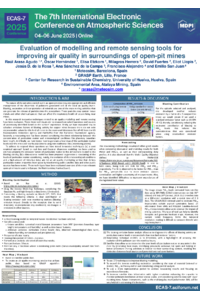
The nature of the activities carried out in open-pit mines necessitates appropriate and efficient management of the dispersion of pollutants generated and of local air quality levels. The blasting, excavation, and transportation of minerals are some of the main mining activities that can cause the release of particles into the atmosphere. These particles may contain heavy metals and other chemical species that can affect the respiratory health of people living near mines.
In this contribution, innovative techniques related to air quality modelling and remote sensing have been evaluated. These three techniques aim to address previously unanswered questions and sources of uncertainty identified based on the authors’ experience, with areas such as the following: (1) recommended emission factors for blasting activity in copper mines do not exist; (2) to adapt environmental management and ensure compliance with legislation, the concentration of particulate matter for the next few hours, depending on meteorological conditions and the mine operation plan, should be known; and (3) methods of generating a heat map of the particulate matter levels in the mine and nearby populations.
To respond to these questions, we have tested innovative techniques: (a) a semi-empirical approach based on real data and Gaussian dispersion modeling has been used to accurately estimate the emission factors of particulate matter in the atmosphere related to blasting activity; (b) a data-science model has been prepared to generate a nowcasting of the levels of particulate matter considering, mainly, the evolution of the meteorological conditions and a large amount of historical data; and (c) an air quality monitoring service has been used that derives particulate matter properties from space by transforming public satellite data, and other public sources has been tested. These techniques have been evaluated over one of the most relevant open-pit mines in southern Europe: the Riotinto mine, Huelva (Spain).
Keywords
Modelling
Remote Sensing
Air Quality
Particulate Matter
Mining
Poster
poster_ECAS2025_sciforum-116513.pdf
Numerical Weather Prediction Models Using Atmospheric and Weather Parameters to Enhance Accurate Weather Forecasting and Risk and Hazard Mitigation
Long-Term Seasonal Investigation of Land Surface Temperature in Cairo