Event submissions
Published
This submission belongs to the session S6. Climatology of the event The 7th International Electronic Conference on Atmospheric Sciences
Published date
30 May, 2025
Academic Editor
'%3e%3cpath%20d='M12.6657%2010.9104C12.4185%2010.325%2012.0599%209.79327%2011.6097%209.34482C11.1609%208.89508%2010.6293%208.5365%2010.0442%208.28888C10.0389%208.28626%2010.0337%208.28495%2010.0285%208.28233C10.8446%207.69279%2011.3752%206.73249%2011.3752%205.64904C11.3752%203.8542%209.92103%202.39999%208.1262%202.39999C6.33136%202.39999%204.87715%203.8542%204.87715%205.64904C4.87715%206.73249%205.40774%207.69279%206.22393%208.28364C6.21869%208.28626%206.21345%208.28757%206.20821%208.29019C5.62129%208.5378%205.09463%208.89284%204.64265%209.34613C4.1929%209.79493%203.83432%2010.3266%203.58671%2010.9117C3.34345%2011.4845%203.21226%2012.0987%203.20023%2012.7209C3.19988%2012.7349%203.20233%2012.7488%203.20744%2012.7619C3.21255%2012.7749%203.22022%2012.7867%203.22998%2012.7968C3.23975%2012.8068%203.25142%2012.8147%203.26431%2012.8202C3.2772%2012.8256%203.29105%2012.8284%203.30504%2012.8284H4.09109C4.14874%2012.8284%204.19459%2012.7825%204.1959%2012.7262C4.2221%2011.7148%204.62823%2010.7676%205.34617%2010.0497C6.08899%209.30683%207.0755%208.89808%208.1262%208.89808C9.17689%208.89808%2010.1634%209.30683%2010.9062%2010.0497C11.6242%2010.7676%2012.0303%2011.7148%2012.0565%2012.7262C12.0578%2012.7838%2012.1037%2012.8284%2012.1613%2012.8284H12.9474C12.9613%2012.8284%2012.9752%2012.8256%2012.9881%2012.8202C13.001%2012.8147%2013.0126%2012.8068%2013.0224%2012.7968C13.0322%2012.7867%2013.0398%2012.7749%2013.0449%2012.7619C13.0501%2012.7488%2013.0525%2012.7349%2013.0522%2012.7209C13.0391%2012.0947%2012.9094%2011.4855%2012.6657%2010.9104ZM8.1262%207.9024C7.52486%207.9024%206.9589%207.6679%206.53312%207.24211C6.10733%206.81633%205.87283%206.25037%205.87283%205.64904C5.87283%205.0477%206.10733%204.48174%206.53312%204.05596C6.9589%203.63018%207.52486%203.39567%208.1262%203.39567C8.72753%203.39567%209.29349%203.63018%209.71927%204.05596C10.1451%204.48174%2010.3796%205.0477%2010.3796%205.64904C10.3796%206.25037%2010.1451%206.81633%209.71927%207.24211C9.29349%207.6679%208.72753%207.9024%208.1262%207.9024Z'%20fill='%235D1EE1'/%3e%3c/g%3e%3c/svg%3e) Eugene Rozanov
Eugene RozanovCitation
Jakob Ernst, Milica Stojanovic, Albenis Pérez-Alarcón, Rogert Sorí, Spatiotemporal evolution of drought episodes in Austria: A high-resolution assessment from 1950 to 2023, in Proceedings of The 7th International Electronic Conference on Atmospheric Sciences, 4 June–6 June 2025, MDPI: Basel, Switzerland
Share
Email
Facebook
Twitter
LinkedIn
Spatiotemporal evolution of drought episodes in Austria: A high-resolution assessment from 1950 to 2023

Jakob Ernst 1

Milica Stojanovic 1

Albenis Pérez-Alarcón 1,2

Rogert Sorí 3
1. Environmental Physics Laboratory (EPhysLab), Centro de Investigación Mariña, Universidade de Vigo, Campus As Lagoas s/n, Ourense 32004, Spain
2. Instituto Dom Luiz (IDL), Facultade de Ciências, Universidade de Lisboa, 1749-016 Lisboa, Portugal
3. University of Vigo
Abstract
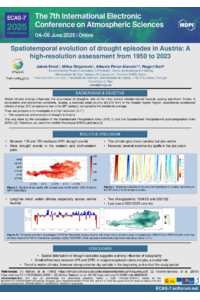
Drought is among the most severe climate-related hazards, posing significant threats to ecosystems and economies worldwide. Consequently, numerous countries have conducted locally focused studies to develop effective adaptation strategies. In this study, we examined the occurrence and evolution of drought in Austria, a relatively small country (83,878 km²) in Central Europe. Our analysis was based on long-term ERA5-Land monthly datasets spanning 1950–2023, incorporating precipitation, surface net radiation, surface pressure, 2 m air and dew point temperatures, and 10 m wind speed components. The precipitation and temperature data from this source exhibited strong agreement with observed datasets, supporting their reliability for this study. These datasets enabled the calculation of the Standardised Precipitation Index (SPI) and the Standardised Precipitation-Evapotranspiration Index (SPEI) at 1-, 3-, 6-, and 12-month timescales. Drought episodes were identified using a threshold of -0.84, with duration determined from the first month the index falls below zero, continuing until it reaches -0.84, and ending before the last month the index becomes positive. Severity was calculated as the sum of all SPI/SPEI values throughout each episode. Given that index variability decreases as the temporal scale increases, the highest number of drought episodes was identified using SPI1 (123) and SPEI1 (124), primarily affecting the western half of the country. The spatial distribution of drought episodes suggests a strong influence of topography. Furthermore, we found a statistically significant relationship between the severity of drought episodes and the affected area. However, differences between SPI and SPEI were consistently small across all temporal scales, indicating that evapotranspiration does not play a crucial role in the severity of drought episodes. These findings contribute to a historical understanding of drought in Austria and will be extended to future periods under different socioeconomic and climate scenarios.
Keywords
Drought
SPI
SPEI
Poster
Jakob_Ernst_ECAS2025_2.pdf
Health risk assessment of atmospheric air pollution: a case study of adolescents and adults in Kazan.
Coupling Between Urban Sublayers: High-Resolution LES Modeling of Microclimate and Energy Dynamics in Bolognina