Event submissions
Published
This submission belongs to the session S2. Air Quality and Human Health of the event The 7th International Electronic Conference on Atmospheric Sciences
Published date
30 May, 2025
Academic Editor
'%3e%3cpath%20d='M12.6657%2010.9104C12.4185%2010.325%2012.0599%209.79327%2011.6097%209.34482C11.1609%208.89508%2010.6293%208.5365%2010.0442%208.28888C10.0389%208.28626%2010.0337%208.28495%2010.0285%208.28233C10.8446%207.69279%2011.3752%206.73249%2011.3752%205.64904C11.3752%203.8542%209.92103%202.39999%208.1262%202.39999C6.33136%202.39999%204.87715%203.8542%204.87715%205.64904C4.87715%206.73249%205.40774%207.69279%206.22393%208.28364C6.21869%208.28626%206.21345%208.28757%206.20821%208.29019C5.62129%208.5378%205.09463%208.89284%204.64265%209.34613C4.1929%209.79493%203.83432%2010.3266%203.58671%2010.9117C3.34345%2011.4845%203.21226%2012.0987%203.20023%2012.7209C3.19988%2012.7349%203.20233%2012.7488%203.20744%2012.7619C3.21255%2012.7749%203.22022%2012.7867%203.22998%2012.7968C3.23975%2012.8068%203.25142%2012.8147%203.26431%2012.8202C3.2772%2012.8256%203.29105%2012.8284%203.30504%2012.8284H4.09109C4.14874%2012.8284%204.19459%2012.7825%204.1959%2012.7262C4.2221%2011.7148%204.62823%2010.7676%205.34617%2010.0497C6.08899%209.30683%207.0755%208.89808%208.1262%208.89808C9.17689%208.89808%2010.1634%209.30683%2010.9062%2010.0497C11.6242%2010.7676%2012.0303%2011.7148%2012.0565%2012.7262C12.0578%2012.7838%2012.1037%2012.8284%2012.1613%2012.8284H12.9474C12.9613%2012.8284%2012.9752%2012.8256%2012.9881%2012.8202C13.001%2012.8147%2013.0126%2012.8068%2013.0224%2012.7968C13.0322%2012.7867%2013.0398%2012.7749%2013.0449%2012.7619C13.0501%2012.7488%2013.0525%2012.7349%2013.0522%2012.7209C13.0391%2012.0947%2012.9094%2011.4855%2012.6657%2010.9104ZM8.1262%207.9024C7.52486%207.9024%206.9589%207.6679%206.53312%207.24211C6.10733%206.81633%205.87283%206.25037%205.87283%205.64904C5.87283%205.0477%206.10733%204.48174%206.53312%204.05596C6.9589%203.63018%207.52486%203.39567%208.1262%203.39567C8.72753%203.39567%209.29349%203.63018%209.71927%204.05596C10.1451%204.48174%2010.3796%205.0477%2010.3796%205.64904C10.3796%206.25037%2010.1451%206.81633%209.71927%207.24211C9.29349%207.6679%208.72753%207.9024%208.1262%207.9024Z'%20fill='%235D1EE1'/%3e%3c/g%3e%3c/svg%3e) Daniele Contini
Daniele ContiniCitation
Sanja Bijelović, Danijela Lukic, Milan Jovanović, Nataša Dragić, Ljilja Torovic, Health risks associated with inhalation exposure to toxic metal(loid)s in the City of Novi Sad, in Proceedings of The 7th International Electronic Conference on Atmospheric Sciences, 4 June–6 June 2025, MDPI: Basel, Switzerland
Share
Email
Facebook
Twitter
LinkedIn
Health risks associated with inhalation exposure to toxic metal(loid)s in the City of Novi Sad
'%3e%3cpath%20d='M12.6647%2010.9104C12.4176%2010.325%2012.0589%209.7933%2011.6088%209.34485C11.16%208.89511%2010.6283%208.53653%2010.0432%208.28891C10.038%208.28629%2010.0327%208.28498%2010.0275%208.28236C10.8437%207.69282%2011.3743%206.73252%2011.3743%205.64907C11.3743%203.85423%209.92005%202.40002%208.12522%202.40002C6.33038%202.40002%204.87618%203.85423%204.87618%205.64907C4.87618%206.73252%205.40677%207.69282%206.22296%208.28367C6.21772%208.28629%206.21248%208.2876%206.20724%208.29022C5.62031%208.53783%205.09365%208.89287%204.64167%209.34616C4.19192%209.79496%203.83334%2010.3266%203.58573%2010.9117C3.34247%2011.4846%203.21128%2012.0987%203.19925%2012.721C3.1989%2012.735%203.20135%2012.7489%203.20646%2012.7619C3.21157%2012.7749%203.21924%2012.7868%203.22901%2012.7968C3.23877%2012.8068%203.25045%2012.8148%203.26334%2012.8202C3.27623%2012.8256%203.29007%2012.8284%203.30406%2012.8284H4.09012C4.14776%2012.8284%204.19362%2012.7825%204.19493%2012.7262C4.22113%2011.7148%204.62726%2010.7676%205.34519%2010.0497C6.08802%209.30686%207.07452%208.89811%208.12522%208.89811C9.17592%208.89811%2010.1624%209.30686%2010.9052%2010.0497C11.6232%2010.7676%2012.0293%2011.7148%2012.0555%2012.7262C12.0568%2012.7839%2012.1027%2012.8284%2012.1603%2012.8284H12.9464C12.9604%2012.8284%2012.9742%2012.8256%2012.9871%2012.8202C13%2012.8148%2013.0117%2012.8068%2013.0214%2012.7968C13.0312%2012.7868%2013.0389%2012.7749%2013.044%2012.7619C13.0491%2012.7489%2013.0515%2012.735%2013.0512%2012.721C13.0381%2012.0947%2012.9084%2011.4856%2012.6647%2010.9104ZM8.12522%207.90243C7.52388%207.90243%206.95792%207.66793%206.53214%207.24215C6.10636%206.81636%205.87185%206.2504%205.87185%205.64907C5.87185%205.04773%206.10636%204.48177%206.53214%204.05599C6.95792%203.63021%207.52388%203.3957%208.12522%203.3957C8.72655%203.3957%209.29252%203.63021%209.7183%204.05599C10.1441%204.48177%2010.3786%205.04773%2010.3786%205.64907C10.3786%206.2504%2010.1441%206.81636%209.7183%207.24215C9.29252%207.66793%208.72655%207.90243%208.12522%207.90243Z'%20fill='%235D1EE1'/%3e%3c/g%3e%3c/svg%3e)
Sanja Bijelović 1,2
Danijela Lukic 2
Milan Jovanović 2
Nataša Dragić 1,2

Ljilja Torovic 3
1. Department of Hygiene, Faculty of Medicine, University of Novi Sad, 21000 Novi Sad, Serbia
2. Center for Hygiene and Human Ecology, Institute of Public Health of Vojvodina, 21000 Novi Sad, Serbia
3. Department of Pharmacy, Faculty of Medicine, University of Novi Sad, 21000 Novi Sad, Serbia
Abstract
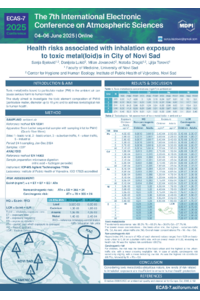
The toxic metal(loid)s bound to particulate matter (PM) in ambient air can cause serious harm to human health. The current study aimed to investigate the toxic element composition of PM10 (diameter up to 10 µm) and to address the risks to human health.
Sampling of PM10 was performed at five sites (basic-rural/urban, urban-/suburban-traffic, industrial) in the City of Novi Sad during 2024. A total of 1357 samples was subjected to microwave digestion followed by the ICP-MS determination of lead (Pb), cadmium (Cd), arsenic (As), and nickel (Ni) content.
The overall share of the samples with quantified amounts of elements was 85.3% Pb > 65.2% As > 36.6% Cd > 27.7% Ni. The lowest mean concentrations (ng/m3) were recorded at the basic-urban site (Pb 4.5, Cd 0.15, As 0.80, Ni 3,0), while the highest were related to the suburban-traffic (Pb 5.9, Cd 0.24, As 0.83) and urban-traffic site (Ni 4.2); the order of the concentrations averaged over all monitored sites (ng/m3) was as follows: Pb 5.1 > Ni 3.4 > As 0.80 > Cd 0.20. The Hazard index (HI), an indicator of non-carcinogenic risk, ranged from 0.29 in the basic-rural/-urban to 0.38 in the suburban-traffic site, with a mean of0.32 (averaging over all the sites), revealing no health risk. Ni was the element with by far the highest contribution to non-carcinogenic risk (68.3%). Carcinogenic risk for children ranged from 6.8E-07 (basic-urban) to 7.6E-07 (urban-traffic), with a mean of7.2E-07, showing negligible risk. In the case of adults, carcinogenic risk varied only slightly, with a mean of2.9E-06, indicating low risk. As was the element with by far the highest contribution to carcinogenic risk (68.7%), followed by Ni (16.1%), Pb (8.0%), and Cd (7.2%).
Considering that toxic metal(loid)s are ubiquitous contaminants, low levels of risk indicators related to the inhalation exposure are not enough to ensure protection of human health.
Keywords
ambient air
arsenic
lead
PM10
public health
risk assessment
Poster
TOXIC ELEMENTS.pdf
Insights into lightning activity in Cuba using GOES-16 GLM observations
Health risks associated with inhalation exposure to benzo(a)pyrene in the City of Novi Sad