Event submissions
Published
This submission belongs to the session S2. Air Quality and Human Health of the event The 7th International Electronic Conference on Atmospheric Sciences
Published date
30 May, 2025
Academic Editor
'%3e%3cpath%20d='M12.6657%2010.9104C12.4185%2010.325%2012.0599%209.79327%2011.6097%209.34482C11.1609%208.89508%2010.6293%208.5365%2010.0442%208.28888C10.0389%208.28626%2010.0337%208.28495%2010.0285%208.28233C10.8446%207.69279%2011.3752%206.73249%2011.3752%205.64904C11.3752%203.8542%209.92103%202.39999%208.1262%202.39999C6.33136%202.39999%204.87715%203.8542%204.87715%205.64904C4.87715%206.73249%205.40774%207.69279%206.22393%208.28364C6.21869%208.28626%206.21345%208.28757%206.20821%208.29019C5.62129%208.5378%205.09463%208.89284%204.64265%209.34613C4.1929%209.79493%203.83432%2010.3266%203.58671%2010.9117C3.34345%2011.4845%203.21226%2012.0987%203.20023%2012.7209C3.19988%2012.7349%203.20233%2012.7488%203.20744%2012.7619C3.21255%2012.7749%203.22022%2012.7867%203.22998%2012.7968C3.23975%2012.8068%203.25142%2012.8147%203.26431%2012.8202C3.2772%2012.8256%203.29105%2012.8284%203.30504%2012.8284H4.09109C4.14874%2012.8284%204.19459%2012.7825%204.1959%2012.7262C4.2221%2011.7148%204.62823%2010.7676%205.34617%2010.0497C6.08899%209.30683%207.0755%208.89808%208.1262%208.89808C9.17689%208.89808%2010.1634%209.30683%2010.9062%2010.0497C11.6242%2010.7676%2012.0303%2011.7148%2012.0565%2012.7262C12.0578%2012.7838%2012.1037%2012.8284%2012.1613%2012.8284H12.9474C12.9613%2012.8284%2012.9752%2012.8256%2012.9881%2012.8202C13.001%2012.8147%2013.0126%2012.8068%2013.0224%2012.7968C13.0322%2012.7867%2013.0398%2012.7749%2013.0449%2012.7619C13.0501%2012.7488%2013.0525%2012.7349%2013.0522%2012.7209C13.0391%2012.0947%2012.9094%2011.4855%2012.6657%2010.9104ZM8.1262%207.9024C7.52486%207.9024%206.9589%207.6679%206.53312%207.24211C6.10733%206.81633%205.87283%206.25037%205.87283%205.64904C5.87283%205.0477%206.10733%204.48174%206.53312%204.05596C6.9589%203.63018%207.52486%203.39567%208.1262%203.39567C8.72753%203.39567%209.29349%203.63018%209.71927%204.05596C10.1451%204.48174%2010.3796%205.0477%2010.3796%205.64904C10.3796%206.25037%2010.1451%206.81633%209.71927%207.24211C9.29349%207.6679%208.72753%207.9024%208.1262%207.9024Z'%20fill='%235D1EE1'/%3e%3c/g%3e%3c/svg%3e) Muhammad Ibrahim
Muhammad IbrahimCitation
Ljilja Torovic, Stanka Bobić, Slobodan Radišić, Nataša Dragić, Sanja Bijelović, Health risks associated with inhalation exposure to benzo(a)pyrene in the City of Novi Sad, in Proceedings of The 7th International Electronic Conference on Atmospheric Sciences, 4 June–6 June 2025, MDPI: Basel, Switzerland
Share
Email
Facebook
Twitter
LinkedIn
Health risks associated with inhalation exposure to benzo(a)pyrene in the City of Novi Sad

Ljilja Torovic 1
'%3e%3cpath%20d='M12.6647%2010.9104C12.4176%2010.325%2012.0589%209.7933%2011.6088%209.34485C11.16%208.89511%2010.6283%208.53653%2010.0432%208.28891C10.038%208.28629%2010.0327%208.28498%2010.0275%208.28236C10.8437%207.69282%2011.3743%206.73252%2011.3743%205.64907C11.3743%203.85423%209.92005%202.40002%208.12522%202.40002C6.33038%202.40002%204.87618%203.85423%204.87618%205.64907C4.87618%206.73252%205.40677%207.69282%206.22296%208.28367C6.21772%208.28629%206.21248%208.2876%206.20724%208.29022C5.62031%208.53783%205.09365%208.89287%204.64167%209.34616C4.19192%209.79496%203.83334%2010.3266%203.58573%2010.9117C3.34247%2011.4846%203.21128%2012.0987%203.19925%2012.721C3.1989%2012.735%203.20135%2012.7489%203.20646%2012.7619C3.21157%2012.7749%203.21924%2012.7868%203.22901%2012.7968C3.23877%2012.8068%203.25045%2012.8148%203.26334%2012.8202C3.27623%2012.8256%203.29007%2012.8284%203.30406%2012.8284H4.09012C4.14776%2012.8284%204.19362%2012.7825%204.19493%2012.7262C4.22113%2011.7148%204.62726%2010.7676%205.34519%2010.0497C6.08802%209.30686%207.07452%208.89811%208.12522%208.89811C9.17592%208.89811%2010.1624%209.30686%2010.9052%2010.0497C11.6232%2010.7676%2012.0293%2011.7148%2012.0555%2012.7262C12.0568%2012.7839%2012.1027%2012.8284%2012.1603%2012.8284H12.9464C12.9604%2012.8284%2012.9742%2012.8256%2012.9871%2012.8202C13%2012.8148%2013.0117%2012.8068%2013.0214%2012.7968C13.0312%2012.7868%2013.0389%2012.7749%2013.044%2012.7619C13.0491%2012.7489%2013.0515%2012.735%2013.0512%2012.721C13.0381%2012.0947%2012.9084%2011.4856%2012.6647%2010.9104ZM8.12522%207.90243C7.52388%207.90243%206.95792%207.66793%206.53214%207.24215C6.10636%206.81636%205.87185%206.2504%205.87185%205.64907C5.87185%205.04773%206.10636%204.48177%206.53214%204.05599C6.95792%203.63021%207.52388%203.3957%208.12522%203.3957C8.72655%203.3957%209.29252%203.63021%209.7183%204.05599C10.1441%204.48177%2010.3786%205.04773%2010.3786%205.64907C10.3786%206.2504%2010.1441%206.81636%209.7183%207.24215C9.29252%207.66793%208.72655%207.90243%208.12522%207.90243Z'%20fill='%235D1EE1'/%3e%3c/g%3e%3c/svg%3e)
Stanka Bobić 2
Slobodan Radišić 2
Nataša Dragić 2,3
Sanja Bijelović 2,3
1. Department of Pharmacy, Faculty of Medicine, University of Novi Sad, 21000 Novi Sad, Serbia
2. Center for Hygiene and Human Ecology, Institute of Public Health of Vojvodina, 21000 Novi Sad, Serbia
3. Department of Hygiene, Faculty of Medicine, University of Novi Sad, 21000 Novi Sad, Serbia
Abstract
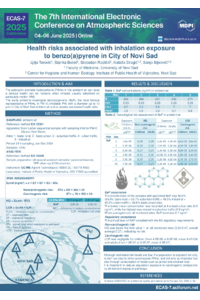
Polycyclic aromatic hydrocarbons (PAHs) in the ambient air can pose serious health risks for humans when inhaled and are usually adsorbed on particulate matter (PM). The current study aimed to investigate the content of benzo(a)pyrene (BaP), the most famous representative of PAHs, in PM10 (inhalable PM, with diameter up to 10 µm) in ambient air in the City of Novi Sad and to assess the associated health risks.
PM10 sampling performed at five monitoring sites (basic-rural/urban, urban/suburban-traffic, industrial) in the City of Novi Sad during 2024 resulted in1340 samples, which were analyzed using the GC-MS method.
The overall share of the samples with quantified amounts of BaP was 46.6 (53.8% basic-rural > 53.7% suburban-traffic > 49.3% industrial > 45.2% urban-traffic > 34.6% basic-urban site). The lowest mean concentration was recorded at the basic-urban site (0.5 ng/m3), while the highest was related to suburban-traffic (0.9 ng/m3); when averaged over all monitored sites, the BaP level was 0.7 ng/m3. The annual level of BAP was in compliance with regulatory requirements. The health risks were estimated using the hazard quotient (HQ) and lifetime cancer risk (LCR) approaches. The HQ was below the limit value of 1 in all monitored sites (0.24-0.47, overall average 0.37), indicating no risk. LCR was negligible for both children (from 4.5E-08 to 8.0E-08, mean 6.4E-08) and adults (from 1.8E-07 to 3.2E-07, mean 2.5E-07).
Although the estimated values of the risk indicators are low, the population is still exposed not only to BaP but also to other polycyclic aromatic hydrocarbons, with some of them also being carcinogens. As exposure occursnot only via inhalation but also through the consumption of foods such as grilled and smoked food, it is of utmost importance to reduce the population's exposure to carcinogenic compounds via all relevant exposure pathways.
Keywords
ambient air
PM10
polycyclic aromatic hydrocarbons
public health
risk assessment
Poster
BaP.pdf
Health risks associated with inhalation exposure to toxic metal(loid)s in the City of Novi Sad
Health risk associated with inhalation exposure to aromatic hydrocarbons (BTEX) in the City of Novi Sad