Event submissions
Published
This submission belongs to the session S2. Air Quality and Human Health of the event The 7th International Electronic Conference on Atmospheric Sciences
Published date
30 May, 2025
Academic Editor
'%3e%3cpath%20d='M12.6657%2010.9104C12.4185%2010.325%2012.0599%209.79327%2011.6097%209.34482C11.1609%208.89508%2010.6293%208.5365%2010.0442%208.28888C10.0389%208.28626%2010.0337%208.28495%2010.0285%208.28233C10.8446%207.69279%2011.3752%206.73249%2011.3752%205.64904C11.3752%203.8542%209.92103%202.39999%208.1262%202.39999C6.33136%202.39999%204.87715%203.8542%204.87715%205.64904C4.87715%206.73249%205.40774%207.69279%206.22393%208.28364C6.21869%208.28626%206.21345%208.28757%206.20821%208.29019C5.62129%208.5378%205.09463%208.89284%204.64265%209.34613C4.1929%209.79493%203.83432%2010.3266%203.58671%2010.9117C3.34345%2011.4845%203.21226%2012.0987%203.20023%2012.7209C3.19988%2012.7349%203.20233%2012.7488%203.20744%2012.7619C3.21255%2012.7749%203.22022%2012.7867%203.22998%2012.7968C3.23975%2012.8068%203.25142%2012.8147%203.26431%2012.8202C3.2772%2012.8256%203.29105%2012.8284%203.30504%2012.8284H4.09109C4.14874%2012.8284%204.19459%2012.7825%204.1959%2012.7262C4.2221%2011.7148%204.62823%2010.7676%205.34617%2010.0497C6.08899%209.30683%207.0755%208.89808%208.1262%208.89808C9.17689%208.89808%2010.1634%209.30683%2010.9062%2010.0497C11.6242%2010.7676%2012.0303%2011.7148%2012.0565%2012.7262C12.0578%2012.7838%2012.1037%2012.8284%2012.1613%2012.8284H12.9474C12.9613%2012.8284%2012.9752%2012.8256%2012.9881%2012.8202C13.001%2012.8147%2013.0126%2012.8068%2013.0224%2012.7968C13.0322%2012.7867%2013.0398%2012.7749%2013.0449%2012.7619C13.0501%2012.7488%2013.0525%2012.7349%2013.0522%2012.7209C13.0391%2012.0947%2012.9094%2011.4855%2012.6657%2010.9104ZM8.1262%207.9024C7.52486%207.9024%206.9589%207.6679%206.53312%207.24211C6.10733%206.81633%205.87283%206.25037%205.87283%205.64904C5.87283%205.0477%206.10733%204.48174%206.53312%204.05596C6.9589%203.63018%207.52486%203.39567%208.1262%203.39567C8.72753%203.39567%209.29349%203.63018%209.71927%204.05596C10.1451%204.48174%2010.3796%205.0477%2010.3796%205.64904C10.3796%206.25037%2010.1451%206.81633%209.71927%207.24211C9.29349%207.6679%208.72753%207.9024%208.1262%207.9024Z'%20fill='%235D1EE1'/%3e%3c/g%3e%3c/svg%3e) Daniele Contini
Daniele ContiniCitation
Ljilja Torovic, Stanka Bobić, Slobodan Radišić, Nataša Dragić, Sanja Bijelović, Health risk associated with inhalation exposure to aromatic hydrocarbons (BTEX) in the City of Novi Sad, in Proceedings of The 7th International Electronic Conference on Atmospheric Sciences, 4 June–6 June 2025, MDPI: Basel, Switzerland
Share
Email
Facebook
Twitter
LinkedIn
Health risk associated with inhalation exposure to aromatic hydrocarbons (BTEX) in the City of Novi Sad

Ljilja Torovic 1
'%3e%3cpath%20d='M12.6647%2010.9104C12.4176%2010.325%2012.0589%209.7933%2011.6088%209.34485C11.16%208.89511%2010.6283%208.53653%2010.0432%208.28891C10.038%208.28629%2010.0327%208.28498%2010.0275%208.28236C10.8437%207.69282%2011.3743%206.73252%2011.3743%205.64907C11.3743%203.85423%209.92005%202.40002%208.12522%202.40002C6.33038%202.40002%204.87618%203.85423%204.87618%205.64907C4.87618%206.73252%205.40677%207.69282%206.22296%208.28367C6.21772%208.28629%206.21248%208.2876%206.20724%208.29022C5.62031%208.53783%205.09365%208.89287%204.64167%209.34616C4.19192%209.79496%203.83334%2010.3266%203.58573%2010.9117C3.34247%2011.4846%203.21128%2012.0987%203.19925%2012.721C3.1989%2012.735%203.20135%2012.7489%203.20646%2012.7619C3.21157%2012.7749%203.21924%2012.7868%203.22901%2012.7968C3.23877%2012.8068%203.25045%2012.8148%203.26334%2012.8202C3.27623%2012.8256%203.29007%2012.8284%203.30406%2012.8284H4.09012C4.14776%2012.8284%204.19362%2012.7825%204.19493%2012.7262C4.22113%2011.7148%204.62726%2010.7676%205.34519%2010.0497C6.08802%209.30686%207.07452%208.89811%208.12522%208.89811C9.17592%208.89811%2010.1624%209.30686%2010.9052%2010.0497C11.6232%2010.7676%2012.0293%2011.7148%2012.0555%2012.7262C12.0568%2012.7839%2012.1027%2012.8284%2012.1603%2012.8284H12.9464C12.9604%2012.8284%2012.9742%2012.8256%2012.9871%2012.8202C13%2012.8148%2013.0117%2012.8068%2013.0214%2012.7968C13.0312%2012.7868%2013.0389%2012.7749%2013.044%2012.7619C13.0491%2012.7489%2013.0515%2012.735%2013.0512%2012.721C13.0381%2012.0947%2012.9084%2011.4856%2012.6647%2010.9104ZM8.12522%207.90243C7.52388%207.90243%206.95792%207.66793%206.53214%207.24215C6.10636%206.81636%205.87185%206.2504%205.87185%205.64907C5.87185%205.04773%206.10636%204.48177%206.53214%204.05599C6.95792%203.63021%207.52388%203.3957%208.12522%203.3957C8.72655%203.3957%209.29252%203.63021%209.7183%204.05599C10.1441%204.48177%2010.3786%205.04773%2010.3786%205.64907C10.3786%206.2504%2010.1441%206.81636%209.7183%207.24215C9.29252%207.66793%208.72655%207.90243%208.12522%207.90243Z'%20fill='%235D1EE1'/%3e%3c/g%3e%3c/svg%3e)
Stanka Bobić 2
Slobodan Radišić 2
Nataša Dragić 2,3
Sanja Bijelović 2,3
1. Department of Pharmacy, Faculty of Medicine, University of Novi Sad, 21000 Novi Sad, Serbia
2. Center for Hygiene and Human Ecology, Institute of Public Health of Vojvodina, 21000 Novi Sad, Serbia
3. Department of Hygiene, Faculty of Medicine, University of Novi Sad, 21000 Novi Sad, Serbia
Abstract
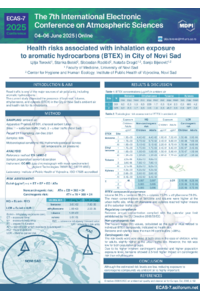
Road traffic is one of the major sources of air pollutants, including aromatic hydrocarbons. The current study assessed the presence of benzene, toluene, ethylbenzene and xylenes (BTEX) in the City of Novi Sad's ambient air and the health risk for its inhabitants.
A total of 686 24h air samples were collected at two sites in the City of Novi Sad during 2024 and analyzed using a GC-MS method.
As expected on traffic sites, BTEX compounds were quantified in the majority of the samples: toluene 94.3% > benzene 88.3% > xylenes 75.6% > ethylbenzene 59.0%. The mean concentrations (µg/m3) of benzene and toluene were higher at urban traffic sites (1.7 vs. 1.3; 3.9 vs. 2.3), while ethylbenzene and xylenes reached higher means at suburban traffic sites (1.0 vs. 1.7; 2.6 vs. 4.2). Benzene's annual concentration was in compliance with the calendar year limit established by Directive 2008/50/EC. The hazard index (HI), calculated as a sum of hazard quotients related to reference inhalation concentrations of individual compounds, was used as a measure of non-carcinogenic risk. The HI values on suburban (0.087) and urban traffic sites (0.085) indicated no health risk. Benzene and xylenes were the main HI contributors (>98%). The carcinogenic risk was based on benzene and ethylbenzene inhalation risk units. In the case of children, it was very similar on suburban and urban traffic sites (2.1E-06 and 2.3E-06), while in the case of adults, it was slightly higher on urban traffic sites (9.1E-06 vs. 8.2E-06). However, the health risk was low regardless of the population group. As expected, due to its higher inherent carcinogenic potential as well as its higher population exposure level, benzene showed a 2.5-fold higher impact on carcinogenic risk than ethyl benzene.
Although the estimated values of the risk indicators are low, it is of utmost importance to reduce exposure to carcinogenic compounds in ambient air.
Keywords
ambient air
benzene
carcinogens
public health
risk assessment
Poster
BTEX.pdf
Health risks associated with inhalation exposure to benzo(a)pyrene in the City of Novi Sad
Modeling the Role of Urban Green Spaces in Cooling Urban Environments: The Case of Villa Ada, Rome