Event submissions
Published
This submission belongs to the session S5. Atmospheric Techniques, Instruments and Modeling of the event The 7th International Electronic Conference on Atmospheric Sciences
Published date
30 May, 2025
Academic Editor
'%3e%3cpath%20d='M12.6657%2010.9104C12.4185%2010.325%2012.0599%209.79327%2011.6097%209.34482C11.1609%208.89508%2010.6293%208.5365%2010.0442%208.28888C10.0389%208.28626%2010.0337%208.28495%2010.0285%208.28233C10.8446%207.69279%2011.3752%206.73249%2011.3752%205.64904C11.3752%203.8542%209.92103%202.39999%208.1262%202.39999C6.33136%202.39999%204.87715%203.8542%204.87715%205.64904C4.87715%206.73249%205.40774%207.69279%206.22393%208.28364C6.21869%208.28626%206.21345%208.28757%206.20821%208.29019C5.62129%208.5378%205.09463%208.89284%204.64265%209.34613C4.1929%209.79493%203.83432%2010.3266%203.58671%2010.9117C3.34345%2011.4845%203.21226%2012.0987%203.20023%2012.7209C3.19988%2012.7349%203.20233%2012.7488%203.20744%2012.7619C3.21255%2012.7749%203.22022%2012.7867%203.22998%2012.7968C3.23975%2012.8068%203.25142%2012.8147%203.26431%2012.8202C3.2772%2012.8256%203.29105%2012.8284%203.30504%2012.8284H4.09109C4.14874%2012.8284%204.19459%2012.7825%204.1959%2012.7262C4.2221%2011.7148%204.62823%2010.7676%205.34617%2010.0497C6.08899%209.30683%207.0755%208.89808%208.1262%208.89808C9.17689%208.89808%2010.1634%209.30683%2010.9062%2010.0497C11.6242%2010.7676%2012.0303%2011.7148%2012.0565%2012.7262C12.0578%2012.7838%2012.1037%2012.8284%2012.1613%2012.8284H12.9474C12.9613%2012.8284%2012.9752%2012.8256%2012.9881%2012.8202C13.001%2012.8147%2013.0126%2012.8068%2013.0224%2012.7968C13.0322%2012.7867%2013.0398%2012.7749%2013.0449%2012.7619C13.0501%2012.7488%2013.0525%2012.7349%2013.0522%2012.7209C13.0391%2012.0947%2012.9094%2011.4855%2012.6657%2010.9104ZM8.1262%207.9024C7.52486%207.9024%206.9589%207.6679%206.53312%207.24211C6.10733%206.81633%205.87283%206.25037%205.87283%205.64904C5.87283%205.0477%206.10733%204.48174%206.53312%204.05596C6.9589%203.63018%207.52486%203.39567%208.1262%203.39567C8.72753%203.39567%209.29349%203.63018%209.71927%204.05596C10.1451%204.48174%2010.3796%205.0477%2010.3796%205.64904C10.3796%206.25037%2010.1451%206.81633%209.71927%207.24211C9.29349%207.6679%208.72753%207.9024%208.1262%207.9024Z'%20fill='%235D1EE1'/%3e%3c/g%3e%3c/svg%3e) Riccardo Buccolieri
Riccardo BuccolieriCitation
Daiane de Vargas Brondani, Tony Christian Landi, Oxana Drofa, Vito Imbrenda, Alessandra Gaeta, Rosa Coluzzi, Stefano Decesari, Daniela Cava, Umberto Giostra, Luca Mortarini, Modeling the Role of Urban Green Spaces in Cooling Urban Environments: The Case of Villa Ada, Rome, in Proceedings of The 7th International Electronic Conference on Atmospheric Sciences, 4 June–6 June 2025, MDPI: Basel, Switzerland
Share
Email
Facebook
Twitter
LinkedIn
Modeling the Role of Urban Green Spaces in Cooling Urban Environments: The Case of Villa Ada, Rome
'%3e%3cpath%20d='M12.6647%2010.9104C12.4176%2010.325%2012.0589%209.7933%2011.6088%209.34485C11.16%208.89511%2010.6283%208.53653%2010.0432%208.28891C10.038%208.28629%2010.0327%208.28498%2010.0275%208.28236C10.8437%207.69282%2011.3743%206.73252%2011.3743%205.64907C11.3743%203.85423%209.92005%202.40002%208.12522%202.40002C6.33038%202.40002%204.87618%203.85423%204.87618%205.64907C4.87618%206.73252%205.40677%207.69282%206.22296%208.28367C6.21772%208.28629%206.21248%208.2876%206.20724%208.29022C5.62031%208.53783%205.09365%208.89287%204.64167%209.34616C4.19192%209.79496%203.83334%2010.3266%203.58573%2010.9117C3.34247%2011.4846%203.21128%2012.0987%203.19925%2012.721C3.1989%2012.735%203.20135%2012.7489%203.20646%2012.7619C3.21157%2012.7749%203.21924%2012.7868%203.22901%2012.7968C3.23877%2012.8068%203.25045%2012.8148%203.26334%2012.8202C3.27623%2012.8256%203.29007%2012.8284%203.30406%2012.8284H4.09012C4.14776%2012.8284%204.19362%2012.7825%204.19493%2012.7262C4.22113%2011.7148%204.62726%2010.7676%205.34519%2010.0497C6.08802%209.30686%207.07452%208.89811%208.12522%208.89811C9.17592%208.89811%2010.1624%209.30686%2010.9052%2010.0497C11.6232%2010.7676%2012.0293%2011.7148%2012.0555%2012.7262C12.0568%2012.7839%2012.1027%2012.8284%2012.1603%2012.8284H12.9464C12.9604%2012.8284%2012.9742%2012.8256%2012.9871%2012.8202C13%2012.8148%2013.0117%2012.8068%2013.0214%2012.7968C13.0312%2012.7868%2013.0389%2012.7749%2013.044%2012.7619C13.0491%2012.7489%2013.0515%2012.735%2013.0512%2012.721C13.0381%2012.0947%2012.9084%2011.4856%2012.6647%2010.9104ZM8.12522%207.90243C7.52388%207.90243%206.95792%207.66793%206.53214%207.24215C6.10636%206.81636%205.87185%206.2504%205.87185%205.64907C5.87185%205.04773%206.10636%204.48177%206.53214%204.05599C6.95792%203.63021%207.52388%203.3957%208.12522%203.3957C8.72655%203.3957%209.29252%203.63021%209.7183%204.05599C10.1441%204.48177%2010.3786%205.04773%2010.3786%205.64907C10.3786%206.2504%2010.1441%206.81636%209.7183%207.24215C9.29252%207.66793%208.72655%207.90243%208.12522%207.90243Z'%20fill='%235D1EE1'/%3e%3c/g%3e%3c/svg%3e)
Daiane de Vargas Brondani 1
Tony Christian Landi 2
Oxana Drofa 2
Vito Imbrenda 3
Alessandra Gaeta 4

Rosa Coluzzi 3
Stefano Decesari 2
Daniela Cava 1
Umberto Giostra 5

Luca Mortarini 6
1. Institute of Atmospheric Sciences and Climate, National Research Council, Lecce, 73100, Italy
2. Institute of Atmospheric Sciences and Climate, National Research Council, Bologna, 40129, Italy
3. Institute of Methodologies for Environmental Analysis, National Research Council, Tito Scalo, 85050, Italy
4. Italian Institute for Environmental Protection and Research, Rome, 00144, Italy
5. Department of Pure and Applied Sciences University of Urbino, Urbino, 61029, Italy
6. Department of Earth Sciences "A. Desio" University of Milan, Milan, 20133, Italy
Abstract
Cities worldwide are facing the dual challenges of urban heat islands (UHIs) and the increasing frequency of heatwaves. Concrete and asphalt, combined with reduced vegetation, cause urban areas to retain more heat than their rural counterparts. This not only leads to discomfort but also poses significant health risks, including heat-related illnesses and increased mortality rates. Urban green spaces, such as parks, play a crucial role in mitigating UHI effects through shading and evapotranspiration, which help cool urban environments.
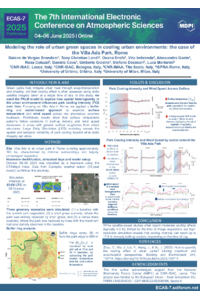
This study focuses on Villa Ada, a 160-hectare park in central Rome, characterized by relatively unmanaged vegetation. We aim to assess its effectiveness in reducing local UHI effects during a heatwave from October 8 to 10, 2023. Using the Parallelized Large-Eddy Simulation Model (PALM), we simulate three urban greenery scenarios: (1) replacement of the park with asphalt, (2) replacement of the park with short grass, and (3) replacement of short grass areas with trees featuring high leaf area density, representing the most adaptive scenario.
The preliminary results suggest that Villa Ada exerts a cooling effect on its immediate surroundings, with increased tree coverage leading to more substantial temperature reductions. These findings underscore the critical role of urban green spaces in mitigating UHI effects and highlight the importance of strategic urban planning that preserves and enhances such areas. Future research should explore the long-term impacts of different vegetation management strategies and their implications for urban climate resilience.
Keywords
Urban Green Spaces
Heatwaves
Temperature Reduction
PALM
Poster
de_vargas_brondani_daiane_ECAS_7.pdf
Health risk associated with inhalation exposure to aromatic hydrocarbons (BTEX) in the City of Novi Sad
Effect of The Form of The Error Correlation Functions on The Uncertainty in The Estimation of Atmospheric Aerosol Distribution When Using Spatial–Temporal Optimal Interpolation