Event submissions
Published
This submission belongs to the session S2. AI in Economics and Finance of the event The 1st International Online Conference on Risk and Financial Management
Published date
12 Jun, 2025
Academic Editor
'%3e%3cpath%20d='M12.6657%2010.9104C12.4185%2010.325%2012.0599%209.79327%2011.6097%209.34482C11.1609%208.89508%2010.6293%208.5365%2010.0442%208.28888C10.0389%208.28626%2010.0337%208.28495%2010.0285%208.28233C10.8446%207.69279%2011.3752%206.73249%2011.3752%205.64904C11.3752%203.8542%209.92103%202.39999%208.1262%202.39999C6.33136%202.39999%204.87715%203.8542%204.87715%205.64904C4.87715%206.73249%205.40774%207.69279%206.22393%208.28364C6.21869%208.28626%206.21345%208.28757%206.20821%208.29019C5.62129%208.5378%205.09463%208.89284%204.64265%209.34613C4.1929%209.79493%203.83432%2010.3266%203.58671%2010.9117C3.34345%2011.4845%203.21226%2012.0987%203.20023%2012.7209C3.19988%2012.7349%203.20233%2012.7488%203.20744%2012.7619C3.21255%2012.7749%203.22022%2012.7867%203.22998%2012.7968C3.23975%2012.8068%203.25142%2012.8147%203.26431%2012.8202C3.2772%2012.8256%203.29105%2012.8284%203.30504%2012.8284H4.09109C4.14874%2012.8284%204.19459%2012.7825%204.1959%2012.7262C4.2221%2011.7148%204.62823%2010.7676%205.34617%2010.0497C6.08899%209.30683%207.0755%208.89808%208.1262%208.89808C9.17689%208.89808%2010.1634%209.30683%2010.9062%2010.0497C11.6242%2010.7676%2012.0303%2011.7148%2012.0565%2012.7262C12.0578%2012.7838%2012.1037%2012.8284%2012.1613%2012.8284H12.9474C12.9613%2012.8284%2012.9752%2012.8256%2012.9881%2012.8202C13.001%2012.8147%2013.0126%2012.8068%2013.0224%2012.7968C13.0322%2012.7867%2013.0398%2012.7749%2013.0449%2012.7619C13.0501%2012.7488%2013.0525%2012.7349%2013.0522%2012.7209C13.0391%2012.0947%2012.9094%2011.4855%2012.6657%2010.9104ZM8.1262%207.9024C7.52486%207.9024%206.9589%207.6679%206.53312%207.24211C6.10733%206.81633%205.87283%206.25037%205.87283%205.64904C5.87283%205.0477%206.10733%204.48174%206.53312%204.05596C6.9589%203.63018%207.52486%203.39567%208.1262%203.39567C8.72753%203.39567%209.29349%203.63018%209.71927%204.05596C10.1451%204.48174%2010.3796%205.0477%2010.3796%205.64904C10.3796%206.25037%2010.1451%206.81633%209.71927%207.24211C9.29349%207.6679%208.72753%207.9024%208.1262%207.9024Z'%20fill='%235D1EE1'/%3e%3c/g%3e%3c/svg%3e) Svetlozar Rachev
Svetlozar RachevCitation
Mounira RADDAOUI, Innovative debt financing to bridge Saudi Arabia's climate and economic gaps, in Proceedings of The 1st International Online Conference on Risk and Financial Management, 17 June–18 June 2025, MDPI: Basel, Switzerland
Share
Email
Facebook
Twitter
LinkedIn
Innovative debt financing to bridge Saudi Arabia's climate and economic gaps
'%3e%3cpath%20d='M12.6647%2010.9104C12.4176%2010.325%2012.0589%209.7933%2011.6088%209.34485C11.16%208.89511%2010.6283%208.53653%2010.0432%208.28891C10.038%208.28629%2010.0327%208.28498%2010.0275%208.28236C10.8437%207.69282%2011.3743%206.73252%2011.3743%205.64907C11.3743%203.85423%209.92005%202.40002%208.12522%202.40002C6.33038%202.40002%204.87618%203.85423%204.87618%205.64907C4.87618%206.73252%205.40677%207.69282%206.22296%208.28367C6.21772%208.28629%206.21248%208.2876%206.20724%208.29022C5.62031%208.53783%205.09365%208.89287%204.64167%209.34616C4.19192%209.79496%203.83334%2010.3266%203.58573%2010.9117C3.34247%2011.4846%203.21128%2012.0987%203.19925%2012.721C3.1989%2012.735%203.20135%2012.7489%203.20646%2012.7619C3.21157%2012.7749%203.21924%2012.7868%203.22901%2012.7968C3.23877%2012.8068%203.25045%2012.8148%203.26334%2012.8202C3.27623%2012.8256%203.29007%2012.8284%203.30406%2012.8284H4.09012C4.14776%2012.8284%204.19362%2012.7825%204.19493%2012.7262C4.22113%2011.7148%204.62726%2010.7676%205.34519%2010.0497C6.08802%209.30686%207.07452%208.89811%208.12522%208.89811C9.17592%208.89811%2010.1624%209.30686%2010.9052%2010.0497C11.6232%2010.7676%2012.0293%2011.7148%2012.0555%2012.7262C12.0568%2012.7839%2012.1027%2012.8284%2012.1603%2012.8284H12.9464C12.9604%2012.8284%2012.9742%2012.8256%2012.9871%2012.8202C13%2012.8148%2013.0117%2012.8068%2013.0214%2012.7968C13.0312%2012.7868%2013.0389%2012.7749%2013.044%2012.7619C13.0491%2012.7489%2013.0515%2012.735%2013.0512%2012.721C13.0381%2012.0947%2012.9084%2011.4856%2012.6647%2010.9104ZM8.12522%207.90243C7.52388%207.90243%206.95792%207.66793%206.53214%207.24215C6.10636%206.81636%205.87185%206.2504%205.87185%205.64907C5.87185%205.04773%206.10636%204.48177%206.53214%204.05599C6.95792%203.63021%207.52388%203.3957%208.12522%203.3957C8.72655%203.3957%209.29252%203.63021%209.7183%204.05599C10.1441%204.48177%2010.3786%205.04773%2010.3786%205.64907C10.3786%206.2504%2010.1441%206.81636%209.7183%207.24215C9.29252%207.66793%208.72655%207.90243%208.12522%207.90243Z'%20fill='%235D1EE1'/%3e%3c/g%3e%3c/svg%3e)
Mounira RADDAOUI 1
1. Department of Financial and Administrative Sciences, Taibah University, Saudi Arabia
Abstract
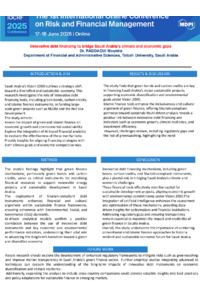
This study explores the role of innovative debt financing mechanisms in Saudi Arabia’s transition towards a sustainable and diversified economy. Specifically, it examines how green bonds and carbon credits are utilized to fund large-scale development projects, such as Neom and the Red Sea development, which focus on renewable energy and environmental sustainability. This research aims to assess the extent to which these financial instruments contribute to the achievement of both economic growth and compliance with the Kingdom’s climate commitments, as outlined in Vision 2030.
This research adopts a case study approach, analyzing the impact of green finance on sustainable development initiatives in Saudi Arabia. It further incorporates artificial intelligence tools to empirically assess the relationship between innovative financing and economic growth, providing a data-driven analysis of the effectiveness of these mechanisms in fostering long-term economic and environmental benefits. This study also considers the integration of Islamic finance instruments, such as Islamic bonds, within the framework of dynamic asset pricing models and financial econometrics. This theoretical alignment helps to highlight the potential of Islamic finance to support global sustainability goals, alongside conventional financing methods.
The findings of this research indicate that green finance mechanisms, including carbon credits and green bonds, are essential for financing renewable energy projects and driving economic diversification in Saudi Arabia. Additionally, the integration of Islamic finance tools strengthens the financial infrastructure and enhances the alignment of Saudi Arabia’s financing strategies with international sustainability initiatives.
In conclusion, this study demonstrates that innovative debt financing can effectively address Saudi Arabia’s environmental and economic challenges. This research underscores the importance of incorporating Islamic finance tools into financial frameworks, offering practical insights for policymakers and financial institutions on how to leverage innovative financing mechanisms to support sustainable development in this region.
Keywords
Innovative debt financing
Carbon credits
AI analytics
Green bonds
Sukuk
Sustainable finance
Climate resilience
Economic competitiveness
Saudi Arabia
Vision 2030
Green investment
Regulatory challenges
Greenwashing
Financial sustainability
Car
Poster
sciforum-116626.pdf
Artificial Intelligence and Machine Learning in Fraud Detection: A Comprehensive Bibliometric Mapping of Research Trends and Directions