Event submissions
Published
This submission belongs to the session S5. Future of Money: Central Bank Digital Currencies, Cryptocurrencies and Stablecoins of the event The 1st International Online Conference on Risk and Financial Management
Published date
12 Jun, 2025
Academic Editor
'%3e%3cpath%20d='M12.6657%2010.9104C12.4185%2010.325%2012.0599%209.79327%2011.6097%209.34482C11.1609%208.89508%2010.6293%208.5365%2010.0442%208.28888C10.0389%208.28626%2010.0337%208.28495%2010.0285%208.28233C10.8446%207.69279%2011.3752%206.73249%2011.3752%205.64904C11.3752%203.8542%209.92103%202.39999%208.1262%202.39999C6.33136%202.39999%204.87715%203.8542%204.87715%205.64904C4.87715%206.73249%205.40774%207.69279%206.22393%208.28364C6.21869%208.28626%206.21345%208.28757%206.20821%208.29019C5.62129%208.5378%205.09463%208.89284%204.64265%209.34613C4.1929%209.79493%203.83432%2010.3266%203.58671%2010.9117C3.34345%2011.4845%203.21226%2012.0987%203.20023%2012.7209C3.19988%2012.7349%203.20233%2012.7488%203.20744%2012.7619C3.21255%2012.7749%203.22022%2012.7867%203.22998%2012.7968C3.23975%2012.8068%203.25142%2012.8147%203.26431%2012.8202C3.2772%2012.8256%203.29105%2012.8284%203.30504%2012.8284H4.09109C4.14874%2012.8284%204.19459%2012.7825%204.1959%2012.7262C4.2221%2011.7148%204.62823%2010.7676%205.34617%2010.0497C6.08899%209.30683%207.0755%208.89808%208.1262%208.89808C9.17689%208.89808%2010.1634%209.30683%2010.9062%2010.0497C11.6242%2010.7676%2012.0303%2011.7148%2012.0565%2012.7262C12.0578%2012.7838%2012.1037%2012.8284%2012.1613%2012.8284H12.9474C12.9613%2012.8284%2012.9752%2012.8256%2012.9881%2012.8202C13.001%2012.8147%2013.0126%2012.8068%2013.0224%2012.7968C13.0322%2012.7867%2013.0398%2012.7749%2013.0449%2012.7619C13.0501%2012.7488%2013.0525%2012.7349%2013.0522%2012.7209C13.0391%2012.0947%2012.9094%2011.4855%2012.6657%2010.9104ZM8.1262%207.9024C7.52486%207.9024%206.9589%207.6679%206.53312%207.24211C6.10733%206.81633%205.87283%206.25037%205.87283%205.64904C5.87283%205.0477%206.10733%204.48174%206.53312%204.05596C6.9589%203.63018%207.52486%203.39567%208.1262%203.39567C8.72753%203.39567%209.29349%203.63018%209.71927%204.05596C10.1451%204.48174%2010.3796%205.0477%2010.3796%205.64904C10.3796%206.25037%2010.1451%206.81633%209.71927%207.24211C9.29349%207.6679%208.72753%207.9024%208.1262%207.9024Z'%20fill='%235D1EE1'/%3e%3c/g%3e%3c/svg%3e) Ramona Rupeika-Apoga
Ramona Rupeika-ApogaCitation
Leo S.F. Lin, Cryptocurrencies and AI-Enabled Organized Fraud: Emerging Risks and Countermeasures, in Proceedings of The 1st International Online Conference on Risk and Financial Management, 17 June–18 June 2025, MDPI: Basel, Switzerland
Share
Email
Facebook
Twitter
LinkedIn
Cryptocurrencies and AI-Enabled Organized Fraud: Emerging Risks and Countermeasures

Leo S.F. Lin 1
1. School of Policing Studies, Faculty of Business, Justice and Behavioural Sciences, Charles Sturt University, Goulburn, NSW 2580, Australia
Abstract
The emergence of cryptocurrencies and artificial intelligence (AI) has had a major effect on worldwide financial crime, allowing for increasingly complex fraud schemes. Criminal groups increasingly leverage these technologies, bundling them with sophisticated business models such as phishing-as-a-service and ransomware-as-a-service. The rapid growth of AI and cryptocurrencies has generated a sharp increase in organized financial crime targeting vulnerable people across borders, according to a recent INTERPOL assessment. Organized crime syndicates are using AI to create convincing deepfakes to dupe victims into false investment or romance scams and cryptocurrencies to transfer ill-gotten gains anonymously. One example is “romance baiting” fraud, in which trafficked people, often under duress to commit crimes, use AI-generated faces to dupe victims into financial scams. This hybrid romance and investment fraud scam has become widespread in Southeast Asia, Africa, and Latin America. Criminal networks repurpose government intelligence tools to target these narratives, making it difficult for authorities to detect and intervene. Finally, this paper examines the implications of new fraud techniques for law enforcement and the urgent need for greater international cooperation and regulatory frameworks. It underlines the promotion of data exchange, capacity-building, and public–private partnerships as crucial mechanisms for tackling AI-powered financial fraud. This paper further highlights the need for consumer awareness for reporting mechanisms to tackle the growing risks of cryptocurrency and AI-enabled scams.
Keywords
Cryptocurrency fraud
AI-enabled scams
romance baiting
human trafficking
deepfakes
phishing-as-a-service
ransomware-as-a-service
global financial crime
regulatory response
Poster
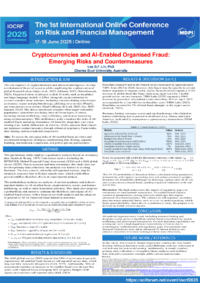
IOCRF2025 Poster presentation- Lin.pdf
Leveraging Federated Learning for Enhancing Anti-Fraud Systems in Fintech: Opportunities and Challenges
Optimising Multi-Scale Volatility Forecasting Approaches for Digital Currencies