Event submissions
Published
This submission belongs to the session S4. Financial Innovations and Technology of the event The 1st International Online Conference on Risk and Financial Management
Published date
13 Jun, 2025
Academic Editor
'%3e%3cpath%20d='M12.6657%2010.9104C12.4185%2010.325%2012.0599%209.79327%2011.6097%209.34482C11.1609%208.89508%2010.6293%208.5365%2010.0442%208.28888C10.0389%208.28626%2010.0337%208.28495%2010.0285%208.28233C10.8446%207.69279%2011.3752%206.73249%2011.3752%205.64904C11.3752%203.8542%209.92103%202.39999%208.1262%202.39999C6.33136%202.39999%204.87715%203.8542%204.87715%205.64904C4.87715%206.73249%205.40774%207.69279%206.22393%208.28364C6.21869%208.28626%206.21345%208.28757%206.20821%208.29019C5.62129%208.5378%205.09463%208.89284%204.64265%209.34613C4.1929%209.79493%203.83432%2010.3266%203.58671%2010.9117C3.34345%2011.4845%203.21226%2012.0987%203.20023%2012.7209C3.19988%2012.7349%203.20233%2012.7488%203.20744%2012.7619C3.21255%2012.7749%203.22022%2012.7867%203.22998%2012.7968C3.23975%2012.8068%203.25142%2012.8147%203.26431%2012.8202C3.2772%2012.8256%203.29105%2012.8284%203.30504%2012.8284H4.09109C4.14874%2012.8284%204.19459%2012.7825%204.1959%2012.7262C4.2221%2011.7148%204.62823%2010.7676%205.34617%2010.0497C6.08899%209.30683%207.0755%208.89808%208.1262%208.89808C9.17689%208.89808%2010.1634%209.30683%2010.9062%2010.0497C11.6242%2010.7676%2012.0303%2011.7148%2012.0565%2012.7262C12.0578%2012.7838%2012.1037%2012.8284%2012.1613%2012.8284H12.9474C12.9613%2012.8284%2012.9752%2012.8256%2012.9881%2012.8202C13.001%2012.8147%2013.0126%2012.8068%2013.0224%2012.7968C13.0322%2012.7867%2013.0398%2012.7749%2013.0449%2012.7619C13.0501%2012.7488%2013.0525%2012.7349%2013.0522%2012.7209C13.0391%2012.0947%2012.9094%2011.4855%2012.6657%2010.9104ZM8.1262%207.9024C7.52486%207.9024%206.9589%207.6679%206.53312%207.24211C6.10733%206.81633%205.87283%206.25037%205.87283%205.64904C5.87283%205.0477%206.10733%204.48174%206.53312%204.05596C6.9589%203.63018%207.52486%203.39567%208.1262%203.39567C8.72753%203.39567%209.29349%203.63018%209.71927%204.05596C10.1451%204.48174%2010.3796%205.0477%2010.3796%205.64904C10.3796%206.25037%2010.1451%206.81633%209.71927%207.24211C9.29349%207.6679%208.72753%207.9024%208.1262%207.9024Z'%20fill='%235D1EE1'/%3e%3c/g%3e%3c/svg%3e) Xianrong (Shawn) Zheng
Xianrong (Shawn) ZhengCitation
Fabrizio Di Sciorio, Daniele Angelini, Integrating the implied regularity into implied volatility models: A study on free arbitrage model, in Proceedings of The 1st International Online Conference on Risk and Financial Management, 17 June–18 June 2025, MDPI: Basel, Switzerland
Share
Email
Facebook
Twitter
LinkedIn
Integrating the implied regularity into implied volatility models: A study on free arbitrage model
'%3e%3cpath%20d='M12.6647%2010.9104C12.4176%2010.325%2012.0589%209.7933%2011.6088%209.34485C11.16%208.89511%2010.6283%208.53653%2010.0432%208.28891C10.038%208.28629%2010.0327%208.28498%2010.0275%208.28236C10.8437%207.69282%2011.3743%206.73252%2011.3743%205.64907C11.3743%203.85423%209.92005%202.40002%208.12522%202.40002C6.33038%202.40002%204.87618%203.85423%204.87618%205.64907C4.87618%206.73252%205.40677%207.69282%206.22296%208.28367C6.21772%208.28629%206.21248%208.2876%206.20724%208.29022C5.62031%208.53783%205.09365%208.89287%204.64167%209.34616C4.19192%209.79496%203.83334%2010.3266%203.58573%2010.9117C3.34247%2011.4846%203.21128%2012.0987%203.19925%2012.721C3.1989%2012.735%203.20135%2012.7489%203.20646%2012.7619C3.21157%2012.7749%203.21924%2012.7868%203.22901%2012.7968C3.23877%2012.8068%203.25045%2012.8148%203.26334%2012.8202C3.27623%2012.8256%203.29007%2012.8284%203.30406%2012.8284H4.09012C4.14776%2012.8284%204.19362%2012.7825%204.19493%2012.7262C4.22113%2011.7148%204.62726%2010.7676%205.34519%2010.0497C6.08802%209.30686%207.07452%208.89811%208.12522%208.89811C9.17592%208.89811%2010.1624%209.30686%2010.9052%2010.0497C11.6232%2010.7676%2012.0293%2011.7148%2012.0555%2012.7262C12.0568%2012.7839%2012.1027%2012.8284%2012.1603%2012.8284H12.9464C12.9604%2012.8284%2012.9742%2012.8256%2012.9871%2012.8202C13%2012.8148%2013.0117%2012.8068%2013.0214%2012.7968C13.0312%2012.7868%2013.0389%2012.7749%2013.044%2012.7619C13.0491%2012.7489%2013.0515%2012.735%2013.0512%2012.721C13.0381%2012.0947%2012.9084%2011.4856%2012.6647%2010.9104ZM8.12522%207.90243C7.52388%207.90243%206.95792%207.66793%206.53214%207.24215C6.10636%206.81636%205.87185%206.2504%205.87185%205.64907C5.87185%205.04773%206.10636%204.48177%206.53214%204.05599C6.95792%203.63021%207.52388%203.3957%208.12522%203.3957C8.72655%203.3957%209.29252%203.63021%209.7183%204.05599C10.1441%204.48177%2010.3786%205.04773%2010.3786%205.64907C10.3786%206.2504%2010.1441%206.81636%209.7183%207.24215C9.29252%207.66793%208.72655%207.90243%208.12522%207.90243Z'%20fill='%235D1EE1'/%3e%3c/g%3e%3c/svg%3e)
Fabrizio Di Sciorio 1
Daniele Angelini 2
1. Department of Economics and Business, University of Almeria, Almeria, 04120, Spain
2. MEMOTEF Department, Faculty of Economy, Sapienza, University of Rome, Rome, 00161, Via del Castro Laurenziano, 9, Rome, Italy
Abstract
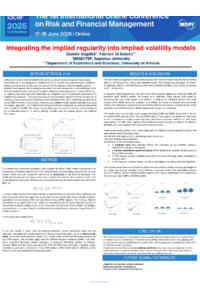
The study "Integrating the Implied Regularity into Implied Volatility Models" investigates the relationship between implied volatility (IV) and the Hurst exponent (H), particularly in the context of option moneyness. The research introduces a novel IV model that integrates the concept of market memory, represented by H, to enhance the accuracy of volatility forecasting compared to traditional models such as SABR and its fractional extension, fSABR.
A key finding of the study is that when moneyness is equal to 1 (ATM), the Hurst exponent converges to 1/2, indicating that price movements follow a Brownian motion, which aligns with the Efficient Market Hypothesis (EMH). However, for options that are in-the-money (ITM) or out-of-the-money (OTM), H decreases, reflecting deviations from pure randomness and greater sensitivity of IV to market conditions. This observation suggests that market inefficiencies are more pronounced in extreme moneyness regions, making standard models less effective in capturing the dynamics of implied volatility.
To validate the model, the authors employ advanced optimization techniques, specifically Optuna, which leverages Bayesian optimization and the Tree-Structured Parzen Estimator (TPE) method. The model is calibrated against real-world market data, and its performance is compared with SABR and fSABR using error metrics such as mean squared error (MSE), mean absolute error (MAE), and curvature-based error measures. The empirical results show that the proposed model achieves lower errors and better fits the observed IV surface, especially in ITM and OTM regions where traditional models struggle.
Another significant contribution of the study is the verification that the proposed IV model satisfies the arbitrage-free conditions required for financial consistency. By ensuring that the model does not allow for riskless profit opportunities, the authors demonstrate its practical applicability in real-world trading and risk management.
Keywords
implied volatility
arbitrage-free volatility theorem
volatility smile
implied market efficiency
inefficient financial markets
Poster
Integrating_the_Implied_Regularity_into_Implied_Volatility_Models_PosterPresentation.pdf
A COMPARATIVE ANALYSIS OF MACHINE LEARNING ALGORITHMS IN TECHNICAL TRADING STRATEGIES
Identifying Market Dynamics Through the Hurst Exponent