Event submissions
Published
This submission belongs to the session S4. Financial Innovations and Technology of the event The 1st International Online Conference on Risk and Financial Management
Published date
13 Jun, 2025
Academic Editor
'%3e%3cpath%20d='M12.6657%2010.9104C12.4185%2010.325%2012.0599%209.79327%2011.6097%209.34482C11.1609%208.89508%2010.6293%208.5365%2010.0442%208.28888C10.0389%208.28626%2010.0337%208.28495%2010.0285%208.28233C10.8446%207.69279%2011.3752%206.73249%2011.3752%205.64904C11.3752%203.8542%209.92103%202.39999%208.1262%202.39999C6.33136%202.39999%204.87715%203.8542%204.87715%205.64904C4.87715%206.73249%205.40774%207.69279%206.22393%208.28364C6.21869%208.28626%206.21345%208.28757%206.20821%208.29019C5.62129%208.5378%205.09463%208.89284%204.64265%209.34613C4.1929%209.79493%203.83432%2010.3266%203.58671%2010.9117C3.34345%2011.4845%203.21226%2012.0987%203.20023%2012.7209C3.19988%2012.7349%203.20233%2012.7488%203.20744%2012.7619C3.21255%2012.7749%203.22022%2012.7867%203.22998%2012.7968C3.23975%2012.8068%203.25142%2012.8147%203.26431%2012.8202C3.2772%2012.8256%203.29105%2012.8284%203.30504%2012.8284H4.09109C4.14874%2012.8284%204.19459%2012.7825%204.1959%2012.7262C4.2221%2011.7148%204.62823%2010.7676%205.34617%2010.0497C6.08899%209.30683%207.0755%208.89808%208.1262%208.89808C9.17689%208.89808%2010.1634%209.30683%2010.9062%2010.0497C11.6242%2010.7676%2012.0303%2011.7148%2012.0565%2012.7262C12.0578%2012.7838%2012.1037%2012.8284%2012.1613%2012.8284H12.9474C12.9613%2012.8284%2012.9752%2012.8256%2012.9881%2012.8202C13.001%2012.8147%2013.0126%2012.8068%2013.0224%2012.7968C13.0322%2012.7867%2013.0398%2012.7749%2013.0449%2012.7619C13.0501%2012.7488%2013.0525%2012.7349%2013.0522%2012.7209C13.0391%2012.0947%2012.9094%2011.4855%2012.6657%2010.9104ZM8.1262%207.9024C7.52486%207.9024%206.9589%207.6679%206.53312%207.24211C6.10733%206.81633%205.87283%206.25037%205.87283%205.64904C5.87283%205.0477%206.10733%204.48174%206.53312%204.05596C6.9589%203.63018%207.52486%203.39567%208.1262%203.39567C8.72753%203.39567%209.29349%203.63018%209.71927%204.05596C10.1451%204.48174%2010.3796%205.0477%2010.3796%205.64904C10.3796%206.25037%2010.1451%206.81633%209.71927%207.24211C9.29349%207.6679%208.72753%207.9024%208.1262%207.9024Z'%20fill='%235D1EE1'/%3e%3c/g%3e%3c/svg%3e) Xianrong (Shawn) Zheng
Xianrong (Shawn) ZhengCitation
Alexandra Trif, Paul Andor, Teodora Ioana Mititean, Claudia Terezia Socol, Alexandru Vasile Rusu, Florin Leontin Criste, Financial Innovations and AI-Driven Management in Romania’s Tourism and Public Catering Sector, in Proceedings of The 1st International Online Conference on Risk and Financial Management, 17 June–18 June 2025, MDPI: Basel, Switzerland
Share
Email
Facebook
Twitter
LinkedIn
Financial Innovations and AI-Driven Management in Romania’s Tourism and Public Catering Sector
'%3e%3cpath%20d='M12.6647%2010.9104C12.4176%2010.325%2012.0589%209.7933%2011.6088%209.34485C11.16%208.89511%2010.6283%208.53653%2010.0432%208.28891C10.038%208.28629%2010.0327%208.28498%2010.0275%208.28236C10.8437%207.69282%2011.3743%206.73252%2011.3743%205.64907C11.3743%203.85423%209.92005%202.40002%208.12522%202.40002C6.33038%202.40002%204.87618%203.85423%204.87618%205.64907C4.87618%206.73252%205.40677%207.69282%206.22296%208.28367C6.21772%208.28629%206.21248%208.2876%206.20724%208.29022C5.62031%208.53783%205.09365%208.89287%204.64167%209.34616C4.19192%209.79496%203.83334%2010.3266%203.58573%2010.9117C3.34247%2011.4846%203.21128%2012.0987%203.19925%2012.721C3.1989%2012.735%203.20135%2012.7489%203.20646%2012.7619C3.21157%2012.7749%203.21924%2012.7868%203.22901%2012.7968C3.23877%2012.8068%203.25045%2012.8148%203.26334%2012.8202C3.27623%2012.8256%203.29007%2012.8284%203.30406%2012.8284H4.09012C4.14776%2012.8284%204.19362%2012.7825%204.19493%2012.7262C4.22113%2011.7148%204.62726%2010.7676%205.34519%2010.0497C6.08802%209.30686%207.07452%208.89811%208.12522%208.89811C9.17592%208.89811%2010.1624%209.30686%2010.9052%2010.0497C11.6232%2010.7676%2012.0293%2011.7148%2012.0555%2012.7262C12.0568%2012.7839%2012.1027%2012.8284%2012.1603%2012.8284H12.9464C12.9604%2012.8284%2012.9742%2012.8256%2012.9871%2012.8202C13%2012.8148%2013.0117%2012.8068%2013.0214%2012.7968C13.0312%2012.7868%2013.0389%2012.7749%2013.044%2012.7619C13.0491%2012.7489%2013.0515%2012.735%2013.0512%2012.721C13.0381%2012.0947%2012.9084%2011.4856%2012.6647%2010.9104ZM8.12522%207.90243C7.52388%207.90243%206.95792%207.66793%206.53214%207.24215C6.10636%206.81636%205.87185%206.2504%205.87185%205.64907C5.87185%205.04773%206.10636%204.48177%206.53214%204.05599C6.95792%203.63021%207.52388%203.3957%208.12522%203.3957C8.72655%203.3957%209.29252%203.63021%209.7183%204.05599C10.1441%204.48177%2010.3786%205.04773%2010.3786%205.64907C10.3786%206.2504%2010.1441%206.81636%209.7183%207.24215C9.29252%207.66793%208.72655%207.90243%208.12522%207.90243Z'%20fill='%235D1EE1'/%3e%3c/g%3e%3c/svg%3e)
Alexandra Trif 1
Paul Andor 2
Teodora Ioana Mititean 3
Claudia Terezia Socol 1

Alexandru Vasile Rusu 3
Florin Leontin Criste 1
1. University of Oradea, Oradea, Romania
2. University of Agricultural Sciences and Technology, Cluj-Napoca, Romania
3. CENCIRA Agrofood Research and Innovation Centre, Romania
Abstract
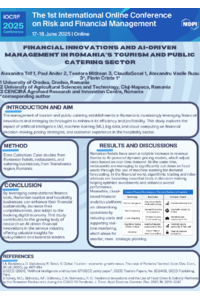
The management of tourism and public catering establishments in Romania is increasingly leveraging financial innovations and emerging technologies to enhance its efficiency and profitability. This study explores the impact of artificial intelligence (AI), machine learning (ML), big data, and cloud computing on financial decision-making, pricing strategies, and customer experience in the hospitality sector. For instance, the AI-powered dynamic pricing models used by Romanian hotels have improved their revenue by up to 20%, while ML-driven demand forecasting helps restaurants reduce their food waste by 15-30%. Algorithmic trading and robo-advisors are also being integrated into financial management strategies, helping optimize investment decisions and resource allocation. Algorithmic trading and robo-advisors are increasingly being used for financial optimization, improving investment returns by an estimated 12-18% annually. Cloud-based financial analytic platforms have contributed to a 10-15% reduction in operational costs, enabling real-time financial monitoring and strategic decision-making. Additionally, blockchain applications in financial reporting and auditing are enhancing transparency and reducing fraud risks. By leveraging computational finance tools, Romanian tourism and hospitality businesses can enhance their financial sustainability, increase their competitiveness, and adapt to the evolving digital economy. This study contributes to the growing body of research on AI-driven financial innovations in the service industry, offering valuable insights for policymakers and business leaders.
Keywords
financial innovations
artificial intelligence
machine learning
big data
tourism management
public catering
Romania
Poster
Financial Innovations and AI-Driven Management in Romania’s Tourism and Public Catering Sector.pdf
Cryptocurrencies in Portfolio Diversification: Evaluating Risk-Adjusted Performance and Strategic Allocation
Predicting Residential Housing Prices using Machine Learning Approach