Event submissions
Published
This submission belongs to the session S3. AI in Financial Reporting and Auditing of the event The 1st International Online Conference on Risk and Financial Management
Published date
13 Jun, 2025
Academic Editor
'%3e%3cpath%20d='M12.6657%2010.9104C12.4185%2010.325%2012.0599%209.79327%2011.6097%209.34482C11.1609%208.89508%2010.6293%208.5365%2010.0442%208.28888C10.0389%208.28626%2010.0337%208.28495%2010.0285%208.28233C10.8446%207.69279%2011.3752%206.73249%2011.3752%205.64904C11.3752%203.8542%209.92103%202.39999%208.1262%202.39999C6.33136%202.39999%204.87715%203.8542%204.87715%205.64904C4.87715%206.73249%205.40774%207.69279%206.22393%208.28364C6.21869%208.28626%206.21345%208.28757%206.20821%208.29019C5.62129%208.5378%205.09463%208.89284%204.64265%209.34613C4.1929%209.79493%203.83432%2010.3266%203.58671%2010.9117C3.34345%2011.4845%203.21226%2012.0987%203.20023%2012.7209C3.19988%2012.7349%203.20233%2012.7488%203.20744%2012.7619C3.21255%2012.7749%203.22022%2012.7867%203.22998%2012.7968C3.23975%2012.8068%203.25142%2012.8147%203.26431%2012.8202C3.2772%2012.8256%203.29105%2012.8284%203.30504%2012.8284H4.09109C4.14874%2012.8284%204.19459%2012.7825%204.1959%2012.7262C4.2221%2011.7148%204.62823%2010.7676%205.34617%2010.0497C6.08899%209.30683%207.0755%208.89808%208.1262%208.89808C9.17689%208.89808%2010.1634%209.30683%2010.9062%2010.0497C11.6242%2010.7676%2012.0303%2011.7148%2012.0565%2012.7262C12.0578%2012.7838%2012.1037%2012.8284%2012.1613%2012.8284H12.9474C12.9613%2012.8284%2012.9752%2012.8256%2012.9881%2012.8202C13.001%2012.8147%2013.0126%2012.8068%2013.0224%2012.7968C13.0322%2012.7867%2013.0398%2012.7749%2013.0449%2012.7619C13.0501%2012.7488%2013.0525%2012.7349%2013.0522%2012.7209C13.0391%2012.0947%2012.9094%2011.4855%2012.6657%2010.9104ZM8.1262%207.9024C7.52486%207.9024%206.9589%207.6679%206.53312%207.24211C6.10733%206.81633%205.87283%206.25037%205.87283%205.64904C5.87283%205.0477%206.10733%204.48174%206.53312%204.05596C6.9589%203.63018%207.52486%203.39567%208.1262%203.39567C8.72753%203.39567%209.29349%203.63018%209.71927%204.05596C10.1451%204.48174%2010.3796%205.0477%2010.3796%205.64904C10.3796%206.25037%2010.1451%206.81633%209.71927%207.24211C9.29349%207.6679%208.72753%207.9024%208.1262%207.9024Z'%20fill='%235D1EE1'/%3e%3c/g%3e%3c/svg%3e) Mahmoud Elmarzouky
Mahmoud ElmarzoukyCitation
Hua Christine Xin, Enhancing Financial Statement Accuracy: The Role of AI in Auditing, in Proceedings of The 1st International Online Conference on Risk and Financial Management, 17 June–18 June 2025, MDPI: Basel, Switzerland
Share
Email
Facebook
Twitter
LinkedIn
Enhancing Financial Statement Accuracy: The Role of AI in Auditing

Hua Christine Xin 1
1. School of Accountancy/Mitchell College of Business/Associate Professor/Main campus in Mobile, AL, University of South Alabama, Mobile, 36608, US
Abstract
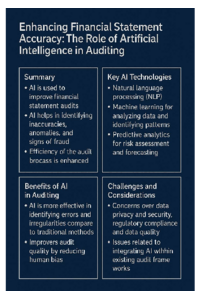
This study examines how Artificial Intelligence (AI) verifies financial statements by using machine learning algorithms together with natural language processing and predictive analytics to spot errors and potential fraudulent activities. AI-based audit systems evaluate financial data accuracy by matching it against historical patterns along with industry standards and regulatory requirements. AI boosts auditing efficiency by using real-time monitoring while reducing human biases in the audit process.
AI-powered financial audits enable organizations to predict and identify financial risks before they escalate by facilitating predictive forecasting beyond basic error detection. AI systems allow for the rapid processing of extensive data sets that traditional techniques cannot match while simultaneously improving transparency and reducing undetected fraud risks. The integration of AI into financial auditing necessitates robust data governance strategies combined with sophisticated cybersecurity protocols and thorough regulatory compliance to address potential algorithmic bias issues and prevent data misinterpretation risks. AI keeps advancing financial auditing even with existing difficulties since it creates a demand for combining machine intelligence with human judgment to achieve precise and trustworthy financial reports. A hybrid mode, combining AI with traditional audit, will be the trend of the future. AI will carry out risk assessments and identify unusual trends in Financial Statements, and auditors will talk with their clients to confirm those high-risk areas and make further investigations.
Keywords
Artificial Intelligence
Financial Statements
Auditing
Poster
sciforum-120661.pdf
Leveraging machine learning for developing a sustainable and stable pricing numeraire with ESG considerations
INFLATION AND NIGERIAN STOCK MARKET PERFORMANCE (1990–2022)