Event submissions
Published
This submission belongs to the session S6. Climate Action on Land Use of the event The 2nd International Electronic Conference on Land
Published date
01 Sep, 2025
Academic Editor
'%3e%3cpath%20d='M12.6657%2010.9104C12.4185%2010.325%2012.0599%209.79327%2011.6097%209.34482C11.1609%208.89508%2010.6293%208.5365%2010.0442%208.28888C10.0389%208.28626%2010.0337%208.28495%2010.0285%208.28233C10.8446%207.69279%2011.3752%206.73249%2011.3752%205.64904C11.3752%203.8542%209.92103%202.39999%208.1262%202.39999C6.33136%202.39999%204.87715%203.8542%204.87715%205.64904C4.87715%206.73249%205.40774%207.69279%206.22393%208.28364C6.21869%208.28626%206.21345%208.28757%206.20821%208.29019C5.62129%208.5378%205.09463%208.89284%204.64265%209.34613C4.1929%209.79493%203.83432%2010.3266%203.58671%2010.9117C3.34345%2011.4845%203.21226%2012.0987%203.20023%2012.7209C3.19988%2012.7349%203.20233%2012.7488%203.20744%2012.7619C3.21255%2012.7749%203.22022%2012.7867%203.22998%2012.7968C3.23975%2012.8068%203.25142%2012.8147%203.26431%2012.8202C3.2772%2012.8256%203.29105%2012.8284%203.30504%2012.8284H4.09109C4.14874%2012.8284%204.19459%2012.7825%204.1959%2012.7262C4.2221%2011.7148%204.62823%2010.7676%205.34617%2010.0497C6.08899%209.30683%207.0755%208.89808%208.1262%208.89808C9.17689%208.89808%2010.1634%209.30683%2010.9062%2010.0497C11.6242%2010.7676%2012.0303%2011.7148%2012.0565%2012.7262C12.0578%2012.7838%2012.1037%2012.8284%2012.1613%2012.8284H12.9474C12.9613%2012.8284%2012.9752%2012.8256%2012.9881%2012.8202C13.001%2012.8147%2013.0126%2012.8068%2013.0224%2012.7968C13.0322%2012.7867%2013.0398%2012.7749%2013.0449%2012.7619C13.0501%2012.7488%2013.0525%2012.7349%2013.0522%2012.7209C13.0391%2012.0947%2012.9094%2011.4855%2012.6657%2010.9104ZM8.1262%207.9024C7.52486%207.9024%206.9589%207.6679%206.53312%207.24211C6.10733%206.81633%205.87283%206.25037%205.87283%205.64904C5.87283%205.0477%206.10733%204.48174%206.53312%204.05596C6.9589%203.63018%207.52486%203.39567%208.1262%203.39567C8.72753%203.39567%209.29349%203.63018%209.71927%204.05596C10.1451%204.48174%2010.3796%205.0477%2010.3796%205.64904C10.3796%206.25037%2010.1451%206.81633%209.71927%207.24211C9.29349%207.6679%208.72753%207.9024%208.1262%207.9024Z'%20fill='%235D1EE1'/%3e%3c/g%3e%3c/svg%3e) Hossein Azadi
Hossein AzadiCitation
Eray Harman, Belgin Çakmak, Comparison of Crop Water Consumption Estimations under Drought Conditions Using Different Methods: A Case Study from Central Anatolia, Türkiye, in Proceedings of The 2nd International Electronic Conference on Land, 4 September–5 September 2025, MDPI: Basel, Switzerland
Share
Email
Facebook
Twitter
LinkedIn
Comparison of Crop Water Consumption Estimations under Drought Conditions Using Different Methods: A Case Study from Central Anatolia, Türkiye
'%3e%3cpath%20d='M12.6647%2010.9104C12.4176%2010.325%2012.0589%209.7933%2011.6088%209.34485C11.16%208.89511%2010.6283%208.53653%2010.0432%208.28891C10.038%208.28629%2010.0327%208.28498%2010.0275%208.28236C10.8437%207.69282%2011.3743%206.73252%2011.3743%205.64907C11.3743%203.85423%209.92005%202.40002%208.12522%202.40002C6.33038%202.40002%204.87618%203.85423%204.87618%205.64907C4.87618%206.73252%205.40677%207.69282%206.22296%208.28367C6.21772%208.28629%206.21248%208.2876%206.20724%208.29022C5.62031%208.53783%205.09365%208.89287%204.64167%209.34616C4.19192%209.79496%203.83334%2010.3266%203.58573%2010.9117C3.34247%2011.4846%203.21128%2012.0987%203.19925%2012.721C3.1989%2012.735%203.20135%2012.7489%203.20646%2012.7619C3.21157%2012.7749%203.21924%2012.7868%203.22901%2012.7968C3.23877%2012.8068%203.25045%2012.8148%203.26334%2012.8202C3.27623%2012.8256%203.29007%2012.8284%203.30406%2012.8284H4.09012C4.14776%2012.8284%204.19362%2012.7825%204.19493%2012.7262C4.22113%2011.7148%204.62726%2010.7676%205.34519%2010.0497C6.08802%209.30686%207.07452%208.89811%208.12522%208.89811C9.17592%208.89811%2010.1624%209.30686%2010.9052%2010.0497C11.6232%2010.7676%2012.0293%2011.7148%2012.0555%2012.7262C12.0568%2012.7839%2012.1027%2012.8284%2012.1603%2012.8284H12.9464C12.9604%2012.8284%2012.9742%2012.8256%2012.9871%2012.8202C13%2012.8148%2013.0117%2012.8068%2013.0214%2012.7968C13.0312%2012.7868%2013.0389%2012.7749%2013.044%2012.7619C13.0491%2012.7489%2013.0515%2012.735%2013.0512%2012.721C13.0381%2012.0947%2012.9084%2011.4856%2012.6647%2010.9104ZM8.12522%207.90243C7.52388%207.90243%206.95792%207.66793%206.53214%207.24215C6.10636%206.81636%205.87185%206.2504%205.87185%205.64907C5.87185%205.04773%206.10636%204.48177%206.53214%204.05599C6.95792%203.63021%207.52388%203.3957%208.12522%203.3957C8.72655%203.3957%209.29252%203.63021%209.7183%204.05599C10.1441%204.48177%2010.3786%205.04773%2010.3786%205.64907C10.3786%206.2504%2010.1441%206.81636%209.7183%207.24215C9.29252%207.66793%208.72655%207.90243%208.12522%207.90243Z'%20fill='%235D1EE1'/%3e%3c/g%3e%3c/svg%3e)
Eray Harman 1
Belgin Çakmak 2
1. State Hydraulic Works (DSI), 31st Department Directorate; Eskişehir; 26010; Turkey
2. Department of Farm Structures and Irrigation, Faculty of Agriculture; Ankara University; Ankara; 06100; Turkey
Abstract
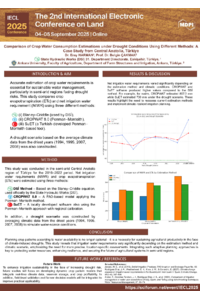
This study evaluates crop water consumption and irrigation requirements in Eskişehir, located in the semi-arid Central Anatolia region of Türkiye, by comparing three widely used estimation methods. Seasonal crop evapotranspiration (ETc) and net irrigation water requirement (NIWR) values were calculated for the period 2016–2022 using (i) the Blaney–Criddle method (State Hydraulic Works, DSİ), (ii) the CROPWAT 8.0 model, and (iii) the locally developed SuET software, both based on the Penman–Monteith approach. A drought scenario was also constructed using the climatic averages of the region’s driest recorded years (1994, 1995, 2007, and 2008).
The findings reveal considerable discrepancies among methods. For maize, the average NIWR was 377.5 mm according to DSİ, whereas CROPWAT and SuET yielded higher values, averaging 639.7 mm and 619.7 mm respectively. Similar differences were observed for alfalfa (NIWR: DSİ 503.5 mm, CROPWAT 789.2 mm, SuET 734.8 mm) and sunflower (DSİ 288.5 mm, CROPWAT 559.8 mm, SuET 636.4 mm). Under drought conditions, ETc values increased sharply. For example, CROPWAT estimated ETc for sunflower as 772.3 mm in 2016, rising to 927.3 mm in the drought scenario; SuET estimates rose from 708.9 mm to 752.1 mm.
The use of well-established models such as CROPWAT and SuET—both based on the validated FAO Penman–Monteith method—ensures methodological consistency and comparability. The inclusion of DSİ’s Blaney–Criddle-based institutional records enables practical benchmarking and enhances the relevance of the findings.
These results emphasize the need for adaptive irrigation planning and provide crucial insights for improving water allocation strategies in drought-prone regions of Central Anatolia.
Keywords
Crop evapotranspiration (ETc)
Net irrigation water requirement
Drought scenario
CROPWAT
SuET model.
Poster
IECL 2025 Poster Template -Dr. Eray Harman.pdf
Quantifying the Impacts of Climate Stress on Vegetation and Land Use in Sylhet Through Geospatial Analysis
Assessing the Impact of Illegal Gold Mining on the Fluvial Morphology of the Punino River in the Ecuadorian Amazon