Event submissions
Published
This submission belongs to the session S7. Resilient Agricultural Landscape Systems of the event The 2nd International Electronic Conference on Land
Published date
02 Sep, 2025
Academic Editor
'%3e%3cpath%20d='M12.6657%2010.9104C12.4185%2010.325%2012.0599%209.79327%2011.6097%209.34482C11.1609%208.89508%2010.6293%208.5365%2010.0442%208.28888C10.0389%208.28626%2010.0337%208.28495%2010.0285%208.28233C10.8446%207.69279%2011.3752%206.73249%2011.3752%205.64904C11.3752%203.8542%209.92103%202.39999%208.1262%202.39999C6.33136%202.39999%204.87715%203.8542%204.87715%205.64904C4.87715%206.73249%205.40774%207.69279%206.22393%208.28364C6.21869%208.28626%206.21345%208.28757%206.20821%208.29019C5.62129%208.5378%205.09463%208.89284%204.64265%209.34613C4.1929%209.79493%203.83432%2010.3266%203.58671%2010.9117C3.34345%2011.4845%203.21226%2012.0987%203.20023%2012.7209C3.19988%2012.7349%203.20233%2012.7488%203.20744%2012.7619C3.21255%2012.7749%203.22022%2012.7867%203.22998%2012.7968C3.23975%2012.8068%203.25142%2012.8147%203.26431%2012.8202C3.2772%2012.8256%203.29105%2012.8284%203.30504%2012.8284H4.09109C4.14874%2012.8284%204.19459%2012.7825%204.1959%2012.7262C4.2221%2011.7148%204.62823%2010.7676%205.34617%2010.0497C6.08899%209.30683%207.0755%208.89808%208.1262%208.89808C9.17689%208.89808%2010.1634%209.30683%2010.9062%2010.0497C11.6242%2010.7676%2012.0303%2011.7148%2012.0565%2012.7262C12.0578%2012.7838%2012.1037%2012.8284%2012.1613%2012.8284H12.9474C12.9613%2012.8284%2012.9752%2012.8256%2012.9881%2012.8202C13.001%2012.8147%2013.0126%2012.8068%2013.0224%2012.7968C13.0322%2012.7867%2013.0398%2012.7749%2013.0449%2012.7619C13.0501%2012.7488%2013.0525%2012.7349%2013.0522%2012.7209C13.0391%2012.0947%2012.9094%2011.4855%2012.6657%2010.9104ZM8.1262%207.9024C7.52486%207.9024%206.9589%207.6679%206.53312%207.24211C6.10733%206.81633%205.87283%206.25037%205.87283%205.64904C5.87283%205.0477%206.10733%204.48174%206.53312%204.05596C6.9589%203.63018%207.52486%203.39567%208.1262%203.39567C8.72753%203.39567%209.29349%203.63018%209.71927%204.05596C10.1451%204.48174%2010.3796%205.0477%2010.3796%205.64904C10.3796%206.25037%2010.1451%206.81633%209.71927%207.24211C9.29349%207.6679%208.72753%207.9024%208.1262%207.9024Z'%20fill='%235D1EE1'/%3e%3c/g%3e%3c/svg%3e) Hossein Azadi
Hossein AzadiCitation
SABRINE SOLTANE, Phyto-Acoustic Mulching: Paradigm for enhancing Allelopathic Weed Control, in Proceedings of The 2nd International Electronic Conference on Land, 4 September–5 September 2025, MDPI: Basel, Switzerland
Share
Email
Facebook
Twitter
LinkedIn
Phyto-Acoustic Mulching: Paradigm for enhancing Allelopathic Weed Control

SABRINE SOLTANE 1
1. Department of Nature and Life Sciences; Laboratory of Genetic, Biotechnology and Valorisation of Bioresources, University of Mohamed Khider Biskra, Biskra, Algeria
Abstract
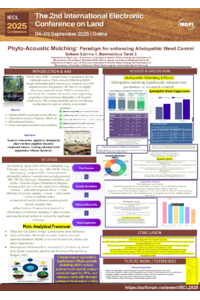
In the realm of sustainable agriculture, the quest for effective weed control methods has been a pressing challenge, with chemical herbicides posing risks to the environment and human health and contributing to herbicide-resistant weed populations. However, the efficacy of allelopathic mulches, such as pine bark or wheat straw, is often limited by inconsistent allelochemical release and environmental factors. This paper explores the potential of phyto-acoustic mulching as an innovative strategy for enhancing allelopathic weed control under field conditions. Allelopathy, the chemical inhibition of weed growth by plant-derived compounds, offers a sustainable alternative. Traditional mulching with allelopathic plant materials such as Pearl millet, Sorghum Parthenium hysterophorus, and Jute nonwoven fibers has demonstrated significant weed suppression, improved soil health, and increased crop yields. Recent research has demonstrated that sound waves can influence plant physiology, including growth, enzyme activity, and secondary metabolite production. For instance, sound waves at 1 kHz and 100 dB have been shown to promote cell division, increase protective enzyme activity, and enhance endogenous hormone levels in plants. Based on the existing literature, phyto-acoustic mulching could achieve significant weed suppression. Studies on allelopathic mulches report weed germination reductions of 20–60% [1]. Sound wave stimulation, which enhances secondary metabolite production by 20–30% in plants, could potentially increase allelochemical release by a similar margin, leading to weed suppression rates of 40–80% [2]. However, the integration of acoustic or vibrational stimuli to augment the release or efficacy of allelochemicals remains underexplored. This study proposes a novel framework for phyto-acoustic mulching, hypothesizing that controlled acoustic frequencies could enhance the decomposition of mulch materials or stimulate allelochemical activity, thereby amplifying weed control.
Keywords
Resilient Agricultural Systemss 2
Allelopathy 3
Weed suppression 4
Sustainable agriculture 5
Acoustic stimulation 6
Green weed control 7
Plant residues 8
Bioactive compounds 9
Ecological resilience 10
Phyto-acoustic mulchin
Poster
sabrine soltaire.pdf
Community Approach to Sustainable Local Development
A Comparative Analysis of the Popularity of Regenerative Agriculture Practices in Poland, Germany, and Belarus