Event submissions
Published
This submission belongs to the session S2. Landscape Architecture and Land Restoration of the event The 2nd International Electronic Conference on Land
Published date
02 Sep, 2025
Academic Editor
'%3e%3cpath%20d='M12.6657%2010.9104C12.4185%2010.325%2012.0599%209.79327%2011.6097%209.34482C11.1609%208.89508%2010.6293%208.5365%2010.0442%208.28888C10.0389%208.28626%2010.0337%208.28495%2010.0285%208.28233C10.8446%207.69279%2011.3752%206.73249%2011.3752%205.64904C11.3752%203.8542%209.92103%202.39999%208.1262%202.39999C6.33136%202.39999%204.87715%203.8542%204.87715%205.64904C4.87715%206.73249%205.40774%207.69279%206.22393%208.28364C6.21869%208.28626%206.21345%208.28757%206.20821%208.29019C5.62129%208.5378%205.09463%208.89284%204.64265%209.34613C4.1929%209.79493%203.83432%2010.3266%203.58671%2010.9117C3.34345%2011.4845%203.21226%2012.0987%203.20023%2012.7209C3.19988%2012.7349%203.20233%2012.7488%203.20744%2012.7619C3.21255%2012.7749%203.22022%2012.7867%203.22998%2012.7968C3.23975%2012.8068%203.25142%2012.8147%203.26431%2012.8202C3.2772%2012.8256%203.29105%2012.8284%203.30504%2012.8284H4.09109C4.14874%2012.8284%204.19459%2012.7825%204.1959%2012.7262C4.2221%2011.7148%204.62823%2010.7676%205.34617%2010.0497C6.08899%209.30683%207.0755%208.89808%208.1262%208.89808C9.17689%208.89808%2010.1634%209.30683%2010.9062%2010.0497C11.6242%2010.7676%2012.0303%2011.7148%2012.0565%2012.7262C12.0578%2012.7838%2012.1037%2012.8284%2012.1613%2012.8284H12.9474C12.9613%2012.8284%2012.9752%2012.8256%2012.9881%2012.8202C13.001%2012.8147%2013.0126%2012.8068%2013.0224%2012.7968C13.0322%2012.7867%2013.0398%2012.7749%2013.0449%2012.7619C13.0501%2012.7488%2013.0525%2012.7349%2013.0522%2012.7209C13.0391%2012.0947%2012.9094%2011.4855%2012.6657%2010.9104ZM8.1262%207.9024C7.52486%207.9024%206.9589%207.6679%206.53312%207.24211C6.10733%206.81633%205.87283%206.25037%205.87283%205.64904C5.87283%205.0477%206.10733%204.48174%206.53312%204.05596C6.9589%203.63018%207.52486%203.39567%208.1262%203.39567C8.72753%203.39567%209.29349%203.63018%209.71927%204.05596C10.1451%204.48174%2010.3796%205.0477%2010.3796%205.64904C10.3796%206.25037%2010.1451%206.81633%209.71927%207.24211C9.29349%207.6679%208.72753%207.9024%208.1262%207.9024Z'%20fill='%235D1EE1'/%3e%3c/g%3e%3c/svg%3e) Thomas Panagopoulos
Thomas PanagopoulosCitation
Adarsh Kumar, Udisha Sarkar, Reviving Mehrauli: Integrating Landscape Design for Ecological Restoration and Heritage Renewal, in Proceedings of The 2nd International Electronic Conference on Land, 4 September–5 September 2025, MDPI: Basel, Switzerland
Share
Email
Facebook
Twitter
LinkedIn
Reviving Mehrauli: Integrating Landscape Design for Ecological Restoration and Heritage Renewal
'%3e%3cpath%20d='M12.6647%2010.9104C12.4176%2010.325%2012.0589%209.7933%2011.6088%209.34485C11.16%208.89511%2010.6283%208.53653%2010.0432%208.28891C10.038%208.28629%2010.0327%208.28498%2010.0275%208.28236C10.8437%207.69282%2011.3743%206.73252%2011.3743%205.64907C11.3743%203.85423%209.92005%202.40002%208.12522%202.40002C6.33038%202.40002%204.87618%203.85423%204.87618%205.64907C4.87618%206.73252%205.40677%207.69282%206.22296%208.28367C6.21772%208.28629%206.21248%208.2876%206.20724%208.29022C5.62031%208.53783%205.09365%208.89287%204.64167%209.34616C4.19192%209.79496%203.83334%2010.3266%203.58573%2010.9117C3.34247%2011.4846%203.21128%2012.0987%203.19925%2012.721C3.1989%2012.735%203.20135%2012.7489%203.20646%2012.7619C3.21157%2012.7749%203.21924%2012.7868%203.22901%2012.7968C3.23877%2012.8068%203.25045%2012.8148%203.26334%2012.8202C3.27623%2012.8256%203.29007%2012.8284%203.30406%2012.8284H4.09012C4.14776%2012.8284%204.19362%2012.7825%204.19493%2012.7262C4.22113%2011.7148%204.62726%2010.7676%205.34519%2010.0497C6.08802%209.30686%207.07452%208.89811%208.12522%208.89811C9.17592%208.89811%2010.1624%209.30686%2010.9052%2010.0497C11.6232%2010.7676%2012.0293%2011.7148%2012.0555%2012.7262C12.0568%2012.7839%2012.1027%2012.8284%2012.1603%2012.8284H12.9464C12.9604%2012.8284%2012.9742%2012.8256%2012.9871%2012.8202C13%2012.8148%2013.0117%2012.8068%2013.0214%2012.7968C13.0312%2012.7868%2013.0389%2012.7749%2013.044%2012.7619C13.0491%2012.7489%2013.0515%2012.735%2013.0512%2012.721C13.0381%2012.0947%2012.9084%2011.4856%2012.6647%2010.9104ZM8.12522%207.90243C7.52388%207.90243%206.95792%207.66793%206.53214%207.24215C6.10636%206.81636%205.87185%206.2504%205.87185%205.64907C5.87185%205.04773%206.10636%204.48177%206.53214%204.05599C6.95792%203.63021%207.52388%203.3957%208.12522%203.3957C8.72655%203.3957%209.29252%203.63021%209.7183%204.05599C10.1441%204.48177%2010.3786%205.04773%2010.3786%205.64907C10.3786%206.2504%2010.1441%206.81636%209.7183%207.24215C9.29252%207.66793%208.72655%207.90243%208.12522%207.90243Z'%20fill='%235D1EE1'/%3e%3c/g%3e%3c/svg%3e)
Adarsh Kumar 1
Udisha Sarkar 2
1. Environmental Planning; School of Planning and Architecture; New Delhi; 110002; India
2. Architecture (Landscape Architecture); School of Planning and Architecture; New Delhi; 110002; India
Abstract
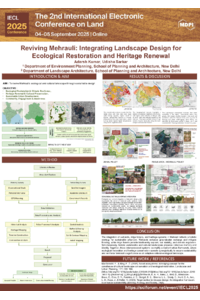
Mehrauli, one of Delhi’s oldest continuously inhabited settlements, lies at the ecological edge of the Aravalli ridge and has historically been sustained by traditional water systems and natural drainage patterns. However, over the past few decades, this balance has been critically disrupted. Rapid urbanization has led to a 76% increase in built-up area and a 51% decline in green cover between 1990 and 2020. The degradation of the Aravalli ridge, fragmentation of forest cover, and the conversion of permeable surfaces into impervious urban land have caused severe ecological and hydrological stress. Groundwater levels have plummeted from an average of 10–12 meters in 1996 to 22–25 meters in 2020. Delhi Police Department has identified 96 flood-prone points in South Delhi and recorded over 250 flooding incidents in the last five years. These incidences have become more frequent due to blocked natural drains and decreased infiltration. There is an urgent need to address the ecological degradation, water scarcity, and flooding risks that threaten Mehrauli’s sustainability and heritage value. The goal is to develop an integrative approach that not only mitigates these urban issues but also revives Mehrauli’s historical water systems and strengthens its cultural identity. The proposed strategy involves a series of landscape-based actions focused on ecological restoration, water management, removal of invasive flora, and the creation of green corridors and bioswales, which will restore ecological balance, reduce surface runoff, and mitigate UHI effects. It will also represent a form of cultural renewal, facilitating the rejuvenation of historic water bodies such as Hauz-i-Shamsi,built in 1230 AD, and key baolis like Rajon Ki Baoli and Gandhak Ki Baoli. Measures include desilting, repairing embankments, and reconnecting feeder channels to revive their groundwater recharge functions. Interventions should be aligned with the Delhi Master Plan 2041 and India’s commitments under the UN Sustainable Development Goals.
Keywords
sustainable
mehrauli
urban flooding
infiltration
ecological restoration
Poster
Mehraul_Adarsh Kumar_ Udisha Sarkar.pdf
A Comparative Analysis of the Popularity of Regenerative Agriculture Practices in Poland, Germany, and Belarus
New perspectives on geothermal energy usage over the past 30 years in Italy: its impact on society, the economy, and land management