Event submissions
Published
This submission belongs to the session S2. Landscape Architecture and Land Restoration of the event The 2nd International Electronic Conference on Land
Published date
02 Sep, 2025
Academic Editor
'%3e%3cpath%20d='M12.6657%2010.9104C12.4185%2010.325%2012.0599%209.79327%2011.6097%209.34482C11.1609%208.89508%2010.6293%208.5365%2010.0442%208.28888C10.0389%208.28626%2010.0337%208.28495%2010.0285%208.28233C10.8446%207.69279%2011.3752%206.73249%2011.3752%205.64904C11.3752%203.8542%209.92103%202.39999%208.1262%202.39999C6.33136%202.39999%204.87715%203.8542%204.87715%205.64904C4.87715%206.73249%205.40774%207.69279%206.22393%208.28364C6.21869%208.28626%206.21345%208.28757%206.20821%208.29019C5.62129%208.5378%205.09463%208.89284%204.64265%209.34613C4.1929%209.79493%203.83432%2010.3266%203.58671%2010.9117C3.34345%2011.4845%203.21226%2012.0987%203.20023%2012.7209C3.19988%2012.7349%203.20233%2012.7488%203.20744%2012.7619C3.21255%2012.7749%203.22022%2012.7867%203.22998%2012.7968C3.23975%2012.8068%203.25142%2012.8147%203.26431%2012.8202C3.2772%2012.8256%203.29105%2012.8284%203.30504%2012.8284H4.09109C4.14874%2012.8284%204.19459%2012.7825%204.1959%2012.7262C4.2221%2011.7148%204.62823%2010.7676%205.34617%2010.0497C6.08899%209.30683%207.0755%208.89808%208.1262%208.89808C9.17689%208.89808%2010.1634%209.30683%2010.9062%2010.0497C11.6242%2010.7676%2012.0303%2011.7148%2012.0565%2012.7262C12.0578%2012.7838%2012.1037%2012.8284%2012.1613%2012.8284H12.9474C12.9613%2012.8284%2012.9752%2012.8256%2012.9881%2012.8202C13.001%2012.8147%2013.0126%2012.8068%2013.0224%2012.7968C13.0322%2012.7867%2013.0398%2012.7749%2013.0449%2012.7619C13.0501%2012.7488%2013.0525%2012.7349%2013.0522%2012.7209C13.0391%2012.0947%2012.9094%2011.4855%2012.6657%2010.9104ZM8.1262%207.9024C7.52486%207.9024%206.9589%207.6679%206.53312%207.24211C6.10733%206.81633%205.87283%206.25037%205.87283%205.64904C5.87283%205.0477%206.10733%204.48174%206.53312%204.05596C6.9589%203.63018%207.52486%203.39567%208.1262%203.39567C8.72753%203.39567%209.29349%203.63018%209.71927%204.05596C10.1451%204.48174%2010.3796%205.0477%2010.3796%205.64904C10.3796%206.25037%2010.1451%206.81633%209.71927%207.24211C9.29349%207.6679%208.72753%207.9024%208.1262%207.9024Z'%20fill='%235D1EE1'/%3e%3c/g%3e%3c/svg%3e) Thomas Panagopoulos
Thomas PanagopoulosCitation
Nudia Aufia, A Framework for Landscape Restoration: Ecological Timeframes and Design Principles for Post-Tin Mining Land, in Proceedings of The 2nd International Electronic Conference on Land, 4 September–5 September 2025, MDPI: Basel, Switzerland
Share
Email
Facebook
Twitter
LinkedIn
A Framework for Landscape Restoration: Ecological Timeframes and Design Principles for Post-Tin Mining Land

Nudia Aufia 1
1. Bandung Institute of Technology (Institut Teknologi Bandung); Bandung; 40132; Indonesia
Abstract
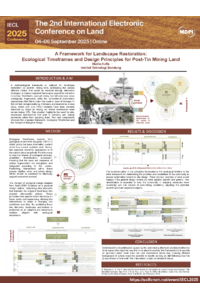
A methodological framework is outlined for landscape restoration on post-tin mining land, addressing the urgent global need for more effective strategies to restore degraded landscapes caused by extractive industries. Worldwide, open-pit mining has left extensive areas ecologically fragmented, while the conventional reclamation approaches often fail to match the scale or pace of damage. In this context, Bangka Belitung, Indonesia, is presented as a case study, where over one million hectares have been severely disrupted by illegal tin mining yet formal reclamation rates remain below 10%. This situation highlights the need for site-responsive interventions that work in harmony with natural processes rather than opposing them.
Two core components structure the proposed framework: Ecological Timeframes and the Percept of Biological Design. Ecological Timeframes provide a way to map the phases of ecological recovery, ensuring that the pace and sequence of natural regeneration are recognised and integrated. Positioning interventions within these phases clarifies when and where design efforts should be prioritised to effectively support ecosystem renewal.
The Percept of Biological Design functions as a practical design toolbox, comprising nine principles that translate the mapped timeframes into phased, site-specific actions. These principles inform decisions on focus, scale, and sequencing, allowing the interventions to adapt to changing site conditions over time.
By combining these two elements, landscape architecture is positioned as an adaptive and responsive medium aligned with ecological succession. Using Bangka Belitung as a case study, this framework demonstrates how locally grounded, time-sensitive strategies can contribute to more resilient and regenerative post-mining landscapes, supporting broader global restoration goals.
Keywords
Architectural intervention
land restoration framework
ecological timeframe
biological design
Poster
Nudia Aufia_ITB_IECL 2025 Poster.pdf
New perspectives on geothermal energy usage over the past 30 years in Italy: its impact on society, the economy, and land management
Strategic planning of linear green spaces that connect green areas in Lagos, improving ecological connectivity, and providing various benefits for both the environment and the city's inhabitants