Event submissions
Published
This submission belongs to the session 4. Pesticides, Pollutants, and Health Risk of the event The 2nd International Online Conference on Toxics
Published date
02 Sep, 2025
Academic Editor
'%3e%3cpath%20d='M12.6657%2010.9104C12.4185%2010.325%2012.0599%209.79327%2011.6097%209.34482C11.1609%208.89508%2010.6293%208.5365%2010.0442%208.28888C10.0389%208.28626%2010.0337%208.28495%2010.0285%208.28233C10.8446%207.69279%2011.3752%206.73249%2011.3752%205.64904C11.3752%203.8542%209.92103%202.39999%208.1262%202.39999C6.33136%202.39999%204.87715%203.8542%204.87715%205.64904C4.87715%206.73249%205.40774%207.69279%206.22393%208.28364C6.21869%208.28626%206.21345%208.28757%206.20821%208.29019C5.62129%208.5378%205.09463%208.89284%204.64265%209.34613C4.1929%209.79493%203.83432%2010.3266%203.58671%2010.9117C3.34345%2011.4845%203.21226%2012.0987%203.20023%2012.7209C3.19988%2012.7349%203.20233%2012.7488%203.20744%2012.7619C3.21255%2012.7749%203.22022%2012.7867%203.22998%2012.7968C3.23975%2012.8068%203.25142%2012.8147%203.26431%2012.8202C3.2772%2012.8256%203.29105%2012.8284%203.30504%2012.8284H4.09109C4.14874%2012.8284%204.19459%2012.7825%204.1959%2012.7262C4.2221%2011.7148%204.62823%2010.7676%205.34617%2010.0497C6.08899%209.30683%207.0755%208.89808%208.1262%208.89808C9.17689%208.89808%2010.1634%209.30683%2010.9062%2010.0497C11.6242%2010.7676%2012.0303%2011.7148%2012.0565%2012.7262C12.0578%2012.7838%2012.1037%2012.8284%2012.1613%2012.8284H12.9474C12.9613%2012.8284%2012.9752%2012.8256%2012.9881%2012.8202C13.001%2012.8147%2013.0126%2012.8068%2013.0224%2012.7968C13.0322%2012.7867%2013.0398%2012.7749%2013.0449%2012.7619C13.0501%2012.7488%2013.0525%2012.7349%2013.0522%2012.7209C13.0391%2012.0947%2012.9094%2011.4855%2012.6657%2010.9104ZM8.1262%207.9024C7.52486%207.9024%206.9589%207.6679%206.53312%207.24211C6.10733%206.81633%205.87283%206.25037%205.87283%205.64904C5.87283%205.0477%206.10733%204.48174%206.53312%204.05596C6.9589%203.63018%207.52486%203.39567%208.1262%203.39567C8.72753%203.39567%209.29349%203.63018%209.71927%204.05596C10.1451%204.48174%2010.3796%205.0477%2010.3796%205.64904C10.3796%206.25037%2010.1451%206.81633%209.71927%207.24211C9.29349%207.6679%208.72753%207.9024%208.1262%207.9024Z'%20fill='%235D1EE1'/%3e%3c/g%3e%3c/svg%3e) Virgínia Cruz Fernandes
Virgínia Cruz FernandesCitation
Thanawadee Chantong, Tippawan Prapamontol, Kriengkrai Srithanaviboonchai, Parinya Panuwet, Dana Boyd Barr, Environmental Exposure Assessment among Infant via Diapered Urine Analysis: A Challenge of Methodology, in Proceedings of The 2nd International Online Conference on Toxics, 8 September–10 September 2025, MDPI: Basel, Switzerland
Share
Email
Facebook
Twitter
LinkedIn
Environmental Exposure Assessment among Infant via Diapered Urine Analysis: A Challenge of Methodology
'%3e%3cpath%20d='M12.6647%2010.9104C12.4176%2010.325%2012.0589%209.7933%2011.6088%209.34485C11.16%208.89511%2010.6283%208.53653%2010.0432%208.28891C10.038%208.28629%2010.0327%208.28498%2010.0275%208.28236C10.8437%207.69282%2011.3743%206.73252%2011.3743%205.64907C11.3743%203.85423%209.92005%202.40002%208.12522%202.40002C6.33038%202.40002%204.87618%203.85423%204.87618%205.64907C4.87618%206.73252%205.40677%207.69282%206.22296%208.28367C6.21772%208.28629%206.21248%208.2876%206.20724%208.29022C5.62031%208.53783%205.09365%208.89287%204.64167%209.34616C4.19192%209.79496%203.83334%2010.3266%203.58573%2010.9117C3.34247%2011.4846%203.21128%2012.0987%203.19925%2012.721C3.1989%2012.735%203.20135%2012.7489%203.20646%2012.7619C3.21157%2012.7749%203.21924%2012.7868%203.22901%2012.7968C3.23877%2012.8068%203.25045%2012.8148%203.26334%2012.8202C3.27623%2012.8256%203.29007%2012.8284%203.30406%2012.8284H4.09012C4.14776%2012.8284%204.19362%2012.7825%204.19493%2012.7262C4.22113%2011.7148%204.62726%2010.7676%205.34519%2010.0497C6.08802%209.30686%207.07452%208.89811%208.12522%208.89811C9.17592%208.89811%2010.1624%209.30686%2010.9052%2010.0497C11.6232%2010.7676%2012.0293%2011.7148%2012.0555%2012.7262C12.0568%2012.7839%2012.1027%2012.8284%2012.1603%2012.8284H12.9464C12.9604%2012.8284%2012.9742%2012.8256%2012.9871%2012.8202C13%2012.8148%2013.0117%2012.8068%2013.0214%2012.7968C13.0312%2012.7868%2013.0389%2012.7749%2013.044%2012.7619C13.0491%2012.7489%2013.0515%2012.735%2013.0512%2012.721C13.0381%2012.0947%2012.9084%2011.4856%2012.6647%2010.9104ZM8.12522%207.90243C7.52388%207.90243%206.95792%207.66793%206.53214%207.24215C6.10636%206.81636%205.87185%206.2504%205.87185%205.64907C5.87185%205.04773%206.10636%204.48177%206.53214%204.05599C6.95792%203.63021%207.52388%203.3957%208.12522%203.3957C8.72655%203.3957%209.29252%203.63021%209.7183%204.05599C10.1441%204.48177%2010.3786%205.04773%2010.3786%205.64907C10.3786%206.2504%2010.1441%206.81636%209.7183%207.24215C9.29252%207.66793%208.72655%207.90243%208.12522%207.90243Z'%20fill='%235D1EE1'/%3e%3c/g%3e%3c/svg%3e)
Thanawadee Chantong 1,2

Tippawan Prapamontol 1
Kriengkrai Srithanaviboonchai 2
Parinya Panuwet 3

Dana Boyd Barr 3
1. Environment and Health Research Group, Research Institute for Health Sciences (RIHES),
Chiang Mai University, Chiang Mai 50200, Thailand.
2. School of Health Sciences Research (SHSR), Research Institute for Health Sciences (RIHES),
Chiang Mai University, Chiang Mai 50200, Thailand.
3. Gangarosa Department of Environmental Health, Rollins School of Public Health,
Emory University, Atlanta, GA, USA.
Abstract
Introduction
Assessment of environmental exposure using biological samples such as urine is non-invasive. However, most infants wear disposable diapers.
Therefore, extraction urine from diapers is a challenge step before laboratory analysis. This study aims to develop and validate a method for detecting
ten hydroxylated polycyclic aromatic hydrocarbons (OHPAHs) in diapered urine.
Methods
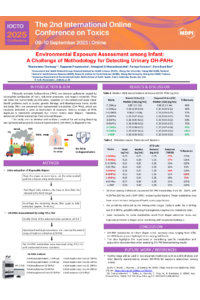
Ten individual adult urine samples (≈100 mL) were employed to experiment. Thirty millimeters of urine were pass through the diaper and extract diaper urine (DU) with 50 mL of 50 g/L calcium chloride (CaCl2) solution. The DU extract was measured calcium ion using atomic absorption spectroscopy (AAS). Then 10 mL aliquot of extracted DU along with normal individual urine (U) were acidified to pH 5.0, hydrolyzed with β-glucuronidase, and clean up the extract using solid phase extraction (C18 OH). Ten OHPAH metabolites (2-hydroxynaphthalene (2-OHNap), 1-hydroxynaphthalene (1-OHNap),
2+3-hydroxyfluorene (2+3-OHFlu), 2-hydroxyphenanthrene (2-OHPhe), 3-hydroxyphenanthrene (3-OHPhe), 9-hydroxyphenanthrene (9-OHPhe),
1-hydroxyphenanthrene (1-OHPhe), 4-hydroxyphenanthrene (4-OHPhe) and 1-hydroxypyrene (1-OHP)) were quantified using High Performance Liquid Chromatography with Fluorescence Detection (HPLC-FLD) with deuterated internal standards (1-OHP-d9 and 1-OHNap-d7) to ensure accuracy.
The detected OHPAHs concentrations of DU and U were compared and discussed.
Results
We found that the recovery rates of OHPAH metabolites from DU compared to U ranged from approximately 34 to 94%, with the highest recoveries observed for 4-OHPhe (94%) and 1-OHPhe (92%), followed by 1-OHP (87%), 2-OHPhe (68%), 2+3-OHFlu (47%), 3-OHPhe (41%), 2-OHNap (40%), 9-OHPhe (36%), and 1-OHNap (34%).
Conclusions
This study developed and validated a method for detecting OHPAH metabolites in infant diaper urine, with recovery rates ranging from 34% to 94%. Lower recoveries for some metabolites suggest losses during extraction from diaper, and interference of high calcium levels in diaper-extracted urine with enzymatic hydrolysis. Further study is warranted to address these challenges.
Keywords
disposable diaper
urine extraction
hydroxylated polycyclic aromatic hydrocarbons
infant exposure assessment
HPLC-FLD
Poster
IOCTO2025 _Thanawadee_Poster.pdf
A Toxicity assessment of metyltetraprole, a novel fungicide inhibitor, to embryo/larval zebrafish (Danio rerio)
Advanced analytical method for determination of Aflatoxins in chilli powder using LC-MS/MS