Event submissions
Published
This submission belongs to the session 5. Exploring Non-Model Species for Ecotoxicology of the event The 2nd International Online Conference on Toxics
Published date
02 Sep, 2025
Academic Editor
'%3e%3cpath%20d='M12.6657%2010.9104C12.4185%2010.325%2012.0599%209.79327%2011.6097%209.34482C11.1609%208.89508%2010.6293%208.5365%2010.0442%208.28888C10.0389%208.28626%2010.0337%208.28495%2010.0285%208.28233C10.8446%207.69279%2011.3752%206.73249%2011.3752%205.64904C11.3752%203.8542%209.92103%202.39999%208.1262%202.39999C6.33136%202.39999%204.87715%203.8542%204.87715%205.64904C4.87715%206.73249%205.40774%207.69279%206.22393%208.28364C6.21869%208.28626%206.21345%208.28757%206.20821%208.29019C5.62129%208.5378%205.09463%208.89284%204.64265%209.34613C4.1929%209.79493%203.83432%2010.3266%203.58671%2010.9117C3.34345%2011.4845%203.21226%2012.0987%203.20023%2012.7209C3.19988%2012.7349%203.20233%2012.7488%203.20744%2012.7619C3.21255%2012.7749%203.22022%2012.7867%203.22998%2012.7968C3.23975%2012.8068%203.25142%2012.8147%203.26431%2012.8202C3.2772%2012.8256%203.29105%2012.8284%203.30504%2012.8284H4.09109C4.14874%2012.8284%204.19459%2012.7825%204.1959%2012.7262C4.2221%2011.7148%204.62823%2010.7676%205.34617%2010.0497C6.08899%209.30683%207.0755%208.89808%208.1262%208.89808C9.17689%208.89808%2010.1634%209.30683%2010.9062%2010.0497C11.6242%2010.7676%2012.0303%2011.7148%2012.0565%2012.7262C12.0578%2012.7838%2012.1037%2012.8284%2012.1613%2012.8284H12.9474C12.9613%2012.8284%2012.9752%2012.8256%2012.9881%2012.8202C13.001%2012.8147%2013.0126%2012.8068%2013.0224%2012.7968C13.0322%2012.7867%2013.0398%2012.7749%2013.0449%2012.7619C13.0501%2012.7488%2013.0525%2012.7349%2013.0522%2012.7209C13.0391%2012.0947%2012.9094%2011.4855%2012.6657%2010.9104ZM8.1262%207.9024C7.52486%207.9024%206.9589%207.6679%206.53312%207.24211C6.10733%206.81633%205.87283%206.25037%205.87283%205.64904C5.87283%205.0477%206.10733%204.48174%206.53312%204.05596C6.9589%203.63018%207.52486%203.39567%208.1262%203.39567C8.72753%203.39567%209.29349%203.63018%209.71927%204.05596C10.1451%204.48174%2010.3796%205.0477%2010.3796%205.64904C10.3796%206.25037%2010.1451%206.81633%209.71927%207.24211C9.29349%207.6679%208.72753%207.9024%208.1262%207.9024Z'%20fill='%235D1EE1'/%3e%3c/g%3e%3c/svg%3e) Carlos Barata
Carlos BarataCitation
Tuba Arooj, Itrat Zahra, Farah Rauf Shakoori, Biodegradation of Dianix Yellow Brown Azo Dye by Paramecium jenningsi Isolated from Industrial Wastewater, in Proceedings of The 2nd International Online Conference on Toxics, 8 September–10 September 2025, MDPI: Basel, Switzerland
Share
Email
Facebook
Twitter
LinkedIn
Biodegradation of Dianix Yellow Brown Azo Dye by Paramecium jenningsi Isolated from Industrial Wastewater
'%3e%3cpath%20d='M12.6647%2010.9104C12.4176%2010.325%2012.0589%209.7933%2011.6088%209.34485C11.16%208.89511%2010.6283%208.53653%2010.0432%208.28891C10.038%208.28629%2010.0327%208.28498%2010.0275%208.28236C10.8437%207.69282%2011.3743%206.73252%2011.3743%205.64907C11.3743%203.85423%209.92005%202.40002%208.12522%202.40002C6.33038%202.40002%204.87618%203.85423%204.87618%205.64907C4.87618%206.73252%205.40677%207.69282%206.22296%208.28367C6.21772%208.28629%206.21248%208.2876%206.20724%208.29022C5.62031%208.53783%205.09365%208.89287%204.64167%209.34616C4.19192%209.79496%203.83334%2010.3266%203.58573%2010.9117C3.34247%2011.4846%203.21128%2012.0987%203.19925%2012.721C3.1989%2012.735%203.20135%2012.7489%203.20646%2012.7619C3.21157%2012.7749%203.21924%2012.7868%203.22901%2012.7968C3.23877%2012.8068%203.25045%2012.8148%203.26334%2012.8202C3.27623%2012.8256%203.29007%2012.8284%203.30406%2012.8284H4.09012C4.14776%2012.8284%204.19362%2012.7825%204.19493%2012.7262C4.22113%2011.7148%204.62726%2010.7676%205.34519%2010.0497C6.08802%209.30686%207.07452%208.89811%208.12522%208.89811C9.17592%208.89811%2010.1624%209.30686%2010.9052%2010.0497C11.6232%2010.7676%2012.0293%2011.7148%2012.0555%2012.7262C12.0568%2012.7839%2012.1027%2012.8284%2012.1603%2012.8284H12.9464C12.9604%2012.8284%2012.9742%2012.8256%2012.9871%2012.8202C13%2012.8148%2013.0117%2012.8068%2013.0214%2012.7968C13.0312%2012.7868%2013.0389%2012.7749%2013.044%2012.7619C13.0491%2012.7489%2013.0515%2012.735%2013.0512%2012.721C13.0381%2012.0947%2012.9084%2011.4856%2012.6647%2010.9104ZM8.12522%207.90243C7.52388%207.90243%206.95792%207.66793%206.53214%207.24215C6.10636%206.81636%205.87185%206.2504%205.87185%205.64907C5.87185%205.04773%206.10636%204.48177%206.53214%204.05599C6.95792%203.63021%207.52388%203.3957%208.12522%203.3957C8.72655%203.3957%209.29252%203.63021%209.7183%204.05599C10.1441%204.48177%2010.3786%205.04773%2010.3786%205.64907C10.3786%206.2504%2010.1441%206.81636%209.7183%207.24215C9.29252%207.66793%208.72655%207.90243%208.12522%207.90243Z'%20fill='%235D1EE1'/%3e%3c/g%3e%3c/svg%3e)
Tuba Arooj 1
Itrat Zahra 1
Farah Rauf Shakoori 1
1. Institute of Zoology, University of the Punjab, Quaid-i-Azam Campus, Lahore, Pakistan
Abstract
Introduction:
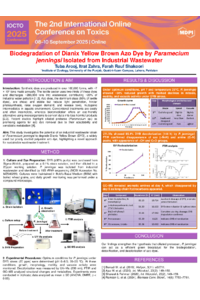
Azo dyes are widely used in textile industry processes. Due to their persistent and recalcitrant nature, they are classified as xenobiotic compounds resistant to biodegradation. However, recent studies suggest that under specific environmental conditions, certain microorganisms can transform these toxic dyes into colorless, non-toxic compounds or even achieve complete mineralization. This study investigates the biodegradation efficiency of a newly isolated Paramecium species in azo dye-contaminated industrial wastewater.
Methods:
A Paramecium strain was isolated from industrial wastewater and identified as P. jenningsi via 18S rRNA sequencing (NCBI Accession No. MZ540265). Growth optimization was conducted at varying pH (6, 6.5, 7, 7.5, 8, and 8.5) and temperatures (20°C, 25°C, 30°C, and 35°C). Under optimum conditions, P. jenningsi was exposed to 20 ppm Dianix Yellow Brown (DYB) azo dye for 30 days. Growth kinetics, morphological changes, and vacuole activity were monitored to assess physiological responses. DYB decolorization was measured using a UV spectrophotometer at 260 nm over 0, 48, 96, and 144 hours. FTIR was used to assess functional group changes, and GC-MS was used to identify dye-degradation metabolites.
Results:
Under optimum pH 7.0 and 25°C, P. jenningsi exhibited distinct growth phases, with a 26-fold increase in growth by day 14 in 20 ppm DYB compared to the control. However, reductions in mitosis, motility, and vacuole activity indicated mild DYB toxicity. By 144 hours, 85.43% DYB decolorization was observed. FTIR revealed the loss of azo (-N=N) and amine (C-N) groups, alongside the formation of hydroxyl (-OH) and carbonyl (-C=O) groups, indicating dye transformation. GC-MS profiling suggested a two-step degradation: by day 4, formation of 4-tert-butylaniline, N-trimethylsilyl, 3-hydroxyanthranilic acid, and bis(2-ethylhexyl) phthalate indicated azo bond cleavage; by day 8, pentacosane, octacosane, and eicosane suggested further DYB breakdown into less toxic compounds.
Conclusions:
This study highlights P. jenningsi as a promising tool for the bioremediation of azo dye-contaminated wastewater.
Keywords
Wastewater
Paramecium
azo dyes
decolorization
bioremediation
Poster
Poster presentaion_Tuba Arooj 01-09-25.pdf
Advanced analytical method for determination of Aflatoxins in chilli powder using LC-MS/MS
Toxicological responses to Perfluorononanoic acid (PFNA) in larval zebrafish (Danio rerio)