Event submissions
Published
This submission belongs to the session S7. Resilient Agricultural Landscape Systems of the event The 2nd International Electronic Conference on Land
Published date
02 Sep, 2025
Academic Editor
'%3e%3cpath%20d='M12.6657%2010.9104C12.4185%2010.325%2012.0599%209.79327%2011.6097%209.34482C11.1609%208.89508%2010.6293%208.5365%2010.0442%208.28888C10.0389%208.28626%2010.0337%208.28495%2010.0285%208.28233C10.8446%207.69279%2011.3752%206.73249%2011.3752%205.64904C11.3752%203.8542%209.92103%202.39999%208.1262%202.39999C6.33136%202.39999%204.87715%203.8542%204.87715%205.64904C4.87715%206.73249%205.40774%207.69279%206.22393%208.28364C6.21869%208.28626%206.21345%208.28757%206.20821%208.29019C5.62129%208.5378%205.09463%208.89284%204.64265%209.34613C4.1929%209.79493%203.83432%2010.3266%203.58671%2010.9117C3.34345%2011.4845%203.21226%2012.0987%203.20023%2012.7209C3.19988%2012.7349%203.20233%2012.7488%203.20744%2012.7619C3.21255%2012.7749%203.22022%2012.7867%203.22998%2012.7968C3.23975%2012.8068%203.25142%2012.8147%203.26431%2012.8202C3.2772%2012.8256%203.29105%2012.8284%203.30504%2012.8284H4.09109C4.14874%2012.8284%204.19459%2012.7825%204.1959%2012.7262C4.2221%2011.7148%204.62823%2010.7676%205.34617%2010.0497C6.08899%209.30683%207.0755%208.89808%208.1262%208.89808C9.17689%208.89808%2010.1634%209.30683%2010.9062%2010.0497C11.6242%2010.7676%2012.0303%2011.7148%2012.0565%2012.7262C12.0578%2012.7838%2012.1037%2012.8284%2012.1613%2012.8284H12.9474C12.9613%2012.8284%2012.9752%2012.8256%2012.9881%2012.8202C13.001%2012.8147%2013.0126%2012.8068%2013.0224%2012.7968C13.0322%2012.7867%2013.0398%2012.7749%2013.0449%2012.7619C13.0501%2012.7488%2013.0525%2012.7349%2013.0522%2012.7209C13.0391%2012.0947%2012.9094%2011.4855%2012.6657%2010.9104ZM8.1262%207.9024C7.52486%207.9024%206.9589%207.6679%206.53312%207.24211C6.10733%206.81633%205.87283%206.25037%205.87283%205.64904C5.87283%205.0477%206.10733%204.48174%206.53312%204.05596C6.9589%203.63018%207.52486%203.39567%208.1262%203.39567C8.72753%203.39567%209.29349%203.63018%209.71927%204.05596C10.1451%204.48174%2010.3796%205.0477%2010.3796%205.64904C10.3796%206.25037%2010.1451%206.81633%209.71927%207.24211C9.29349%207.6679%208.72753%207.9024%208.1262%207.9024Z'%20fill='%235D1EE1'/%3e%3c/g%3e%3c/svg%3e) Hossein Azadi
Hossein AzadiCitation
O. S. Carine Oyatola, Tatiana De Oliviera, Samuel Laboisse, Bruno Bachelier, Rodrigue Vivien Cao Diogo, Optimizing mineral fertilizer rates with biochar and compost: a slow-release fertilizer for nutrient use efficiency and cotton yield improvement in northern Benin, in Proceedings of The 2nd International Electronic Conference on Land, 4 September–5 September 2025, MDPI: Basel, Switzerland
Share
Email
Facebook
Twitter
LinkedIn
Optimizing mineral fertilizer rates with biochar and compost: a slow-release fertilizer for nutrient use efficiency and cotton yield improvement in northern Benin
'%3e%3cpath%20d='M12.6647%2010.9104C12.4176%2010.325%2012.0589%209.7933%2011.6088%209.34485C11.16%208.89511%2010.6283%208.53653%2010.0432%208.28891C10.038%208.28629%2010.0327%208.28498%2010.0275%208.28236C10.8437%207.69282%2011.3743%206.73252%2011.3743%205.64907C11.3743%203.85423%209.92005%202.40002%208.12522%202.40002C6.33038%202.40002%204.87618%203.85423%204.87618%205.64907C4.87618%206.73252%205.40677%207.69282%206.22296%208.28367C6.21772%208.28629%206.21248%208.2876%206.20724%208.29022C5.62031%208.53783%205.09365%208.89287%204.64167%209.34616C4.19192%209.79496%203.83334%2010.3266%203.58573%2010.9117C3.34247%2011.4846%203.21128%2012.0987%203.19925%2012.721C3.1989%2012.735%203.20135%2012.7489%203.20646%2012.7619C3.21157%2012.7749%203.21924%2012.7868%203.22901%2012.7968C3.23877%2012.8068%203.25045%2012.8148%203.26334%2012.8202C3.27623%2012.8256%203.29007%2012.8284%203.30406%2012.8284H4.09012C4.14776%2012.8284%204.19362%2012.7825%204.19493%2012.7262C4.22113%2011.7148%204.62726%2010.7676%205.34519%2010.0497C6.08802%209.30686%207.07452%208.89811%208.12522%208.89811C9.17592%208.89811%2010.1624%209.30686%2010.9052%2010.0497C11.6232%2010.7676%2012.0293%2011.7148%2012.0555%2012.7262C12.0568%2012.7839%2012.1027%2012.8284%2012.1603%2012.8284H12.9464C12.9604%2012.8284%2012.9742%2012.8256%2012.9871%2012.8202C13%2012.8148%2013.0117%2012.8068%2013.0214%2012.7968C13.0312%2012.7868%2013.0389%2012.7749%2013.044%2012.7619C13.0491%2012.7489%2013.0515%2012.735%2013.0512%2012.721C13.0381%2012.0947%2012.9084%2011.4856%2012.6647%2010.9104ZM8.12522%207.90243C7.52388%207.90243%206.95792%207.66793%206.53214%207.24215C6.10636%206.81636%205.87185%206.2504%205.87185%205.64907C5.87185%205.04773%206.10636%204.48177%206.53214%204.05599C6.95792%203.63021%207.52388%203.3957%208.12522%203.3957C8.72655%203.3957%209.29252%203.63021%209.7183%204.05599C10.1441%204.48177%2010.3786%205.04773%2010.3786%205.64907C10.3786%206.2504%2010.1441%206.81636%209.7183%207.24215C9.29252%207.66793%208.72655%207.90243%208.12522%207.90243Z'%20fill='%235D1EE1'/%3e%3c/g%3e%3c/svg%3e)
O. S. Carine Oyatola 1
Tatiana De Oliviera 2
Samuel Laboisse 2
Bruno Bachelier 3
Rodrigue Vivien Cao Diogo 4
1. Doctoral School of Agricultural and Water Sciences; University of Parakou; P.O. Box 123; Parakou; 123; Benin
2. International School of Agro-Development (ISTOM); 4 Rue Joseph Lakanal; Angers; 49000; France
3. International Cooperation Centre of Agricultural Research for Development (CIRAD); Avenue Agropolis; Montpellier; 34398; France
4. Faculty of Agronomy; University of Parakou; Parakou; 123; Benin
Abstract
In Benin, the sustainability of cotton (Gossypium hirsutum L.) production is threatened by the dependency on mineral fertilizers (MFs). Although MFs are effective in increasing cotton yields, they are often misused by farmers, leading to soil degradation and detrimental environmental impacts. This study optimizes nutrient use efficiency by activating biochar with two nutrient sources, MF (NPKSB+urea) and Compost (C), which was tested on cotton. The design was an RCBD with four replicates and eighteen (18) treatment combinations:three proportions of biochar (0%, 15%, and 25%, named B0, B15, and B25, respectively) and six fertilizer rates (combinations of MF and compost: 25% C+50% MF; 50% C+50% MF; 25% C+75% MF; 0% C+100% MF; 0% C+75% MF; and 0% C+50% MF, named C25N50; C50N50; C25N75; C0N100; C0N75; and C0N50, respectively). Variables measured included yield (YLD: 180 days after planting (DAP)), plant height (HT: 45, 60, 90, and 120 DAP), number of fruiting branches per plant (NFB: 120 DAP), and number of capsules per branch (NCF: 120 DAP). Analysis of variance (ANOVA) was performed using standard procedure in R version 4.4.2. The results show that yield was strongly influenced by the application of NPK fertilizer with or without compost compensation, while biochar does not show a significant effect (p = 0.912). But MF has a significant effect on all response variables, particularly on HT (p < 0.001) and NFB (p = 0.001). Application of 25% biochar combined with 75% fertilizer exhibited higher performance, with an average of 141.2 cm. NFB increased with B15C50N50 (30.65 compared to 21,4 per plant on control plot). Regarding the cottonseed yield, an average highest yield of 3,41 t/ha was determined with B15C25N75 compared to 2.25 t/ha in B0C0N0. These results highlight the potential of biochar as a sustainable amendment to improve nutrient use efficiency. Combining MF application with biochar and compost maximizes cotton performance while reducing environmental impacts.
Keywords
NPK fertilizer
organic amendments
slow-release fertilizer-SRF
Soil degradation
Sustainable agriculture
yield
West Africa.
Poster
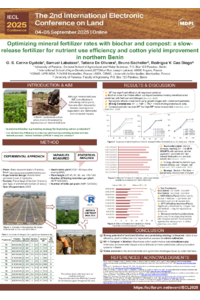
2nd International Electronic Conference on Land_OYATOLA.pdf
Urban Transformation Analysis of Metro Corridor Expansion, LULC Changes, and openly accessible DEM Accuracy Assessments using ICESat-2
Wildfire Damage Assessment over Eaton Canyon, California, using Radar and Multispectral datasets from Sentinel Satellites and Machine Learning Methods