Event submissions
Published
This submission belongs to the session 2. Molecular Stressors – Nanoparticles, Mixtures, and Persistent Pollutants of the event The 2nd International Online Conference on Toxics
Published date
02 Sep, 2025
Academic Editor
'%3e%3cpath%20d='M12.6657%2010.9104C12.4185%2010.325%2012.0599%209.79327%2011.6097%209.34482C11.1609%208.89508%2010.6293%208.5365%2010.0442%208.28888C10.0389%208.28626%2010.0337%208.28495%2010.0285%208.28233C10.8446%207.69279%2011.3752%206.73249%2011.3752%205.64904C11.3752%203.8542%209.92103%202.39999%208.1262%202.39999C6.33136%202.39999%204.87715%203.8542%204.87715%205.64904C4.87715%206.73249%205.40774%207.69279%206.22393%208.28364C6.21869%208.28626%206.21345%208.28757%206.20821%208.29019C5.62129%208.5378%205.09463%208.89284%204.64265%209.34613C4.1929%209.79493%203.83432%2010.3266%203.58671%2010.9117C3.34345%2011.4845%203.21226%2012.0987%203.20023%2012.7209C3.19988%2012.7349%203.20233%2012.7488%203.20744%2012.7619C3.21255%2012.7749%203.22022%2012.7867%203.22998%2012.7968C3.23975%2012.8068%203.25142%2012.8147%203.26431%2012.8202C3.2772%2012.8256%203.29105%2012.8284%203.30504%2012.8284H4.09109C4.14874%2012.8284%204.19459%2012.7825%204.1959%2012.7262C4.2221%2011.7148%204.62823%2010.7676%205.34617%2010.0497C6.08899%209.30683%207.0755%208.89808%208.1262%208.89808C9.17689%208.89808%2010.1634%209.30683%2010.9062%2010.0497C11.6242%2010.7676%2012.0303%2011.7148%2012.0565%2012.7262C12.0578%2012.7838%2012.1037%2012.8284%2012.1613%2012.8284H12.9474C12.9613%2012.8284%2012.9752%2012.8256%2012.9881%2012.8202C13.001%2012.8147%2013.0126%2012.8068%2013.0224%2012.7968C13.0322%2012.7867%2013.0398%2012.7749%2013.0449%2012.7619C13.0501%2012.7488%2013.0525%2012.7349%2013.0522%2012.7209C13.0391%2012.0947%2012.9094%2011.4855%2012.6657%2010.9104ZM8.1262%207.9024C7.52486%207.9024%206.9589%207.6679%206.53312%207.24211C6.10733%206.81633%205.87283%206.25037%205.87283%205.64904C5.87283%205.0477%206.10733%204.48174%206.53312%204.05596C6.9589%203.63018%207.52486%203.39567%208.1262%203.39567C8.72753%203.39567%209.29349%203.63018%209.71927%204.05596C10.1451%204.48174%2010.3796%205.0477%2010.3796%205.64904C10.3796%206.25037%2010.1451%206.81633%209.71927%207.24211C9.29349%207.6679%208.72753%207.9024%208.1262%207.9024Z'%20fill='%235D1EE1'/%3e%3c/g%3e%3c/svg%3e) Xiaojun Luo
Xiaojun LuoCitation
Beatriz Cristão, Paula Martins-Lopes, Filomena Adega, Helena Rodrigues, Marlene Lúcio, Carla M. Lopes, Toxicity evaluation of solid lipid nanocarriers using in vitro and in vivo approaches, in Proceedings of The 2nd International Online Conference on Toxics, 8 September–10 September 2025, MDPI: Basel, Switzerland
Share
Email
Facebook
Twitter
LinkedIn
Toxicity evaluation of solid lipid nanocarriers using in vitro and in vivo approaches
'%3e%3cpath%20d='M12.6647%2010.9104C12.4176%2010.325%2012.0589%209.7933%2011.6088%209.34485C11.16%208.89511%2010.6283%208.53653%2010.0432%208.28891C10.038%208.28629%2010.0327%208.28498%2010.0275%208.28236C10.8437%207.69282%2011.3743%206.73252%2011.3743%205.64907C11.3743%203.85423%209.92005%202.40002%208.12522%202.40002C6.33038%202.40002%204.87618%203.85423%204.87618%205.64907C4.87618%206.73252%205.40677%207.69282%206.22296%208.28367C6.21772%208.28629%206.21248%208.2876%206.20724%208.29022C5.62031%208.53783%205.09365%208.89287%204.64167%209.34616C4.19192%209.79496%203.83334%2010.3266%203.58573%2010.9117C3.34247%2011.4846%203.21128%2012.0987%203.19925%2012.721C3.1989%2012.735%203.20135%2012.7489%203.20646%2012.7619C3.21157%2012.7749%203.21924%2012.7868%203.22901%2012.7968C3.23877%2012.8068%203.25045%2012.8148%203.26334%2012.8202C3.27623%2012.8256%203.29007%2012.8284%203.30406%2012.8284H4.09012C4.14776%2012.8284%204.19362%2012.7825%204.19493%2012.7262C4.22113%2011.7148%204.62726%2010.7676%205.34519%2010.0497C6.08802%209.30686%207.07452%208.89811%208.12522%208.89811C9.17592%208.89811%2010.1624%209.30686%2010.9052%2010.0497C11.6232%2010.7676%2012.0293%2011.7148%2012.0555%2012.7262C12.0568%2012.7839%2012.1027%2012.8284%2012.1603%2012.8284H12.9464C12.9604%2012.8284%2012.9742%2012.8256%2012.9871%2012.8202C13%2012.8148%2013.0117%2012.8068%2013.0214%2012.7968C13.0312%2012.7868%2013.0389%2012.7749%2013.044%2012.7619C13.0491%2012.7489%2013.0515%2012.735%2013.0512%2012.721C13.0381%2012.0947%2012.9084%2011.4856%2012.6647%2010.9104ZM8.12522%207.90243C7.52388%207.90243%206.95792%207.66793%206.53214%207.24215C6.10636%206.81636%205.87185%206.2504%205.87185%205.64907C5.87185%205.04773%206.10636%204.48177%206.53214%204.05599C6.95792%203.63021%207.52388%203.3957%208.12522%203.3957C8.72655%203.3957%209.29252%203.63021%209.7183%204.05599C10.1441%204.48177%2010.3786%205.04773%2010.3786%205.64907C10.3786%206.2504%2010.1441%206.81636%209.7183%207.24215C9.29252%207.66793%208.72655%207.90243%208.12522%207.90243Z'%20fill='%235D1EE1'/%3e%3c/g%3e%3c/svg%3e)
Beatriz Cristão 1,2
Paula Martins-Lopes 1,2
Filomena Adega 2,3
Helena Rodrigues 4

Marlene Lúcio 5

Carla M. Lopes 6,7
1. DNA & RNA Sensing Lab, University of Trás-os-Montes and Alto Douro, Genetics and Biotechnology Department, Blocos Laboratoriais Ed, 5000-801 Vila Real, Portugal
2. University of Lisboa, Faculty of Sciences, BioISI – Biosystems & Integrative Sciences Institute, Campo Grande, 1749-016 Lisboa, Portugal
3. CAG—Laboratory of Cytogenomics and Animal Genomics, Department of Genetics and Biotechnology, University of Trás-os-Montes e Alto Douro, 5000-801 Vila Real, Portugal
4. LAQV, REQUIMTE, Department of Chemistry and Biochemistry, Faculty of Sciences, University of Porto, Porto, Portugal
5. CF-UM-UP- Centre of Physics of University of Minho and Porto; LAPMET- Laboratório para Materiais e Tecnologias Emergentes; CBMA- Centre of Molecular and Environmental Biology, Department of Biology, University of Minho, Campus of Gualtar, 4710-057, Braga,
6. I3ID – Instituto de Investigação, Inovação e Desenvolvimento, FP-BHS – Biomedical and Health Sciences Research Unit, RISE HEALTH – UFP, Faculdade Ciências da Saúde, Universidade Fernando Pessoa, 4200-551, Porto, Portugal
7. Associate Laboratory i4HB–Institute for Health and Bioeconomy and UCIBIO–Applied Molecular Biosciences Unit, MEDTECH, Laboratory of Pharmaceutical Technology, Faculty of Pharmacy, University of Porto, 4050-313, Porto, Portugal
Abstract
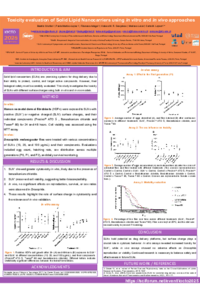
Nanotechnology has been extensively used in the development of drug delivery systems, with various benefits on the protection, control release, and improvement of drug delivery to target sites. Among nanocarriers, lipid-based ones, such as solid lipid nanoparticles (SLNs), have been biocompatible and theoretically safe for pharmaceutical application. Even so, studies evaluating the possible toxicity of nanocarriers have been dismissed and are lacking in the literature. Therefore, our study aimed to evaluate the toxicity of SLNs and their components using in vitro and in vivo studies. The in vitro studies were carried out in a normal human fibroblast cell line. The formulations of positively charged SLNs (SLNs+) exhibited greater cytotoxicity compared to negatively charged ones (SLNs-), especially at higher concentrations (10, 20, and 100µg/mL), suggesting that this response is probably due to the higher interaction of SLNs+ with cell membranes. The SLN components (Precirol® ATO 5, Tween® 80, and benzalkonium chloride) were also studied in their higher concentration within the formulation. Benzalkonium chloride was the only component that exhibited toxicity in the in vitro studies. The in vivo assays were performed using Drosophila melanogaster with SLN+ at 100µg/mL and their components. The toxicity was studied taking into consideration chronic and periodic exposition, and the parameters accessed were egg number, hatched flies, and sex. Considering chronic exposure, no statistical differences were found considering these parameters. When F1 flies, submitted to chronical exposure, were crossed with non-treated flies, the effect on gender was evident when the different components were tested. The discrepancy between the in vitro and in vivo result suggests that while SLNs demonstrate toxicity in cell cultures, their effects are less pronounced in whole organisms, likely due to biological factors such as metabolism and detoxification mechanisms, highlighting the need for comprehensive in vivo testing to assess the true impact of nanocarriers.
Keywords
Solid lipid nanoparticles
Toxicity
Cell viability
Drosophila melanogaster
Poster
Sciforum 130019_Beatriz Cristão.pdf
Potential of wood-based activated carbon to mitigate toxic element uptake in spinach for safe consumption
RNA m6A reader YTHDF3/UBE2G2 m6A methylation/ACSL4 ubiquitination axis-facilitated cell ferroptosis to mediate benzene hematotoxicity and the protective effect of melatonin