Event submissions
Published
This submission belongs to the session 4. Pesticides, Pollutants, and Health Risk of the event The 2nd International Online Conference on Toxics
Published date
02 Sep, 2025
Academic Editor
'%3e%3cpath%20d='M12.6657%2010.9104C12.4185%2010.325%2012.0599%209.79327%2011.6097%209.34482C11.1609%208.89508%2010.6293%208.5365%2010.0442%208.28888C10.0389%208.28626%2010.0337%208.28495%2010.0285%208.28233C10.8446%207.69279%2011.3752%206.73249%2011.3752%205.64904C11.3752%203.8542%209.92103%202.39999%208.1262%202.39999C6.33136%202.39999%204.87715%203.8542%204.87715%205.64904C4.87715%206.73249%205.40774%207.69279%206.22393%208.28364C6.21869%208.28626%206.21345%208.28757%206.20821%208.29019C5.62129%208.5378%205.09463%208.89284%204.64265%209.34613C4.1929%209.79493%203.83432%2010.3266%203.58671%2010.9117C3.34345%2011.4845%203.21226%2012.0987%203.20023%2012.7209C3.19988%2012.7349%203.20233%2012.7488%203.20744%2012.7619C3.21255%2012.7749%203.22022%2012.7867%203.22998%2012.7968C3.23975%2012.8068%203.25142%2012.8147%203.26431%2012.8202C3.2772%2012.8256%203.29105%2012.8284%203.30504%2012.8284H4.09109C4.14874%2012.8284%204.19459%2012.7825%204.1959%2012.7262C4.2221%2011.7148%204.62823%2010.7676%205.34617%2010.0497C6.08899%209.30683%207.0755%208.89808%208.1262%208.89808C9.17689%208.89808%2010.1634%209.30683%2010.9062%2010.0497C11.6242%2010.7676%2012.0303%2011.7148%2012.0565%2012.7262C12.0578%2012.7838%2012.1037%2012.8284%2012.1613%2012.8284H12.9474C12.9613%2012.8284%2012.9752%2012.8256%2012.9881%2012.8202C13.001%2012.8147%2013.0126%2012.8068%2013.0224%2012.7968C13.0322%2012.7867%2013.0398%2012.7749%2013.0449%2012.7619C13.0501%2012.7488%2013.0525%2012.7349%2013.0522%2012.7209C13.0391%2012.0947%2012.9094%2011.4855%2012.6657%2010.9104ZM8.1262%207.9024C7.52486%207.9024%206.9589%207.6679%206.53312%207.24211C6.10733%206.81633%205.87283%206.25037%205.87283%205.64904C5.87283%205.0477%206.10733%204.48174%206.53312%204.05596C6.9589%203.63018%207.52486%203.39567%208.1262%203.39567C8.72753%203.39567%209.29349%203.63018%209.71927%204.05596C10.1451%204.48174%2010.3796%205.0477%2010.3796%205.64904C10.3796%206.25037%2010.1451%206.81633%209.71927%207.24211C9.29349%207.6679%208.72753%207.9024%208.1262%207.9024Z'%20fill='%235D1EE1'/%3e%3c/g%3e%3c/svg%3e) Virgínia Cruz Fernandes
Virgínia Cruz FernandesCitation
Marta Rojais, Sara C. Antunes, Sara Rodrigues, The Ecotoxicological Effects of Metformin under Global Warming Scenarios: Daphnia magna and Danio rerio Insights, in Proceedings of The 2nd International Online Conference on Toxics, 8 September–10 September 2025, MDPI: Basel, Switzerland
Share
Email
Facebook
Twitter
LinkedIn
The Ecotoxicological Effects of Metformin under Global Warming Scenarios: Daphnia magna and Danio rerio Insights

Marta Rojais 1,2

Sara C. Antunes 1,3

Sara Rodrigues 1,3
1. Biology Department, Sciences Faculty of the University of Porto, Rua do Campo Alegre S/N, 4169-007 Porto, Portugal
2. School of Medicine and Biomedical Sciences of the University of Porto, Rua de Jorge Viterbo Ferreira, 228, 4050-313 Porto, Portugal
3. Interdisciplinary Centre of Marine and Environmental Research, Terminal de Cruzeiros do Porto de Leixões, Avenida General Norton de Matos S/N, 4550-208 Matosinhos, Portugal
Abstract
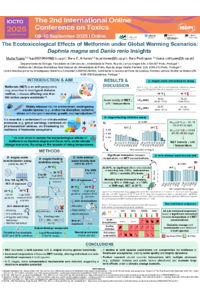
Background: Diabetes Mellitus (DM) is a major global health issue, affecting over 500 million people. Metformin (MET), an antihyperglycemic drug prescribed for Type II DM treatment, is frequently detected in aquatic environments due to its widespread use and poor removal capacity from wastewater. Concomitantly, freshwater ecosystems are also threatened by other environmental stressors, including global warming, making it necessary to understand the interactions between anthropogenic and climate-related pressures. This study aimed to assess the ecotoxicological effects of metformin on Daphnia magna and Danio rerio under rising temperature scenarios. Methods: D. magna acute immobilization (48 h; 0.00–120 mg MET/L; 20 ± 1°C) and D. rerio Fish Embryo Acute Toxicity (FET) (96 h; 0.00–3000 mg MET/L; 26 ± 1°C) assays were performed following OECD guidelines. D. magna feeding inhibition assays (24 h; 0.00–80 mg MET/L; 20 ± 1°C) were conducted following previous works (standard temperature). The same bioassays were also performed with a 4°C temperature increase (projections by the IPCC until 2100), i.e., 24 ± 1°C for D. magna and 30 ± 1°C for D. rerio. Results: At standard temperature, MET induced acute toxicity in D. magna (LC₅₀ (48 h) = 70.64 mg/L; EC₅₀ (48 h) = 53.67 mg/L) and reduced feeding rate (EC₅₀ = 54.18 mg/L). In D. rerio, MET had no significant effects on mortality and hatching but induced malformations (scoliosis and edema). MET exposure induced oxidative stress and neurotoxicity in D. magna and altered the homeostasis of the antioxidant and detoxification enzymes in D. rerio larvae. Increased temperature influenced MET's toxic effects, affecting individual and sub-individual responses. Conclusions: This study showed that increased temperatures (based on global warming projections) influence MET toxicity at the individual and sub-individual level, with D. magna showing higher sensitivity. The combined effects of rising temperatures and MET pollution underscore the vulnerability of freshwater environments.
Keywords
Pharmaceuticals
Climate Change
Ecotoxicological studies
Aquatic standard species
Poster
Rojais_et_al_poster_IOCTO.pdf
Association between phenolic compound exposure and liver function: Using machine learning models to identify primary risk factors
Microplastic contamination in reservoirs: an invisible threat to ecosystem and water quality integrity