Event submissions
Published
This submission belongs to the session S6. Neuropsychiatric Disorders of the event The 1st International Online Conference on Diseases
Published date
02 Sep, 2025
Academic Editor
'%3e%3cpath%20d='M12.6657%2010.9104C12.4185%2010.325%2012.0599%209.79327%2011.6097%209.34482C11.1609%208.89508%2010.6293%208.5365%2010.0442%208.28888C10.0389%208.28626%2010.0337%208.28495%2010.0285%208.28233C10.8446%207.69279%2011.3752%206.73249%2011.3752%205.64904C11.3752%203.8542%209.92103%202.39999%208.1262%202.39999C6.33136%202.39999%204.87715%203.8542%204.87715%205.64904C4.87715%206.73249%205.40774%207.69279%206.22393%208.28364C6.21869%208.28626%206.21345%208.28757%206.20821%208.29019C5.62129%208.5378%205.09463%208.89284%204.64265%209.34613C4.1929%209.79493%203.83432%2010.3266%203.58671%2010.9117C3.34345%2011.4845%203.21226%2012.0987%203.20023%2012.7209C3.19988%2012.7349%203.20233%2012.7488%203.20744%2012.7619C3.21255%2012.7749%203.22022%2012.7867%203.22998%2012.7968C3.23975%2012.8068%203.25142%2012.8147%203.26431%2012.8202C3.2772%2012.8256%203.29105%2012.8284%203.30504%2012.8284H4.09109C4.14874%2012.8284%204.19459%2012.7825%204.1959%2012.7262C4.2221%2011.7148%204.62823%2010.7676%205.34617%2010.0497C6.08899%209.30683%207.0755%208.89808%208.1262%208.89808C9.17689%208.89808%2010.1634%209.30683%2010.9062%2010.0497C11.6242%2010.7676%2012.0303%2011.7148%2012.0565%2012.7262C12.0578%2012.7838%2012.1037%2012.8284%2012.1613%2012.8284H12.9474C12.9613%2012.8284%2012.9752%2012.8256%2012.9881%2012.8202C13.001%2012.8147%2013.0126%2012.8068%2013.0224%2012.7968C13.0322%2012.7867%2013.0398%2012.7749%2013.0449%2012.7619C13.0501%2012.7488%2013.0525%2012.7349%2013.0522%2012.7209C13.0391%2012.0947%2012.9094%2011.4855%2012.6657%2010.9104ZM8.1262%207.9024C7.52486%207.9024%206.9589%207.6679%206.53312%207.24211C6.10733%206.81633%205.87283%206.25037%205.87283%205.64904C5.87283%205.0477%206.10733%204.48174%206.53312%204.05596C6.9589%203.63018%207.52486%203.39567%208.1262%203.39567C8.72753%203.39567%209.29349%203.63018%209.71927%204.05596C10.1451%204.48174%2010.3796%205.0477%2010.3796%205.64904C10.3796%206.25037%2010.1451%206.81633%209.71927%207.24211C9.29349%207.6679%208.72753%207.9024%208.1262%207.9024Z'%20fill='%235D1EE1'/%3e%3c/g%3e%3c/svg%3e) Michele Malaguarnera
Michele MalaguarneraCitation
Stefano Castellani, Rosanna Mallamaci, Nicola Zizzo, Giuseppe Passantino, Giuseppe Fracchiolla, Danilo Scardicchio, Ilaria Deruggiero, Vito Cannillo, Anna Patrizia Denichilo, Massimo Conese, Adriana Trapani, Solid lipid nanoparticles for Anle 138b administration in Parkinson disease: towards an industrial scale up with nutraceutical formulations, in Proceedings of The 1st International Online Conference on Diseases, 9 September–11 September 2025, MDPI: Basel, Switzerland
Share
Email
Facebook
Twitter
LinkedIn
Solid lipid nanoparticles for Anle 138b administration in Parkinson disease: towards an industrial scale up with nutraceutical formulations

Stefano Castellani 1

Rosanna Mallamaci 2
'%3e%3cpath%20d='M12.6647%2010.9104C12.4176%2010.325%2012.0589%209.7933%2011.6088%209.34485C11.16%208.89511%2010.6283%208.53653%2010.0432%208.28891C10.038%208.28629%2010.0327%208.28498%2010.0275%208.28236C10.8437%207.69282%2011.3743%206.73252%2011.3743%205.64907C11.3743%203.85423%209.92005%202.40002%208.12522%202.40002C6.33038%202.40002%204.87618%203.85423%204.87618%205.64907C4.87618%206.73252%205.40677%207.69282%206.22296%208.28367C6.21772%208.28629%206.21248%208.2876%206.20724%208.29022C5.62031%208.53783%205.09365%208.89287%204.64167%209.34616C4.19192%209.79496%203.83334%2010.3266%203.58573%2010.9117C3.34247%2011.4846%203.21128%2012.0987%203.19925%2012.721C3.1989%2012.735%203.20135%2012.7489%203.20646%2012.7619C3.21157%2012.7749%203.21924%2012.7868%203.22901%2012.7968C3.23877%2012.8068%203.25045%2012.8148%203.26334%2012.8202C3.27623%2012.8256%203.29007%2012.8284%203.30406%2012.8284H4.09012C4.14776%2012.8284%204.19362%2012.7825%204.19493%2012.7262C4.22113%2011.7148%204.62726%2010.7676%205.34519%2010.0497C6.08802%209.30686%207.07452%208.89811%208.12522%208.89811C9.17592%208.89811%2010.1624%209.30686%2010.9052%2010.0497C11.6232%2010.7676%2012.0293%2011.7148%2012.0555%2012.7262C12.0568%2012.7839%2012.1027%2012.8284%2012.1603%2012.8284H12.9464C12.9604%2012.8284%2012.9742%2012.8256%2012.9871%2012.8202C13%2012.8148%2013.0117%2012.8068%2013.0214%2012.7968C13.0312%2012.7868%2013.0389%2012.7749%2013.044%2012.7619C13.0491%2012.7489%2013.0515%2012.735%2013.0512%2012.721C13.0381%2012.0947%2012.9084%2011.4856%2012.6647%2010.9104ZM8.12522%207.90243C7.52388%207.90243%206.95792%207.66793%206.53214%207.24215C6.10636%206.81636%205.87185%206.2504%205.87185%205.64907C5.87185%205.04773%206.10636%204.48177%206.53214%204.05599C6.95792%203.63021%207.52388%203.3957%208.12522%203.3957C8.72655%203.3957%209.29252%203.63021%209.7183%204.05599C10.1441%204.48177%2010.3786%205.04773%2010.3786%205.64907C10.3786%206.2504%2010.1441%206.81636%209.7183%207.24215C9.29252%207.66793%208.72655%207.90243%208.12522%207.90243Z'%20fill='%235D1EE1'/%3e%3c/g%3e%3c/svg%3e)
Nicola Zizzo 3

Giuseppe Passantino 3
Giuseppe Fracchiolla 4
Danilo Scardicchio 5
Ilaria Deruggiero 5
Vito Cannillo 5
Anna Patrizia Denichilo 4

Massimo Conese 6
Adriana Trapani 4
1. Department of Precision and Regenerative Medicine and Ionian Area (DiMePRe-J),University of Bari “Aldo Moro”, 70124 Bari, Italy
2. Department of Biosciences, Biotechnologies and Environment, University of Bari “Aldo Moro”, 70125 Bari, Italy
3. Department of Veterinary Medicine, Pathological Anatomy, University of Bari “Aldo Moro”, 70125 Bari, Italy
4. Department of Pharmacy-Drug Sciences, University of Bari “Aldo Moro”, 70125 Bari, Italy
5. Erbenobili s.r.l., 70033 Corato, Italy
6. Department of Clinical and Experimental Medicine, University of Foggia, 71122 Foggia, Italy
Abstract
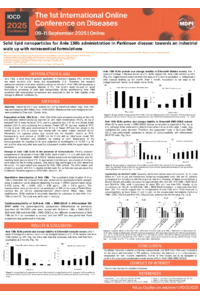
INTRODUCTION Anle 138b, a novel drug for geriatric application in Parkinson's disease (PD), suffers from low water solubility and, hence, low bioavailability (1-2). Therefore, the research on novel water-soluble products as a vehicle for Anle 138b still represents a challenge for the neurological disorder of PD. The current study focused on some formulations consisting of solid lipid nanoparticles (SLNs) allowing the administration of Anle 138b combined with nutraceutical components, evaluated in vitro for their stability under storage in different conditions (3).
METHODS Via dynamic light scattering apparatus, the particle size evolution of the SLNs over 2 months was monitored during the storage time. Furthermore, via spectrophotometric quantification, drug content analysis allowed us to monitor the changes in the Anle 138b concentrations in order to identify the most promising formulation among the tested ones. For cytocompatibility assessment, by using the MTT test, differentiated SH-SY5Y cells were treated for 24 hours with SLN-Anle 138b in the presence of a multicomponent nutraceutical formulation.
RESULTS Viscous vegetal extract combined with SLN-Anle 138b was difficult to handle after seven days, whereas a less dense tested formulation was flocculated after one month of storage at 4 °C. In differentiated SH-SY5Y cells, a multicomponent nutraceutical formulation was well tolerated for 24 h, when combined with SLN-Anle 138b in the range of 1 and 10 µM.
CONCLUSIONS Candidate industrial products combining nutraceuticals and SLN-Anle 138b were evaluated for administration via the nasal route in PD patients, indicating the potential of a multicomponent preparation for non-invasive treatments.
REFERENCES
- Antonschmidt, L., et al., (2022). Nat. Commun. 13, 5385
- Jia, C.Y., et al (2020). Drug Discov. Today 25, 248
- Mallamaci R., Castellani S., et al., (2025). Int J Pharm, 673, 125399
Keywords
Parkinson disease
Drug administration
Solid lipid Nanoparticles
Poster
POSTER SCIFORUM Castellani et al.pdf
Impact of Dual-Task Resistance Training on Klotho Levels in Institutionalized Older Adults
Sex-related differences in nurse–patient relations and problematic cell phone use among Italian oncology nurses