Event submissions
Published
This submission belongs to the session 4. Pesticides, Pollutants, and Health Risk of the event The 2nd International Online Conference on Toxics
Published date
03 Sep, 2025
Academic Editor
'%3e%3cpath%20d='M12.6657%2010.9104C12.4185%2010.325%2012.0599%209.79327%2011.6097%209.34482C11.1609%208.89508%2010.6293%208.5365%2010.0442%208.28888C10.0389%208.28626%2010.0337%208.28495%2010.0285%208.28233C10.8446%207.69279%2011.3752%206.73249%2011.3752%205.64904C11.3752%203.8542%209.92103%202.39999%208.1262%202.39999C6.33136%202.39999%204.87715%203.8542%204.87715%205.64904C4.87715%206.73249%205.40774%207.69279%206.22393%208.28364C6.21869%208.28626%206.21345%208.28757%206.20821%208.29019C5.62129%208.5378%205.09463%208.89284%204.64265%209.34613C4.1929%209.79493%203.83432%2010.3266%203.58671%2010.9117C3.34345%2011.4845%203.21226%2012.0987%203.20023%2012.7209C3.19988%2012.7349%203.20233%2012.7488%203.20744%2012.7619C3.21255%2012.7749%203.22022%2012.7867%203.22998%2012.7968C3.23975%2012.8068%203.25142%2012.8147%203.26431%2012.8202C3.2772%2012.8256%203.29105%2012.8284%203.30504%2012.8284H4.09109C4.14874%2012.8284%204.19459%2012.7825%204.1959%2012.7262C4.2221%2011.7148%204.62823%2010.7676%205.34617%2010.0497C6.08899%209.30683%207.0755%208.89808%208.1262%208.89808C9.17689%208.89808%2010.1634%209.30683%2010.9062%2010.0497C11.6242%2010.7676%2012.0303%2011.7148%2012.0565%2012.7262C12.0578%2012.7838%2012.1037%2012.8284%2012.1613%2012.8284H12.9474C12.9613%2012.8284%2012.9752%2012.8256%2012.9881%2012.8202C13.001%2012.8147%2013.0126%2012.8068%2013.0224%2012.7968C13.0322%2012.7867%2013.0398%2012.7749%2013.0449%2012.7619C13.0501%2012.7488%2013.0525%2012.7349%2013.0522%2012.7209C13.0391%2012.0947%2012.9094%2011.4855%2012.6657%2010.9104ZM8.1262%207.9024C7.52486%207.9024%206.9589%207.6679%206.53312%207.24211C6.10733%206.81633%205.87283%206.25037%205.87283%205.64904C5.87283%205.0477%206.10733%204.48174%206.53312%204.05596C6.9589%203.63018%207.52486%203.39567%208.1262%203.39567C8.72753%203.39567%209.29349%203.63018%209.71927%204.05596C10.1451%204.48174%2010.3796%205.0477%2010.3796%205.64904C10.3796%206.25037%2010.1451%206.81633%209.71927%207.24211C9.29349%207.6679%208.72753%207.9024%208.1262%207.9024Z'%20fill='%235D1EE1'/%3e%3c/g%3e%3c/svg%3e) Virgínia Cruz Fernandes
Virgínia Cruz FernandesCitation
Sara Rodrigues, Sara C. Antunes, From bacteria to fish: ecotoxicological insights into the bioinsecticide Spinosad, in Proceedings of The 2nd International Online Conference on Toxics, 8 September–10 September 2025, MDPI: Basel, Switzerland
Share
Email
Facebook
Twitter
LinkedIn
From bacteria to fish: ecotoxicological insights into the bioinsecticide Spinosad

Sara Rodrigues 1

Sara C. Antunes 2
1. Centro Interdisciplinar de Investigação Marinha e Ambiental (CIIMAR/CIMAR), Universidade do Porto, Matosinhos, 4550-208 Matosinhos, Portugal
2. Department of Biology, Faculty of Sciences, University of Porto, Porto, 4169-007 Porto, Portugal
Abstract
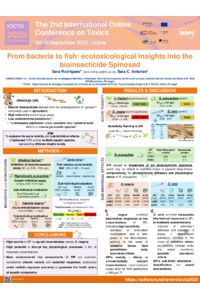
Background: Spinosad, a natural bioinsecticide derived from Saccharopolyspora spinosa, is widely used in agriculture due to its high selectivity toward target pests and low environmental persistence. However, its increasing application raises concerns about its potential toxic effects on non-target species, especially under environmentally relevant exposure scenarios. This study aimed to evaluate the acute toxicity and sublethal biochemical effects of Spinosad across multiple aquatic species, representing different trophic levels.
Methods: A multi-species ecotoxicological assessment was conducted to evaluate the sensitivity of model aquatic species to Spinosad. Standardized acute toxicity tests were performed with Aliivibrio fischeri (bacteria), Raphidocelis subcapitata (algae), Daphnia magna (crustacean), and Danio rerio embryos (fish). In addition, biochemical biomarkers were analyzed in D. magna and D. rerio to assess oxidative stress (catalase [CAT], glutathione S-transferase [GST] activities), lipid peroxidation (thiobarbituric acid reactive substances [TBARSs]), and neurotoxicity (acetylcholinesterase [AChE] inhibition) effects.
Results: Spinosad exhibited a wide range of toxicities among the tested species, with EC₅₀ values of 105.66 mg/L for A. fischeri, 3.93 mg/L for R. subcapitata, 0.018 mg/L for D. magna, and 1.37 mg/L for D. rerio embryos, indicating increasing sensitivity from prokaryotes to invertebrates. Biochemical assays revealed that even at environmentally relevant concentrations (~0.4 μg/L reported in surface waters), Spinosad induced significant oxidative stress, enhanced lipid peroxidation, and inhibited AChE activity in D. magna and D. rerio embryos, suggesting sublethal but ecologically relevant effects.
Conclusions: The ecotoxicological profile of Spinosad demonstrates its high toxicity to aquatic invertebrates and its potential to disrupt key physiological processes in fish at low concentrations. These findings highlight the need for more comprehensive environmental risk assessments that consider both acute and chronic toxicity and sublethal biomarker responses, particularly under realistic exposure scenarios. Monitoring Spinosad levels in freshwater ecosystems is crucial in order to safeguard aquatic biodiversity and guarantee the health status of aquatic ecosystems.
Keywords
Biopesticide
Screening toxicity
Aquatic organisms
Bioassays
Biomarkers
Poster
Rodrigues and Antunes_2nd International Online Conference on Toxics.pdf
Microplastic contamination in reservoirs: an invisible threat to ecosystem and water quality integrity
The Hidden Threat of Combined Stressors: The Influence of Temperature and pH on Antibiotic Toxicity in Danio rerio