Event submissions
Published
This submission belongs to the session 4. Pesticides, Pollutants, and Health Risk of the event The 2nd International Online Conference on Toxics
Published date
03 Sep, 2025
Academic Editor
'%3e%3cpath%20d='M12.6657%2010.9104C12.4185%2010.325%2012.0599%209.79327%2011.6097%209.34482C11.1609%208.89508%2010.6293%208.5365%2010.0442%208.28888C10.0389%208.28626%2010.0337%208.28495%2010.0285%208.28233C10.8446%207.69279%2011.3752%206.73249%2011.3752%205.64904C11.3752%203.8542%209.92103%202.39999%208.1262%202.39999C6.33136%202.39999%204.87715%203.8542%204.87715%205.64904C4.87715%206.73249%205.40774%207.69279%206.22393%208.28364C6.21869%208.28626%206.21345%208.28757%206.20821%208.29019C5.62129%208.5378%205.09463%208.89284%204.64265%209.34613C4.1929%209.79493%203.83432%2010.3266%203.58671%2010.9117C3.34345%2011.4845%203.21226%2012.0987%203.20023%2012.7209C3.19988%2012.7349%203.20233%2012.7488%203.20744%2012.7619C3.21255%2012.7749%203.22022%2012.7867%203.22998%2012.7968C3.23975%2012.8068%203.25142%2012.8147%203.26431%2012.8202C3.2772%2012.8256%203.29105%2012.8284%203.30504%2012.8284H4.09109C4.14874%2012.8284%204.19459%2012.7825%204.1959%2012.7262C4.2221%2011.7148%204.62823%2010.7676%205.34617%2010.0497C6.08899%209.30683%207.0755%208.89808%208.1262%208.89808C9.17689%208.89808%2010.1634%209.30683%2010.9062%2010.0497C11.6242%2010.7676%2012.0303%2011.7148%2012.0565%2012.7262C12.0578%2012.7838%2012.1037%2012.8284%2012.1613%2012.8284H12.9474C12.9613%2012.8284%2012.9752%2012.8256%2012.9881%2012.8202C13.001%2012.8147%2013.0126%2012.8068%2013.0224%2012.7968C13.0322%2012.7867%2013.0398%2012.7749%2013.0449%2012.7619C13.0501%2012.7488%2013.0525%2012.7349%2013.0522%2012.7209C13.0391%2012.0947%2012.9094%2011.4855%2012.6657%2010.9104ZM8.1262%207.9024C7.52486%207.9024%206.9589%207.6679%206.53312%207.24211C6.10733%206.81633%205.87283%206.25037%205.87283%205.64904C5.87283%205.0477%206.10733%204.48174%206.53312%204.05596C6.9589%203.63018%207.52486%203.39567%208.1262%203.39567C8.72753%203.39567%209.29349%203.63018%209.71927%204.05596C10.1451%204.48174%2010.3796%205.0477%2010.3796%205.64904C10.3796%206.25037%2010.1451%206.81633%209.71927%207.24211C9.29349%207.6679%208.72753%207.9024%208.1262%207.9024Z'%20fill='%235D1EE1'/%3e%3c/g%3e%3c/svg%3e) Virgínia Cruz Fernandes
Virgínia Cruz FernandesCitation
Bárbara S. Diogo, Sara Rodrigues, Sara C. Antunes, The Hidden Threat of Combined Stressors: The Influence of Temperature and pH on Antibiotic Toxicity in Danio rerio, in Proceedings of The 2nd International Online Conference on Toxics, 8 September–10 September 2025, MDPI: Basel, Switzerland
Share
Email
Facebook
Twitter
LinkedIn
The Hidden Threat of Combined Stressors: The Influence of Temperature and pH on Antibiotic Toxicity in Danio rerio

Bárbara S. Diogo 1,2,3

Sara Rodrigues 2,3

Sara C. Antunes 2,3
1. Abel Salazar Institute of Biomedical Sciences, University of Porto, Rua de Jorge Viterbo Ferreira 228, 4050-313 Porto, Portugal
2. Interdisciplinary Center for Marine and Environmental Research, University of Porto, Leixões Cruise Terminal, Avenida General Norton de Matos, S/N, 4450-208 Matosinhos, Portugal
3. Departamento de Biologia, Faculdade de Ciências, Universidade do Porto, 4169-007 Porto, Portugal
Abstract
Background: Aquatic ecosystems are increasingly subjected to overlapping stressors, including rising temperatures, pH variations, and antibiotic contamination (e.g., sulfamethoxazole—SMX, trimethoprim—TRIM, and their mixture—MIX). These abiotic factors may interact in complex ways, altering antibiotic toxicity and impairing key biological processes in aquatic organisms. This study aims to contribute significant data to bridge the gap regarding the combined impacts of environmental stressors, particularly in a climate change context, underscoring the need for integrative studies. Methods: We evaluated the chronic effects of environmentally relevant concentrations of SMX (150 µg/L), TRIM (30 µg/L), and their mixture (150 µg SMX/L + 30 µg TRIM/L) on Danio rerio after exposure to various i) temperatures (26, 28, and 32 °C) and ii) pH values (6.5, 7.5, and 9.0). A multi-biomarker approach was applied to assess antibiotic ecotoxicity and the biological health status of D. rerio. Results: Temperature and pH variations affected the antibiotic’s toxicity to D. rerio. At 28 °C, SMX and MIX exhibited moderate toxicity, inducing significant biological alterations (neurotoxicity and DNA damage), while TRIM showed only slight toxicity, mainly altering antioxidant/detoxification defenses. At 32 °C, MIX emerged as the most toxic compound, causing genotoxic and histopathological damage. In terms of the influence of pH, SMX had a greater impact under low-pH conditions (pH 6.5 and 7.5), leading to oxidative stress, lipid peroxidation, and DNA damage. In contrast, TRIM and MIX showed increased toxicity at neutral-to-alkaline pH (7.5 and 9.0), with notable impairment of antioxidant defenses, as well as DNA and histopathological injuries. Conclusions: The results highlight the urgent need for integrated studies that address chemical pollutants and climate change-related stressors. Ignoring these combined pressures could lead to long-term impacts on aquatic biodiversity and ecosystem stability. These findings reinforce the importance of comprehensive risk assessments that consider the potential amplification of pharmaceutical toxicity under changing environmental conditions.
Keywords
Sulfamethoxazole
Trimethoprim
Mixtures
Climate change
Ecotoxicity
Biomarkers
Zebrafish
Poster
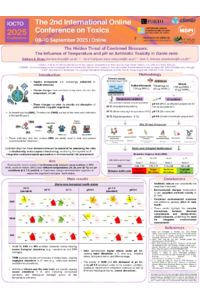
Diogo et al., Poster Toxics.pdf
From bacteria to fish: ecotoxicological insights into the bioinsecticide Spinosad
Growth Response and Phytoremediation of Copper and Chromium in Dumpsite Leachate by Common duckweed (Lemna minor L.): A Case Study of A Market Dumpsite in Maiduguri, Nigeria