Event submissions
Published
This submission belongs to the session 4. Pesticides, Pollutants, and Health Risk of the event The 2nd International Online Conference on Toxics
Published date
03 Sep, 2025
Academic Editor
'%3e%3cpath%20d='M12.6657%2010.9104C12.4185%2010.325%2012.0599%209.79327%2011.6097%209.34482C11.1609%208.89508%2010.6293%208.5365%2010.0442%208.28888C10.0389%208.28626%2010.0337%208.28495%2010.0285%208.28233C10.8446%207.69279%2011.3752%206.73249%2011.3752%205.64904C11.3752%203.8542%209.92103%202.39999%208.1262%202.39999C6.33136%202.39999%204.87715%203.8542%204.87715%205.64904C4.87715%206.73249%205.40774%207.69279%206.22393%208.28364C6.21869%208.28626%206.21345%208.28757%206.20821%208.29019C5.62129%208.5378%205.09463%208.89284%204.64265%209.34613C4.1929%209.79493%203.83432%2010.3266%203.58671%2010.9117C3.34345%2011.4845%203.21226%2012.0987%203.20023%2012.7209C3.19988%2012.7349%203.20233%2012.7488%203.20744%2012.7619C3.21255%2012.7749%203.22022%2012.7867%203.22998%2012.7968C3.23975%2012.8068%203.25142%2012.8147%203.26431%2012.8202C3.2772%2012.8256%203.29105%2012.8284%203.30504%2012.8284H4.09109C4.14874%2012.8284%204.19459%2012.7825%204.1959%2012.7262C4.2221%2011.7148%204.62823%2010.7676%205.34617%2010.0497C6.08899%209.30683%207.0755%208.89808%208.1262%208.89808C9.17689%208.89808%2010.1634%209.30683%2010.9062%2010.0497C11.6242%2010.7676%2012.0303%2011.7148%2012.0565%2012.7262C12.0578%2012.7838%2012.1037%2012.8284%2012.1613%2012.8284H12.9474C12.9613%2012.8284%2012.9752%2012.8256%2012.9881%2012.8202C13.001%2012.8147%2013.0126%2012.8068%2013.0224%2012.7968C13.0322%2012.7867%2013.0398%2012.7749%2013.0449%2012.7619C13.0501%2012.7488%2013.0525%2012.7349%2013.0522%2012.7209C13.0391%2012.0947%2012.9094%2011.4855%2012.6657%2010.9104ZM8.1262%207.9024C7.52486%207.9024%206.9589%207.6679%206.53312%207.24211C6.10733%206.81633%205.87283%206.25037%205.87283%205.64904C5.87283%205.0477%206.10733%204.48174%206.53312%204.05596C6.9589%203.63018%207.52486%203.39567%208.1262%203.39567C8.72753%203.39567%209.29349%203.63018%209.71927%204.05596C10.1451%204.48174%2010.3796%205.0477%2010.3796%205.64904C10.3796%206.25037%2010.1451%206.81633%209.71927%207.24211C9.29349%207.6679%208.72753%207.9024%208.1262%207.9024Z'%20fill='%235D1EE1'/%3e%3c/g%3e%3c/svg%3e) Virgínia Cruz Fernandes
Virgínia Cruz FernandesCitation
Hugo Ahuactzi-Cortes, Juana Sánchez-Alarcón, Josefat Gregorio-Jorge, Mirta Milić, Rafael Valencia Quintana, Genotoxicity and cytotoxicity induced by water and sediment samples from river systems in Vicia faba root cells, in Proceedings of The 2nd International Online Conference on Toxics, 8 September–10 September 2025, MDPI: Basel, Switzerland
Share
Email
Facebook
Twitter
LinkedIn
Genotoxicity and cytotoxicity induced by water and sediment samples from river systems in Vicia faba root cells
'%3e%3cpath%20d='M12.6647%2010.9104C12.4176%2010.325%2012.0589%209.7933%2011.6088%209.34485C11.16%208.89511%2010.6283%208.53653%2010.0432%208.28891C10.038%208.28629%2010.0327%208.28498%2010.0275%208.28236C10.8437%207.69282%2011.3743%206.73252%2011.3743%205.64907C11.3743%203.85423%209.92005%202.40002%208.12522%202.40002C6.33038%202.40002%204.87618%203.85423%204.87618%205.64907C4.87618%206.73252%205.40677%207.69282%206.22296%208.28367C6.21772%208.28629%206.21248%208.2876%206.20724%208.29022C5.62031%208.53783%205.09365%208.89287%204.64167%209.34616C4.19192%209.79496%203.83334%2010.3266%203.58573%2010.9117C3.34247%2011.4846%203.21128%2012.0987%203.19925%2012.721C3.1989%2012.735%203.20135%2012.7489%203.20646%2012.7619C3.21157%2012.7749%203.21924%2012.7868%203.22901%2012.7968C3.23877%2012.8068%203.25045%2012.8148%203.26334%2012.8202C3.27623%2012.8256%203.29007%2012.8284%203.30406%2012.8284H4.09012C4.14776%2012.8284%204.19362%2012.7825%204.19493%2012.7262C4.22113%2011.7148%204.62726%2010.7676%205.34519%2010.0497C6.08802%209.30686%207.07452%208.89811%208.12522%208.89811C9.17592%208.89811%2010.1624%209.30686%2010.9052%2010.0497C11.6232%2010.7676%2012.0293%2011.7148%2012.0555%2012.7262C12.0568%2012.7839%2012.1027%2012.8284%2012.1603%2012.8284H12.9464C12.9604%2012.8284%2012.9742%2012.8256%2012.9871%2012.8202C13%2012.8148%2013.0117%2012.8068%2013.0214%2012.7968C13.0312%2012.7868%2013.0389%2012.7749%2013.044%2012.7619C13.0491%2012.7489%2013.0515%2012.735%2013.0512%2012.721C13.0381%2012.0947%2012.9084%2011.4856%2012.6647%2010.9104ZM8.12522%207.90243C7.52388%207.90243%206.95792%207.66793%206.53214%207.24215C6.10636%206.81636%205.87185%206.2504%205.87185%205.64907C5.87185%205.04773%206.10636%204.48177%206.53214%204.05599C6.95792%203.63021%207.52388%203.3957%208.12522%203.3957C8.72655%203.3957%209.29252%203.63021%209.7183%204.05599C10.1441%204.48177%2010.3786%205.04773%2010.3786%205.64907C10.3786%206.2504%2010.1441%206.81636%209.7183%207.24215C9.29252%207.66793%208.72655%207.90243%208.12522%207.90243Z'%20fill='%235D1EE1'/%3e%3c/g%3e%3c/svg%3e)
Hugo Ahuactzi-Cortes 1
Juana Sánchez-Alarcón 2,3,4
Josefat Gregorio-Jorge 5

Mirta Milić 6

Rafael Valencia Quintana 2,3,4
1. Facultad de Agrobiología, Universidad Autónoma de Tlaxcala, Tlaxcala, C.P. 90120, México.
2. Laboratorio “Rafael Villalobos-Pietrini” de Toxicología Genómica y Química Ambiental, Facultad de Agrobiología, Universidad Autónoma de Tlaxcala, Tlaxcala, C.P. 90120, México.
3. Red Temática “La Toxicidad de los Plaguicidas”, Consejo Nacional de Ciencia y Tecnología-Universidad Autónoma de Nayarit, México
4. CA Ambiente y Genética UATLX-CA-223, Facultad de Agrobiología, Universidad Autónoma de Tlaxcala, Tlaxcala, Mexico
5. Consejo Nacional de Ciencia y Tecnología – Comisión Nacional del Agua, 03940, Ciudad de México, México.
6. Division of Toxicology, Institute for Medical Research and Occupational Health,
Ksaverska Cesta 2, 10000 Zagreb, Croatia
Abstract
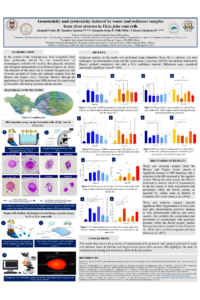
In the context of the Anthropocene, river ecosystems have been profoundly altered by the intensification of anthropogenic activities that modify their physical, chemical, and biological characteristics. The continuous discharge of urban, industrial, and agricultural effluents has generated a substantial deterioration in water quality, compromising biodiversity and ecosystem functions. Globally, it is estimated that approximately 50% of major river systems are polluted; in Mexico, this figure reaches nearly 60%, underscoring the urgency of implementing bioindicator tools for environmental assessment and monitoring. The objective of this study was to evaluate the genotoxic and cytotoxic potential of water and sediment samples from the Briones and Negros rivers (Tlaxcala, Mexico) by applying the micronucleus (MN) test and the comet assay in Vicia faba cells. Spot sampling was carried out during the rainy and dry seasons at five representative sites. The results showed statistically significant increases (p < 0.05) in MN frequency, DNA fragmentation, and a reduction in the mitotic index (MI) in most of the samples evaluated compared to negative controls. Marked spatial and temporal variability was observed, suggesting differential exposure to toxic agents. The presence of compounds such as polycyclic aromatic hydrocarbons (PAHs), organochlorine pesticides, and heavy metals is postulated as a possible cause of the observed effects. These findings confirm the existence of contaminants with genotoxic and cytotoxic potential in the studied water bodies, which represent not only a threat to the ecological integrity of aquatic ecosystems but also a latent risk to human health. The implementation of comprehensive genotoxicological monitoring programs is recommended, as well as the development of strategies for ecological restoration and mitigation of anthropogenic impacts.
Keywords
Micronucleus assay
Comet assay
Environmental assessment
Biological indicators
Poster
sciforum-125638 Hugo Ahuactzi.pdf
Eco-Treatment of Microplastics: Laccase Enzyme-based Biodegradation
Update on pesticides in European agriculture: toxicity, persistence and ecosystem risks