Event submissions
Published
This submission belongs to the session 4. Pesticides, Pollutants, and Health Risk of the event The 2nd International Online Conference on Toxics
Published date
03 Sep, 2025
Academic Editor
'%3e%3cpath%20d='M12.6657%2010.9104C12.4185%2010.325%2012.0599%209.79327%2011.6097%209.34482C11.1609%208.89508%2010.6293%208.5365%2010.0442%208.28888C10.0389%208.28626%2010.0337%208.28495%2010.0285%208.28233C10.8446%207.69279%2011.3752%206.73249%2011.3752%205.64904C11.3752%203.8542%209.92103%202.39999%208.1262%202.39999C6.33136%202.39999%204.87715%203.8542%204.87715%205.64904C4.87715%206.73249%205.40774%207.69279%206.22393%208.28364C6.21869%208.28626%206.21345%208.28757%206.20821%208.29019C5.62129%208.5378%205.09463%208.89284%204.64265%209.34613C4.1929%209.79493%203.83432%2010.3266%203.58671%2010.9117C3.34345%2011.4845%203.21226%2012.0987%203.20023%2012.7209C3.19988%2012.7349%203.20233%2012.7488%203.20744%2012.7619C3.21255%2012.7749%203.22022%2012.7867%203.22998%2012.7968C3.23975%2012.8068%203.25142%2012.8147%203.26431%2012.8202C3.2772%2012.8256%203.29105%2012.8284%203.30504%2012.8284H4.09109C4.14874%2012.8284%204.19459%2012.7825%204.1959%2012.7262C4.2221%2011.7148%204.62823%2010.7676%205.34617%2010.0497C6.08899%209.30683%207.0755%208.89808%208.1262%208.89808C9.17689%208.89808%2010.1634%209.30683%2010.9062%2010.0497C11.6242%2010.7676%2012.0303%2011.7148%2012.0565%2012.7262C12.0578%2012.7838%2012.1037%2012.8284%2012.1613%2012.8284H12.9474C12.9613%2012.8284%2012.9752%2012.8256%2012.9881%2012.8202C13.001%2012.8147%2013.0126%2012.8068%2013.0224%2012.7968C13.0322%2012.7867%2013.0398%2012.7749%2013.0449%2012.7619C13.0501%2012.7488%2013.0525%2012.7349%2013.0522%2012.7209C13.0391%2012.0947%2012.9094%2011.4855%2012.6657%2010.9104ZM8.1262%207.9024C7.52486%207.9024%206.9589%207.6679%206.53312%207.24211C6.10733%206.81633%205.87283%206.25037%205.87283%205.64904C5.87283%205.0477%206.10733%204.48174%206.53312%204.05596C6.9589%203.63018%207.52486%203.39567%208.1262%203.39567C8.72753%203.39567%209.29349%203.63018%209.71927%204.05596C10.1451%204.48174%2010.3796%205.0477%2010.3796%205.64904C10.3796%206.25037%2010.1451%206.81633%209.71927%207.24211C9.29349%207.6679%208.72753%207.9024%208.1262%207.9024Z'%20fill='%235D1EE1'/%3e%3c/g%3e%3c/svg%3e) Virgínia Cruz Fernandes
Virgínia Cruz FernandesCitation
P. Barciela, M. Carpena, M.A. Prieto, Update on pesticides in European agriculture: toxicity, persistence and ecosystem risks, in Proceedings of The 2nd International Online Conference on Toxics, 8 September–10 September 2025, MDPI: Basel, Switzerland
Share
Email
Facebook
Twitter
LinkedIn
Update on pesticides in European agriculture: toxicity, persistence and ecosystem risks

P. Barciela 1

M. Carpena 1

M.A. Prieto 1
1. Universidade de Vigo, Nutrition and Bromatology Group (NuFog), Department of Analytical Chemistry and Food Science, Instituto de Agroecoloxía e Alimentación (IAA) – CITEXVI, 36310 Vigo, España.
Abstract
To meet the global demand for food due to the world's rapidly growing population , pesticides are widely used worldwide. Modern agriculture has been enhanced by the use of pesticides to control many phytopathogenic infections. In 2020, pesticide concentrations exceeded the threshold of concern at 22% of European river and lake sampling points. Likewise, 83% of agricultural soils tested in 2019 contained pesticide residues. Fungicides and bactericides was the top selling pesticide group in 2022. In agriculture, the use of agrochemicals is justified for three main reasons: (a) increased production, (b) improved crop quality, and (c) reduced labor and energy consumption in production. Tang et al., (2021), found that 64% of the world's agricultural land (roughly 24.5 million km²) is at risk of pesticide contamination due to the presence of more than one active ingredient, and 31% is at high-risk zones. This staggering figure emphasizes the need for heightened safety measures and public awareness of pesticide use. The extensive persistence of these inputs results in their potential bioaccumulation in non-target organisms, resulting in their detection across diverse biotic matrices. Given the interconnectedness of organisms in trophic networks, these residues can spread through trophic transfer and affect food webs. The greater the volume of pesticides applied on land, the greater the spread to the aquatic ecosystem through meteorological activities, creating serious ecotoxicological risks. Therefore, the aim of this systematic review is to investigate the most widespread pesticide formulations used on crops, their acute and chronic toxicity, persistence and associated risks to human health.
Keywords
Pesticides
Agriculture
Toxicity
Persistence
Ecosystemic risks
Poster
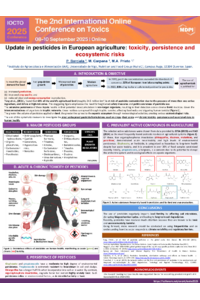
IOCTO 2025_P. Barciela.pdf
Genotoxicity and cytotoxicity induced by water and sediment samples from river systems in Vicia faba root cells
Cigarette- and E-Cigarette-Derived Pollutants Impact the Physiology of Daphnids