Event submissions
Published
This submission belongs to the session 4. Pesticides, Pollutants, and Health Risk of the event The 2nd International Online Conference on Toxics
Published date
03 Sep, 2025
Academic Editor
'%3e%3cpath%20d='M12.6657%2010.9104C12.4185%2010.325%2012.0599%209.79327%2011.6097%209.34482C11.1609%208.89508%2010.6293%208.5365%2010.0442%208.28888C10.0389%208.28626%2010.0337%208.28495%2010.0285%208.28233C10.8446%207.69279%2011.3752%206.73249%2011.3752%205.64904C11.3752%203.8542%209.92103%202.39999%208.1262%202.39999C6.33136%202.39999%204.87715%203.8542%204.87715%205.64904C4.87715%206.73249%205.40774%207.69279%206.22393%208.28364C6.21869%208.28626%206.21345%208.28757%206.20821%208.29019C5.62129%208.5378%205.09463%208.89284%204.64265%209.34613C4.1929%209.79493%203.83432%2010.3266%203.58671%2010.9117C3.34345%2011.4845%203.21226%2012.0987%203.20023%2012.7209C3.19988%2012.7349%203.20233%2012.7488%203.20744%2012.7619C3.21255%2012.7749%203.22022%2012.7867%203.22998%2012.7968C3.23975%2012.8068%203.25142%2012.8147%203.26431%2012.8202C3.2772%2012.8256%203.29105%2012.8284%203.30504%2012.8284H4.09109C4.14874%2012.8284%204.19459%2012.7825%204.1959%2012.7262C4.2221%2011.7148%204.62823%2010.7676%205.34617%2010.0497C6.08899%209.30683%207.0755%208.89808%208.1262%208.89808C9.17689%208.89808%2010.1634%209.30683%2010.9062%2010.0497C11.6242%2010.7676%2012.0303%2011.7148%2012.0565%2012.7262C12.0578%2012.7838%2012.1037%2012.8284%2012.1613%2012.8284H12.9474C12.9613%2012.8284%2012.9752%2012.8256%2012.9881%2012.8202C13.001%2012.8147%2013.0126%2012.8068%2013.0224%2012.7968C13.0322%2012.7867%2013.0398%2012.7749%2013.0449%2012.7619C13.0501%2012.7488%2013.0525%2012.7349%2013.0522%2012.7209C13.0391%2012.0947%2012.9094%2011.4855%2012.6657%2010.9104ZM8.1262%207.9024C7.52486%207.9024%206.9589%207.6679%206.53312%207.24211C6.10733%206.81633%205.87283%206.25037%205.87283%205.64904C5.87283%205.0477%206.10733%204.48174%206.53312%204.05596C6.9589%203.63018%207.52486%203.39567%208.1262%203.39567C8.72753%203.39567%209.29349%203.63018%209.71927%204.05596C10.1451%204.48174%2010.3796%205.0477%2010.3796%205.64904C10.3796%206.25037%2010.1451%206.81633%209.71927%207.24211C9.29349%207.6679%208.72753%207.9024%208.1262%207.9024Z'%20fill='%235D1EE1'/%3e%3c/g%3e%3c/svg%3e) Carlos Barata
Carlos BarataCitation
Michael Ribas Celano, Julia Vianna da Anunciação de Pinho, Mauro Cesar Palmeira Vilar, Mariana Dias Marques, Sandra Maria Feliciano de Oliveira e Azevedo, Azithromycin reshapes the effect of toxic Microcystis aeruginosa on the grazing behavior of Daphnia similis at environmentally relevant concentrations, in Proceedings of The 2nd International Online Conference on Toxics, 8 September–10 September 2025, MDPI: Basel, Switzerland
Share
Email
Facebook
Twitter
LinkedIn
Azithromycin reshapes the effect of toxic Microcystis aeruginosa on the grazing behavior of Daphnia similis at environmentally relevant concentrations
'%3e%3cpath%20d='M12.6647%2010.9104C12.4176%2010.325%2012.0589%209.7933%2011.6088%209.34485C11.16%208.89511%2010.6283%208.53653%2010.0432%208.28891C10.038%208.28629%2010.0327%208.28498%2010.0275%208.28236C10.8437%207.69282%2011.3743%206.73252%2011.3743%205.64907C11.3743%203.85423%209.92005%202.40002%208.12522%202.40002C6.33038%202.40002%204.87618%203.85423%204.87618%205.64907C4.87618%206.73252%205.40677%207.69282%206.22296%208.28367C6.21772%208.28629%206.21248%208.2876%206.20724%208.29022C5.62031%208.53783%205.09365%208.89287%204.64167%209.34616C4.19192%209.79496%203.83334%2010.3266%203.58573%2010.9117C3.34247%2011.4846%203.21128%2012.0987%203.19925%2012.721C3.1989%2012.735%203.20135%2012.7489%203.20646%2012.7619C3.21157%2012.7749%203.21924%2012.7868%203.22901%2012.7968C3.23877%2012.8068%203.25045%2012.8148%203.26334%2012.8202C3.27623%2012.8256%203.29007%2012.8284%203.30406%2012.8284H4.09012C4.14776%2012.8284%204.19362%2012.7825%204.19493%2012.7262C4.22113%2011.7148%204.62726%2010.7676%205.34519%2010.0497C6.08802%209.30686%207.07452%208.89811%208.12522%208.89811C9.17592%208.89811%2010.1624%209.30686%2010.9052%2010.0497C11.6232%2010.7676%2012.0293%2011.7148%2012.0555%2012.7262C12.0568%2012.7839%2012.1027%2012.8284%2012.1603%2012.8284H12.9464C12.9604%2012.8284%2012.9742%2012.8256%2012.9871%2012.8202C13%2012.8148%2013.0117%2012.8068%2013.0214%2012.7968C13.0312%2012.7868%2013.0389%2012.7749%2013.044%2012.7619C13.0491%2012.7489%2013.0515%2012.735%2013.0512%2012.721C13.0381%2012.0947%2012.9084%2011.4856%2012.6647%2010.9104ZM8.12522%207.90243C7.52388%207.90243%206.95792%207.66793%206.53214%207.24215C6.10636%206.81636%205.87185%206.2504%205.87185%205.64907C5.87185%205.04773%206.10636%204.48177%206.53214%204.05599C6.95792%203.63021%207.52388%203.3957%208.12522%203.3957C8.72655%203.3957%209.29252%203.63021%209.7183%204.05599C10.1441%204.48177%2010.3786%205.04773%2010.3786%205.64907C10.3786%206.2504%2010.1441%206.81636%209.7183%207.24215C9.29252%207.66793%208.72655%207.90243%208.12522%207.90243Z'%20fill='%235D1EE1'/%3e%3c/g%3e%3c/svg%3e)
Michael Ribas Celano 1
Julia Vianna da Anunciação de Pinho 2

Mauro Cesar Palmeira Vilar 1
Mariana Dias Marques 1
Sandra Maria Feliciano de Oliveira e Azevedo 1
1. Carlos Chagas Filho Institute of Biophysics, Federal University of Rio de Janeiro, Rio de Janeiro, 21949-902, Brazil
2. National Institute Quality Control In Health, Oswaldo Cruz Foundation, Rio de Janeiro, 21040-900, Brazil
Abstract
The irregular disposal of effluents and agropastoral waste promotes artificial eutrophication, favoring the proliferation of cyanobacteria in water bodies. In addition to nutrients, antibiotics frequently reach these environments, further limiting water quality and impacting aquatic biota. During the SARS-CoV-2 pandemic in Brazil, the indiscriminate use of azithromycin (AZT) significantly increased its concentrations in water bodies, with concentrations reaching up to 2.85 µg L⁻¹, a value four times higher than that reported before the pandemic. This study investigated the effect of environmentally relevant concentrations of AZT on the feeding behavior of the zooplankton Daphnia similis in the presence of the toxic cyanobacterium Microcystis aeruginosa (LETC-MC-25). After 12 h of starvation, two individuals per replicate (n = 4) were incubated for 6 hours in tubes containing 20 mL of RT medium with different diets (chlorophytes and/or cyanobacteria, totaling 1000 µgC L⁻¹) and AZT concentrations (0.3, 0.6, and 3.0 µg L⁻¹), totaling 16 treatments. A control with chlorophytes, individual treatments, and combinations of the antibiotic with cyanobacteria at concentrations of 125, 250, and 500 µgC L⁻¹ were evaluated. Isolated exposure to AZT did not significantly alter the feeding behavior of the organisms. In contrast, a single exposure to M. aeruginosa reduced the clearance rate by up to 34%. However, in combined exposures, a significant increase in clearance rates was observed, indicating greater consumption of toxic cells in the presence of the antibiotic. This increase was 16% for 125 µgC L⁻¹ of M. aeruginosa combined with 0.3 µg L⁻¹ of AZT, and between 33.7% and 61.8% for 250 µgC L⁻¹ of M. aeruginosa combined with 0.3-3.0 µg L⁻¹ of AZT. These results suggest that azithromycin enhances the consumption of toxic cyanobacteria, increasing the risk of exposure to their toxins. Therefore, it is essential to investigate the combined effects of antibiotics and cyanobacteria on non-target species.
Keywords
Environmental contamination
cyanobacteria
microcystins
antibiotics
macrolides
Poster
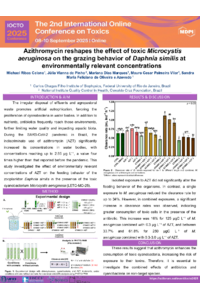
Pôster_IOCTO_2025_Michael.pdf
A comprehensive multiclass method for the determination of pesticide residues and selected mycotoxins in nuts using liquid chromatography with tandem mass spectrometry: Single Laboratory Validation
Assessment of endocrine-disrupting chemicals in companion animals