Event submissions
Published
This submission belongs to the session 4. Pesticides, Pollutants, and Health Risk of the event The 2nd International Online Conference on Toxics
Published date
03 Sep, 2025
Academic Editor
'%3e%3cpath%20d='M12.6657%2010.9104C12.4185%2010.325%2012.0599%209.79327%2011.6097%209.34482C11.1609%208.89508%2010.6293%208.5365%2010.0442%208.28888C10.0389%208.28626%2010.0337%208.28495%2010.0285%208.28233C10.8446%207.69279%2011.3752%206.73249%2011.3752%205.64904C11.3752%203.8542%209.92103%202.39999%208.1262%202.39999C6.33136%202.39999%204.87715%203.8542%204.87715%205.64904C4.87715%206.73249%205.40774%207.69279%206.22393%208.28364C6.21869%208.28626%206.21345%208.28757%206.20821%208.29019C5.62129%208.5378%205.09463%208.89284%204.64265%209.34613C4.1929%209.79493%203.83432%2010.3266%203.58671%2010.9117C3.34345%2011.4845%203.21226%2012.0987%203.20023%2012.7209C3.19988%2012.7349%203.20233%2012.7488%203.20744%2012.7619C3.21255%2012.7749%203.22022%2012.7867%203.22998%2012.7968C3.23975%2012.8068%203.25142%2012.8147%203.26431%2012.8202C3.2772%2012.8256%203.29105%2012.8284%203.30504%2012.8284H4.09109C4.14874%2012.8284%204.19459%2012.7825%204.1959%2012.7262C4.2221%2011.7148%204.62823%2010.7676%205.34617%2010.0497C6.08899%209.30683%207.0755%208.89808%208.1262%208.89808C9.17689%208.89808%2010.1634%209.30683%2010.9062%2010.0497C11.6242%2010.7676%2012.0303%2011.7148%2012.0565%2012.7262C12.0578%2012.7838%2012.1037%2012.8284%2012.1613%2012.8284H12.9474C12.9613%2012.8284%2012.9752%2012.8256%2012.9881%2012.8202C13.001%2012.8147%2013.0126%2012.8068%2013.0224%2012.7968C13.0322%2012.7867%2013.0398%2012.7749%2013.0449%2012.7619C13.0501%2012.7488%2013.0525%2012.7349%2013.0522%2012.7209C13.0391%2012.0947%2012.9094%2011.4855%2012.6657%2010.9104ZM8.1262%207.9024C7.52486%207.9024%206.9589%207.6679%206.53312%207.24211C6.10733%206.81633%205.87283%206.25037%205.87283%205.64904C5.87283%205.0477%206.10733%204.48174%206.53312%204.05596C6.9589%203.63018%207.52486%203.39567%208.1262%203.39567C8.72753%203.39567%209.29349%203.63018%209.71927%204.05596C10.1451%204.48174%2010.3796%205.0477%2010.3796%205.64904C10.3796%206.25037%2010.1451%206.81633%209.71927%207.24211C9.29349%207.6679%208.72753%207.9024%208.1262%207.9024Z'%20fill='%235D1EE1'/%3e%3c/g%3e%3c/svg%3e) Virgínia Cruz Fernandes
Virgínia Cruz FernandesCitation
Phuong Hang Le, Xiyuan Cheng, Neelima Verma, Shelley DuTeaux, A study evaluating the performance of the GHS Mixtures Equation for predicting the acute oral toxicity (LD₅₀) of spray adjuvants, in Proceedings of The 2nd International Online Conference on Toxics, 8 September–10 September 2025, MDPI: Basel, Switzerland
Share
Email
Facebook
Twitter
LinkedIn
A study evaluating the performance of the GHS Mixtures Equation for predicting the acute oral toxicity (LD50) of spray adjuvants
'%3e%3cpath%20d='M12.6647%2010.9104C12.4176%2010.325%2012.0589%209.7933%2011.6088%209.34485C11.16%208.89511%2010.6283%208.53653%2010.0432%208.28891C10.038%208.28629%2010.0327%208.28498%2010.0275%208.28236C10.8437%207.69282%2011.3743%206.73252%2011.3743%205.64907C11.3743%203.85423%209.92005%202.40002%208.12522%202.40002C6.33038%202.40002%204.87618%203.85423%204.87618%205.64907C4.87618%206.73252%205.40677%207.69282%206.22296%208.28367C6.21772%208.28629%206.21248%208.2876%206.20724%208.29022C5.62031%208.53783%205.09365%208.89287%204.64167%209.34616C4.19192%209.79496%203.83334%2010.3266%203.58573%2010.9117C3.34247%2011.4846%203.21128%2012.0987%203.19925%2012.721C3.1989%2012.735%203.20135%2012.7489%203.20646%2012.7619C3.21157%2012.7749%203.21924%2012.7868%203.22901%2012.7968C3.23877%2012.8068%203.25045%2012.8148%203.26334%2012.8202C3.27623%2012.8256%203.29007%2012.8284%203.30406%2012.8284H4.09012C4.14776%2012.8284%204.19362%2012.7825%204.19493%2012.7262C4.22113%2011.7148%204.62726%2010.7676%205.34519%2010.0497C6.08802%209.30686%207.07452%208.89811%208.12522%208.89811C9.17592%208.89811%2010.1624%209.30686%2010.9052%2010.0497C11.6232%2010.7676%2012.0293%2011.7148%2012.0555%2012.7262C12.0568%2012.7839%2012.1027%2012.8284%2012.1603%2012.8284H12.9464C12.9604%2012.8284%2012.9742%2012.8256%2012.9871%2012.8202C13%2012.8148%2013.0117%2012.8068%2013.0214%2012.7968C13.0312%2012.7868%2013.0389%2012.7749%2013.044%2012.7619C13.0491%2012.7489%2013.0515%2012.735%2013.0512%2012.721C13.0381%2012.0947%2012.9084%2011.4856%2012.6647%2010.9104ZM8.12522%207.90243C7.52388%207.90243%206.95792%207.66793%206.53214%207.24215C6.10636%206.81636%205.87185%206.2504%205.87185%205.64907C5.87185%205.04773%206.10636%204.48177%206.53214%204.05599C6.95792%203.63021%207.52388%203.3957%208.12522%203.3957C8.72655%203.3957%209.29252%203.63021%209.7183%204.05599C10.1441%204.48177%2010.3786%205.04773%2010.3786%205.64907C10.3786%206.2504%2010.1441%206.81636%209.7183%207.24215C9.29252%207.66793%208.72655%207.90243%208.12522%207.90243Z'%20fill='%235D1EE1'/%3e%3c/g%3e%3c/svg%3e)
Phuong Hang Le 1
Xiyuan Cheng 1
Neelima Verma 1
Shelley DuTeaux 1
1. Department of Pesticide Regulation, California Environmental Protection Agency, Sacramento 95812, California, USA
Abstract
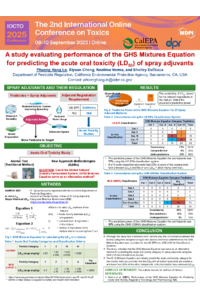
Spray adjuvants are products used with pesticides to improve their application or effectiveness. While exempt from federal pesticide registration by the US Environmental Protection Agency (US EPA), California law requires their registration as pesticides before sale or use. The California Department of Pesticide Regulation evaluated the suitability and acceptability of the United Nations Globally Harmonized System of Classification and Labelling of Chemicals (GHS) Mixtures Equation for predicting the acute oral toxicity of spray adjuvants as an alternative to requiring in vivo animal toxicity testing. The GHS Mixtures Equation estimates the acute oral toxicity (LD50) of a mixture by combining individual LD50 values of component ingredients. This study compared the results of the acute oral toxicity categories derived from the GHS Mixtures Equation with toxicity categories determined from in vivo oral studies for 51 mixtures. The results showed that the availability of LD50 values for the relevant ingredients in the mixture limited the equation’s predictivity. The equation predicted the LD50 values for 67% (N = 34) of the dataset. When these datasets were further compared against the US EPA toxicity classification system, the GHS Mixtures Equation results achieved 71% concordance, with toxicity either over-classified (6%) or under-classified (22%) by one category. Most discordant results were for spray adjuvant mixtures with LD50 > 2000 mg/kg (limit test), particularly when 20% or more of the components had unknown LD50s (N = 5). Finally, when compared against the US Occupational Safety and Health Administration’s GHS classification system, our results showed 82% concordance with 15% over-classified and 3% under-classified by one toxicity category (N = 34). Overall, the findings indicate that the GHS Mixtures Equation can reliably predict acute oral toxicity in low-toxicity mixtures, provided that all active ingredients have known LD50s and that fewer than 20% of the components have unknown LD50s.
Keywords
pesticides
spray adjuvants
GHS Mixtures Equation
acute oral toxicity
Poster
IOCTO Poster_Final.pdf
Transcriptional Biomarkers of Metal-Induced Stress Contamination in the Critically Endangered Burrunan Dolphin (Tursiops australis)
A Green In-Syringe Microextraction Approach Using Deep Eutectic Solvents for the Determination of Pesticides in Environmental Water by GC-MS