Event submissions
Published
This submission belongs to the session S3. Immune and Inflammatory Diseases of the event The 1st International Online Conference on Diseases
Published date
03 Sep, 2025
Academic Editor
'%3e%3cpath%20d='M12.6657%2010.9104C12.4185%2010.325%2012.0599%209.79327%2011.6097%209.34482C11.1609%208.89508%2010.6293%208.5365%2010.0442%208.28888C10.0389%208.28626%2010.0337%208.28495%2010.0285%208.28233C10.8446%207.69279%2011.3752%206.73249%2011.3752%205.64904C11.3752%203.8542%209.92103%202.39999%208.1262%202.39999C6.33136%202.39999%204.87715%203.8542%204.87715%205.64904C4.87715%206.73249%205.40774%207.69279%206.22393%208.28364C6.21869%208.28626%206.21345%208.28757%206.20821%208.29019C5.62129%208.5378%205.09463%208.89284%204.64265%209.34613C4.1929%209.79493%203.83432%2010.3266%203.58671%2010.9117C3.34345%2011.4845%203.21226%2012.0987%203.20023%2012.7209C3.19988%2012.7349%203.20233%2012.7488%203.20744%2012.7619C3.21255%2012.7749%203.22022%2012.7867%203.22998%2012.7968C3.23975%2012.8068%203.25142%2012.8147%203.26431%2012.8202C3.2772%2012.8256%203.29105%2012.8284%203.30504%2012.8284H4.09109C4.14874%2012.8284%204.19459%2012.7825%204.1959%2012.7262C4.2221%2011.7148%204.62823%2010.7676%205.34617%2010.0497C6.08899%209.30683%207.0755%208.89808%208.1262%208.89808C9.17689%208.89808%2010.1634%209.30683%2010.9062%2010.0497C11.6242%2010.7676%2012.0303%2011.7148%2012.0565%2012.7262C12.0578%2012.7838%2012.1037%2012.8284%2012.1613%2012.8284H12.9474C12.9613%2012.8284%2012.9752%2012.8256%2012.9881%2012.8202C13.001%2012.8147%2013.0126%2012.8068%2013.0224%2012.7968C13.0322%2012.7867%2013.0398%2012.7749%2013.0449%2012.7619C13.0501%2012.7488%2013.0525%2012.7349%2013.0522%2012.7209C13.0391%2012.0947%2012.9094%2011.4855%2012.6657%2010.9104ZM8.1262%207.9024C7.52486%207.9024%206.9589%207.6679%206.53312%207.24211C6.10733%206.81633%205.87283%206.25037%205.87283%205.64904C5.87283%205.0477%206.10733%204.48174%206.53312%204.05596C6.9589%203.63018%207.52486%203.39567%208.1262%203.39567C8.72753%203.39567%209.29349%203.63018%209.71927%204.05596C10.1451%204.48174%2010.3796%205.0477%2010.3796%205.64904C10.3796%206.25037%2010.1451%206.81633%209.71927%207.24211C9.29349%207.6679%208.72753%207.9024%208.1262%207.9024Z'%20fill='%235D1EE1'/%3e%3c/g%3e%3c/svg%3e) Veysel Tahan
Veysel TahanCitation
Mohammad-Salar Hosseini, Farhad Jadidi-Niaragh, Yosra Vaez-Gharamaleki, Mohammad Amin Akbarzadeh, Fatigue among lung cancer patients treated with atezolizumab: a systematic review and meta-analysis, in Proceedings of The 1st International Online Conference on Diseases, 9 September–11 September 2025, MDPI: Basel, Switzerland
Share
Email
Facebook
Twitter
LinkedIn
Fatigue among lung cancer patients treated with atezolizumab: a systematic review and meta-analysis
'%3e%3cpath%20d='M12.6647%2010.9104C12.4176%2010.325%2012.0589%209.7933%2011.6088%209.34485C11.16%208.89511%2010.6283%208.53653%2010.0432%208.28891C10.038%208.28629%2010.0327%208.28498%2010.0275%208.28236C10.8437%207.69282%2011.3743%206.73252%2011.3743%205.64907C11.3743%203.85423%209.92005%202.40002%208.12522%202.40002C6.33038%202.40002%204.87618%203.85423%204.87618%205.64907C4.87618%206.73252%205.40677%207.69282%206.22296%208.28367C6.21772%208.28629%206.21248%208.2876%206.20724%208.29022C5.62031%208.53783%205.09365%208.89287%204.64167%209.34616C4.19192%209.79496%203.83334%2010.3266%203.58573%2010.9117C3.34247%2011.4846%203.21128%2012.0987%203.19925%2012.721C3.1989%2012.735%203.20135%2012.7489%203.20646%2012.7619C3.21157%2012.7749%203.21924%2012.7868%203.22901%2012.7968C3.23877%2012.8068%203.25045%2012.8148%203.26334%2012.8202C3.27623%2012.8256%203.29007%2012.8284%203.30406%2012.8284H4.09012C4.14776%2012.8284%204.19362%2012.7825%204.19493%2012.7262C4.22113%2011.7148%204.62726%2010.7676%205.34519%2010.0497C6.08802%209.30686%207.07452%208.89811%208.12522%208.89811C9.17592%208.89811%2010.1624%209.30686%2010.9052%2010.0497C11.6232%2010.7676%2012.0293%2011.7148%2012.0555%2012.7262C12.0568%2012.7839%2012.1027%2012.8284%2012.1603%2012.8284H12.9464C12.9604%2012.8284%2012.9742%2012.8256%2012.9871%2012.8202C13%2012.8148%2013.0117%2012.8068%2013.0214%2012.7968C13.0312%2012.7868%2013.0389%2012.7749%2013.044%2012.7619C13.0491%2012.7489%2013.0515%2012.735%2013.0512%2012.721C13.0381%2012.0947%2012.9084%2011.4856%2012.6647%2010.9104ZM8.12522%207.90243C7.52388%207.90243%206.95792%207.66793%206.53214%207.24215C6.10636%206.81636%205.87185%206.2504%205.87185%205.64907C5.87185%205.04773%206.10636%204.48177%206.53214%204.05599C6.95792%203.63021%207.52388%203.3957%208.12522%203.3957C8.72655%203.3957%209.29252%203.63021%209.7183%204.05599C10.1441%204.48177%2010.3786%205.04773%2010.3786%205.64907C10.3786%206.2504%2010.1441%206.81636%209.7183%207.24215C9.29252%207.66793%208.72655%207.90243%208.12522%207.90243Z'%20fill='%235D1EE1'/%3e%3c/g%3e%3c/svg%3e)
Mohammad-Salar Hosseini 1,2,3
Farhad Jadidi-Niaragh 4
Yosra Vaez-Gharamaleki 1
Mohammad Amin Akbarzadeh 2,5
1. Hematology and Oncology Research Center, Tabriz University of Medical Sciences, Tabriz, Iran
2. Research Center for Integrative Medicine in Aging, Aging Research Institute, Tabriz University of Medical Sciences, Tabriz, Iran
3. Iranian Cancer Control Center (MACSA) – Tabriz Branch, Tabriz, Iran
4. Department of Immunology, Immunology Research Center, Tabriz University of Medical Sciences, Tabriz, Iran
5. Research Center for Evidence-Based Medicine, Iranian EBM Center: A JBI Center of Excellence, Tabriz University of Medical Sciences, Tabriz, Iran
Abstract
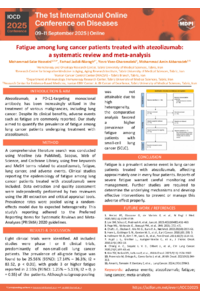
Background: Atezolizumab, a PD-L1-targeting monoclonal antibody, has been increasingly utilized in the treatment of various malignancies, including lung cancer. Despite its clinical benefits, adverse events such as fatigue are commonly reported. Our study aimed to quantify the prevalence of fatigue among lung cancer patients undergoing treatment with atezolizumab.
Methodology: A comprehensive literature search was conducted using Medline (via PubMed), Scopus, Web of Science, and Cochrane Library, using free keywords and MeSH terms related to atezolizumab, fatigue, lung cancer, and adverse events. Clinical studies reporting the epidemiology of fatigue among lung cancer patients treated with atezolizumab were included. Data extraction and quality assessment were independently performed by two reviewers using the JBI extraction and critical appraisal tools. Prevalence rates were pooled using a random-effects model due to expected heterogeneity. This study's reporting adhered to the Preferred Reporting Items for Systematic Reviews and Meta-Analyses (PRISMA) 2020 guidelines.
Results: Eight clinical trials were identified. All included studies were phase I or II clinical trials, predominantly of non-small-cell lung cancer patients. The prevalence of all-grade fatigue was found to be 25.56% (95%CI: 17.14% – 36.3%; I2 = 83.52, p < 0.01), with grade 3 or higher fatigue reported in 2.55% (95%CI: 1.25% – 5.13%; I2 = 0, p = 0.55) of the patients. Although subgroup pooling was not attainable due to high heterogeneity, the comparative analysis favored a higher prevalence of fatigue among patients with small-cell lung cancer (SCLC).
Conclusions: Fatigue is a prevalent adverse event in lung cancer patients treated with atezolizumab, affecting approximately one in every four patients. Reports of severe fatigue warrant careful monitoring and management. Further studies are required to determine the underlying mechanisms and develop effective interventions to prevent or manage this adverse effect properly.
Keywords
adverse events
atezolizumab
fatigue
lung cancer
meta-analysis
Poster
sciforum-127958.pdf
CD47-targeted therapies in breast cancer treatment: a systematic review of preclinical- and early-phase clinical studies
Pharmacological Therapy and Quality of Life in Rheumatoid Arthritis Patients from the North-East of Portugal: An Exploratory Study