Event submissions
Published
This submission belongs to the session 2. Molecular Stressors – Nanoparticles, Mixtures, and Persistent Pollutants of the event The 2nd International Online Conference on Toxics
Published date
03 Sep, 2025
Academic Editor
'%3e%3cpath%20d='M12.6657%2010.9104C12.4185%2010.325%2012.0599%209.79327%2011.6097%209.34482C11.1609%208.89508%2010.6293%208.5365%2010.0442%208.28888C10.0389%208.28626%2010.0337%208.28495%2010.0285%208.28233C10.8446%207.69279%2011.3752%206.73249%2011.3752%205.64904C11.3752%203.8542%209.92103%202.39999%208.1262%202.39999C6.33136%202.39999%204.87715%203.8542%204.87715%205.64904C4.87715%206.73249%205.40774%207.69279%206.22393%208.28364C6.21869%208.28626%206.21345%208.28757%206.20821%208.29019C5.62129%208.5378%205.09463%208.89284%204.64265%209.34613C4.1929%209.79493%203.83432%2010.3266%203.58671%2010.9117C3.34345%2011.4845%203.21226%2012.0987%203.20023%2012.7209C3.19988%2012.7349%203.20233%2012.7488%203.20744%2012.7619C3.21255%2012.7749%203.22022%2012.7867%203.22998%2012.7968C3.23975%2012.8068%203.25142%2012.8147%203.26431%2012.8202C3.2772%2012.8256%203.29105%2012.8284%203.30504%2012.8284H4.09109C4.14874%2012.8284%204.19459%2012.7825%204.1959%2012.7262C4.2221%2011.7148%204.62823%2010.7676%205.34617%2010.0497C6.08899%209.30683%207.0755%208.89808%208.1262%208.89808C9.17689%208.89808%2010.1634%209.30683%2010.9062%2010.0497C11.6242%2010.7676%2012.0303%2011.7148%2012.0565%2012.7262C12.0578%2012.7838%2012.1037%2012.8284%2012.1613%2012.8284H12.9474C12.9613%2012.8284%2012.9752%2012.8256%2012.9881%2012.8202C13.001%2012.8147%2013.0126%2012.8068%2013.0224%2012.7968C13.0322%2012.7867%2013.0398%2012.7749%2013.0449%2012.7619C13.0501%2012.7488%2013.0525%2012.7349%2013.0522%2012.7209C13.0391%2012.0947%2012.9094%2011.4855%2012.6657%2010.9104ZM8.1262%207.9024C7.52486%207.9024%206.9589%207.6679%206.53312%207.24211C6.10733%206.81633%205.87283%206.25037%205.87283%205.64904C5.87283%205.0477%206.10733%204.48174%206.53312%204.05596C6.9589%203.63018%207.52486%203.39567%208.1262%203.39567C8.72753%203.39567%209.29349%203.63018%209.71927%204.05596C10.1451%204.48174%2010.3796%205.0477%2010.3796%205.64904C10.3796%206.25037%2010.1451%206.81633%209.71927%207.24211C9.29349%207.6679%208.72753%207.9024%208.1262%207.9024Z'%20fill='%235D1EE1'/%3e%3c/g%3e%3c/svg%3e) Xiaojun Luo
Xiaojun LuoCitation
Manuela D. Machado, Eduardo V. Soares, Characterization of copper toxicity mechanisms, at environmentally relevant concentrations, in the model green alga Raphidocelis subcapitata, in Proceedings of The 2nd International Online Conference on Toxics, 8 September–10 September 2025, MDPI: Basel, Switzerland
Share
Email
Facebook
Twitter
LinkedIn
Characterization of copper toxicity mechanisms, at environmentally relevant concentrations, in the model green alga Raphidocelis subcapitata

Manuela D. Machado 1,2,3

Eduardo V. Soares 1,2,3
1. Bioengineering Laboratory, ISEP, Polytechnic of Porto, Rua Dr António Bernardino de Almeida, 431, 4249-015 Porto, Portugal
2. CEB—Centre of Biological Engineering, University of Minho, Campus de Gualtar, 4710-057 Braga, Portugal
3. LABBELS—Associate Laboratory, 4800-122 Braga, Portugal
Abstract
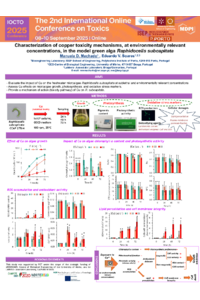
Introduction: Copper (Cu) is a toxic and one of the most common heavy metals. Even at low concentrations, this pollutant negatively impacts the aquatic environment. This study aimed to characterize the mechanisms underlying Cu toxicity in the freshwater microalga Raphidocelis subcapitata at environmentally relevant concentrations.
Methods: Algal cultures were exposed to Cu (33 or 53 µg L⁻¹) in OECD medium up to 72 hours. Growth, photosynthetic pigments content, photosynthetic efficiency (by PAM fluorometry), intracellular ROS levels, antioxidant enzyme activity (SOD and CAT), lipid peroxidation (MDA levels), and membrane integrity were assessed over time.
Results: Both Cu concentrations significantly inhibited growth, with cell density reductions of 53% and 93%, respectively. At 33 µg L⁻¹, chlorophyll a level decreased transiently, with partial recovery by 72 hours. In contrast, exposure to 53 µg L⁻¹ led to sustained chlorophyll loss and photoinhibition, as indicated by a decrease in Fv/Fm. ROS and MDA levels increased significantly for both concentrations, with membrane damage for 53 µg L⁻¹ (5% of cells showed compromised membrane integrity). Enhanced catalase (CAT) activity indicates activation of antioxidant defences.
Conclusions: Exposure to environmentally relevant Cu concentrations caused a severe physiological disruption in R. subcapitata, as translated by the modification of different biomarkers of toxicity. This work provides insights into the algal response to Cu contamination and presents a global proposal of the toxicity pathway of Cu on R. subcapitata at environmental concentrations.
Keywords
antioxidative defenses
cell membrane integrity
lipid peroxidation
oxidative stress
photosynthetic activity
Pseudokirchneriella subcapitata (=Selenastrum capricornutum)
Poster
s2 sciforum-124928 Poster.pdf
Environmental Toxins in the Beehive: GC-Based Detection of Pesticides in Royal Jelly
210Po and 210Pb content and radiation safety of worldwide tea brands