Event submissions
Published
This submission belongs to the session S6. Neuropsychiatric Disorders of the event The 1st International Online Conference on Diseases
Published date
03 Sep, 2025
Academic Editor
'%3e%3cpath%20d='M12.6657%2010.9104C12.4185%2010.325%2012.0599%209.79327%2011.6097%209.34482C11.1609%208.89508%2010.6293%208.5365%2010.0442%208.28888C10.0389%208.28626%2010.0337%208.28495%2010.0285%208.28233C10.8446%207.69279%2011.3752%206.73249%2011.3752%205.64904C11.3752%203.8542%209.92103%202.39999%208.1262%202.39999C6.33136%202.39999%204.87715%203.8542%204.87715%205.64904C4.87715%206.73249%205.40774%207.69279%206.22393%208.28364C6.21869%208.28626%206.21345%208.28757%206.20821%208.29019C5.62129%208.5378%205.09463%208.89284%204.64265%209.34613C4.1929%209.79493%203.83432%2010.3266%203.58671%2010.9117C3.34345%2011.4845%203.21226%2012.0987%203.20023%2012.7209C3.19988%2012.7349%203.20233%2012.7488%203.20744%2012.7619C3.21255%2012.7749%203.22022%2012.7867%203.22998%2012.7968C3.23975%2012.8068%203.25142%2012.8147%203.26431%2012.8202C3.2772%2012.8256%203.29105%2012.8284%203.30504%2012.8284H4.09109C4.14874%2012.8284%204.19459%2012.7825%204.1959%2012.7262C4.2221%2011.7148%204.62823%2010.7676%205.34617%2010.0497C6.08899%209.30683%207.0755%208.89808%208.1262%208.89808C9.17689%208.89808%2010.1634%209.30683%2010.9062%2010.0497C11.6242%2010.7676%2012.0303%2011.7148%2012.0565%2012.7262C12.0578%2012.7838%2012.1037%2012.8284%2012.1613%2012.8284H12.9474C12.9613%2012.8284%2012.9752%2012.8256%2012.9881%2012.8202C13.001%2012.8147%2013.0126%2012.8068%2013.0224%2012.7968C13.0322%2012.7867%2013.0398%2012.7749%2013.0449%2012.7619C13.0501%2012.7488%2013.0525%2012.7349%2013.0522%2012.7209C13.0391%2012.0947%2012.9094%2011.4855%2012.6657%2010.9104ZM8.1262%207.9024C7.52486%207.9024%206.9589%207.6679%206.53312%207.24211C6.10733%206.81633%205.87283%206.25037%205.87283%205.64904C5.87283%205.0477%206.10733%204.48174%206.53312%204.05596C6.9589%203.63018%207.52486%203.39567%208.1262%203.39567C8.72753%203.39567%209.29349%203.63018%209.71927%204.05596C10.1451%204.48174%2010.3796%205.0477%2010.3796%205.64904C10.3796%206.25037%2010.1451%206.81633%209.71927%207.24211C9.29349%207.6679%208.72753%207.9024%208.1262%207.9024Z'%20fill='%235D1EE1'/%3e%3c/g%3e%3c/svg%3e) Michele Malaguarnera
Michele MalaguarneraCitation
Maria Crina Isac, An Investigation of the Effects of Mansorin on Memory Processes in a Zebrafish (Danio rerio) Animal Model, in Proceedings of The 1st International Online Conference on Diseases, 9 September–11 September 2025, MDPI: Basel, Switzerland
Share
Email
Facebook
Twitter
LinkedIn
An Investigation of the Effects of Mansorin on Memory Processes in a Zebrafish (Danio rerio) Animal Model
'%3e%3cpath%20d='M12.6647%2010.9104C12.4176%2010.325%2012.0589%209.7933%2011.6088%209.34485C11.16%208.89511%2010.6283%208.53653%2010.0432%208.28891C10.038%208.28629%2010.0327%208.28498%2010.0275%208.28236C10.8437%207.69282%2011.3743%206.73252%2011.3743%205.64907C11.3743%203.85423%209.92005%202.40002%208.12522%202.40002C6.33038%202.40002%204.87618%203.85423%204.87618%205.64907C4.87618%206.73252%205.40677%207.69282%206.22296%208.28367C6.21772%208.28629%206.21248%208.2876%206.20724%208.29022C5.62031%208.53783%205.09365%208.89287%204.64167%209.34616C4.19192%209.79496%203.83334%2010.3266%203.58573%2010.9117C3.34247%2011.4846%203.21128%2012.0987%203.19925%2012.721C3.1989%2012.735%203.20135%2012.7489%203.20646%2012.7619C3.21157%2012.7749%203.21924%2012.7868%203.22901%2012.7968C3.23877%2012.8068%203.25045%2012.8148%203.26334%2012.8202C3.27623%2012.8256%203.29007%2012.8284%203.30406%2012.8284H4.09012C4.14776%2012.8284%204.19362%2012.7825%204.19493%2012.7262C4.22113%2011.7148%204.62726%2010.7676%205.34519%2010.0497C6.08802%209.30686%207.07452%208.89811%208.12522%208.89811C9.17592%208.89811%2010.1624%209.30686%2010.9052%2010.0497C11.6232%2010.7676%2012.0293%2011.7148%2012.0555%2012.7262C12.0568%2012.7839%2012.1027%2012.8284%2012.1603%2012.8284H12.9464C12.9604%2012.8284%2012.9742%2012.8256%2012.9871%2012.8202C13%2012.8148%2013.0117%2012.8068%2013.0214%2012.7968C13.0312%2012.7868%2013.0389%2012.7749%2013.044%2012.7619C13.0491%2012.7489%2013.0515%2012.735%2013.0512%2012.721C13.0381%2012.0947%2012.9084%2011.4856%2012.6647%2010.9104ZM8.12522%207.90243C7.52388%207.90243%206.95792%207.66793%206.53214%207.24215C6.10636%206.81636%205.87185%206.2504%205.87185%205.64907C5.87185%205.04773%206.10636%204.48177%206.53214%204.05599C6.95792%203.63021%207.52388%203.3957%208.12522%203.3957C8.72655%203.3957%209.29252%203.63021%209.7183%204.05599C10.1441%204.48177%2010.3786%205.04773%2010.3786%205.64907C10.3786%206.2504%2010.1441%206.81636%209.7183%207.24215C9.29252%207.66793%208.72655%207.90243%208.12522%207.90243Z'%20fill='%235D1EE1'/%3e%3c/g%3e%3c/svg%3e)
Maria Crina Isac 1
1. Department of Biology, Faculty of Biology, Alexandru Ioan Cuza University, Iași, 700506, Romania
Abstract
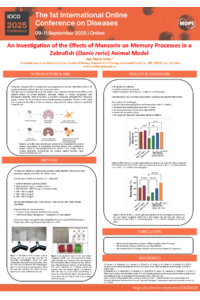
Alzheimer's disease (AD) is a progressive neurodegenerative disorder with a major global impact. Due to the limitations of current treatments and adverse effects, there is increasing interest in natural compounds with therapeutic potential. Mansorina (MA), a coumarin from Mansonia gagei, has antioxidant and anti-inflammatory properties. The present study aims to evaluate the effects of MA on memory, using zebrafish as a preclinical model for AD.
To induce an Alzheimer's disease-like amnesia model, zebrafish (Danio rerio) were exposed to okadaic acid (OKA, 10 nM) for 4 days. Six groups (n = 10/group) were formed: control (DMSO), GAL (1 mg/L), OKA, and OKA co-treated with mansorine (MA) at 1, 3, or 6 μg/L. MA was administered for 7 days, every 3 days, during water changes. Cognitive functions were assessed by Y-maze tests (spatial memory and locomotor activity) and novel object recognition (NOR). Behavioral data were analyzed with one-way ANOVA and Tukey's test (GraphPad Prism 9, p < 0.05).
OKA treatment significantly impaired spatial memory and object recognition in zebrafish, as evidenced by decreased time spent in the novel arm (Y-maze) and novel object preference (NOR) (p < 0.0001). GAL improved both parameters, confirming its cognitive effects. Co-treatment with MA (3 and 6 μg/L) significantly reversed these deficits (p < 0.001 – p < 0.00001), increasing exploration of the novel arm and object. MA also increased locomotor activity, suggesting a stimulant effect. The results support the neuroprotective role of MA.
The results of this study show that the administration of mansorine (MA) to okadaic acid (OKA)-treated fish increased exploratory behavior, as evidenced by novel arm preference in the Y-maze test, and improved recognition memory in the NOR test. MA also contributed to the restoration of cholinergic deficit and the improvement of dementia symptoms, supporting its neuroprotective potential.
Keywords
Alzheimer's disease
Mansorine memory
neuroprotection
Poster
Poster_sciforum-127836_Final.pdf
The early detection and management of emerging toxicities associated with bispecific antibodies and T-cell engagers: the key role of oncology nursing
ICSI Outcomes According to Sperm Origin: Comparing Fresh and Frozen Ejaculated and Testicular Sperm Collected Over a Five-Year Period.