Event submissions
Published
This submission belongs to the session 3. Cutting-Edge Approaches in Pharmacology & Toxicology of the event The 2nd International Online Conference on Toxics
Published date
03 Sep, 2025
Academic Editor
'%3e%3cpath%20d='M12.6657%2010.9104C12.4185%2010.325%2012.0599%209.79327%2011.6097%209.34482C11.1609%208.89508%2010.6293%208.5365%2010.0442%208.28888C10.0389%208.28626%2010.0337%208.28495%2010.0285%208.28233C10.8446%207.69279%2011.3752%206.73249%2011.3752%205.64904C11.3752%203.8542%209.92103%202.39999%208.1262%202.39999C6.33136%202.39999%204.87715%203.8542%204.87715%205.64904C4.87715%206.73249%205.40774%207.69279%206.22393%208.28364C6.21869%208.28626%206.21345%208.28757%206.20821%208.29019C5.62129%208.5378%205.09463%208.89284%204.64265%209.34613C4.1929%209.79493%203.83432%2010.3266%203.58671%2010.9117C3.34345%2011.4845%203.21226%2012.0987%203.20023%2012.7209C3.19988%2012.7349%203.20233%2012.7488%203.20744%2012.7619C3.21255%2012.7749%203.22022%2012.7867%203.22998%2012.7968C3.23975%2012.8068%203.25142%2012.8147%203.26431%2012.8202C3.2772%2012.8256%203.29105%2012.8284%203.30504%2012.8284H4.09109C4.14874%2012.8284%204.19459%2012.7825%204.1959%2012.7262C4.2221%2011.7148%204.62823%2010.7676%205.34617%2010.0497C6.08899%209.30683%207.0755%208.89808%208.1262%208.89808C9.17689%208.89808%2010.1634%209.30683%2010.9062%2010.0497C11.6242%2010.7676%2012.0303%2011.7148%2012.0565%2012.7262C12.0578%2012.7838%2012.1037%2012.8284%2012.1613%2012.8284H12.9474C12.9613%2012.8284%2012.9752%2012.8256%2012.9881%2012.8202C13.001%2012.8147%2013.0126%2012.8068%2013.0224%2012.7968C13.0322%2012.7867%2013.0398%2012.7749%2013.0449%2012.7619C13.0501%2012.7488%2013.0525%2012.7349%2013.0522%2012.7209C13.0391%2012.0947%2012.9094%2011.4855%2012.6657%2010.9104ZM8.1262%207.9024C7.52486%207.9024%206.9589%207.6679%206.53312%207.24211C6.10733%206.81633%205.87283%206.25037%205.87283%205.64904C5.87283%205.0477%206.10733%204.48174%206.53312%204.05596C6.9589%203.63018%207.52486%203.39567%208.1262%203.39567C8.72753%203.39567%209.29349%203.63018%209.71927%204.05596C10.1451%204.48174%2010.3796%205.0477%2010.3796%205.64904C10.3796%206.25037%2010.1451%206.81633%209.71927%207.24211C9.29349%207.6679%208.72753%207.9024%208.1262%207.9024Z'%20fill='%235D1EE1'/%3e%3c/g%3e%3c/svg%3e) Youssef Sari
Youssef SariCitation
Kaja Tusiewicz, Olga Wachełko, Karolina Nowak, Marcin Zawadzki, Paweł Szpot, BEYOND THE BLOTTER: FORENSIC IDENTIFICATION OF NOVEL LSD ANALOGS VIA GC–QqQ–MS AND UHPLC–QqQ–MS/MS, in Proceedings of The 2nd International Online Conference on Toxics, 8 September–10 September 2025, MDPI: Basel, Switzerland
Share
Email
Facebook
Twitter
LinkedIn
BEYOND THE BLOTTER: FORENSIC IDENTIFICATION OF NOVEL LSD ANALOGS VIA GC–QqQ–MS AND UHPLC–QqQ–MS/MS
'%3e%3cpath%20d='M12.6647%2010.9104C12.4176%2010.325%2012.0589%209.7933%2011.6088%209.34485C11.16%208.89511%2010.6283%208.53653%2010.0432%208.28891C10.038%208.28629%2010.0327%208.28498%2010.0275%208.28236C10.8437%207.69282%2011.3743%206.73252%2011.3743%205.64907C11.3743%203.85423%209.92005%202.40002%208.12522%202.40002C6.33038%202.40002%204.87618%203.85423%204.87618%205.64907C4.87618%206.73252%205.40677%207.69282%206.22296%208.28367C6.21772%208.28629%206.21248%208.2876%206.20724%208.29022C5.62031%208.53783%205.09365%208.89287%204.64167%209.34616C4.19192%209.79496%203.83334%2010.3266%203.58573%2010.9117C3.34247%2011.4846%203.21128%2012.0987%203.19925%2012.721C3.1989%2012.735%203.20135%2012.7489%203.20646%2012.7619C3.21157%2012.7749%203.21924%2012.7868%203.22901%2012.7968C3.23877%2012.8068%203.25045%2012.8148%203.26334%2012.8202C3.27623%2012.8256%203.29007%2012.8284%203.30406%2012.8284H4.09012C4.14776%2012.8284%204.19362%2012.7825%204.19493%2012.7262C4.22113%2011.7148%204.62726%2010.7676%205.34519%2010.0497C6.08802%209.30686%207.07452%208.89811%208.12522%208.89811C9.17592%208.89811%2010.1624%209.30686%2010.9052%2010.0497C11.6232%2010.7676%2012.0293%2011.7148%2012.0555%2012.7262C12.0568%2012.7839%2012.1027%2012.8284%2012.1603%2012.8284H12.9464C12.9604%2012.8284%2012.9742%2012.8256%2012.9871%2012.8202C13%2012.8148%2013.0117%2012.8068%2013.0214%2012.7968C13.0312%2012.7868%2013.0389%2012.7749%2013.044%2012.7619C13.0491%2012.7489%2013.0515%2012.735%2013.0512%2012.721C13.0381%2012.0947%2012.9084%2011.4856%2012.6647%2010.9104ZM8.12522%207.90243C7.52388%207.90243%206.95792%207.66793%206.53214%207.24215C6.10636%206.81636%205.87185%206.2504%205.87185%205.64907C5.87185%205.04773%206.10636%204.48177%206.53214%204.05599C6.95792%203.63021%207.52388%203.3957%208.12522%203.3957C8.72655%203.3957%209.29252%203.63021%209.7183%204.05599C10.1441%204.48177%2010.3786%205.04773%2010.3786%205.64907C10.3786%206.2504%2010.1441%206.81636%209.7183%207.24215C9.29252%207.66793%208.72655%207.90243%208.12522%207.90243Z'%20fill='%235D1EE1'/%3e%3c/g%3e%3c/svg%3e)
Kaja Tusiewicz 1
Olga Wachełko 2

Karolina Nowak 3
Marcin Zawadzki 4
Paweł Szpot 5
1. Department of Forensic Medicine, Wroclaw Medical University, Wroclaw, 50345, Poland
2. Institute of Toxicology Research, Borowa, 55-093, Poland
3. Faculty of Medicine, Department of Pharmacology, University of Opole, Opole, 45052, Poland
4. Faculty of Medicine, Department of Social Sciences and Infectious Diseases, Wroclaw University of Science and Technology, Wrocław, 50370, Poland
5. Department of Forensic Medicine, Wroclaw Medical University, Wroclaw, 50345, Poland
Abstract
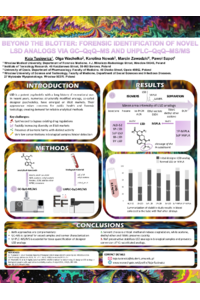
Introduction: The proliferation of novel LSD analogs, often synthesized to circumvent existing legal regulations, presents a growing challenge for both forensic toxicology and public health. These so-called "designer psychedelics" often remain undetectable by routine screening methods and may exist in isomeric forms with different pharmacological profiles. As their availability rises, particularly via online markets, so does the urgency for accurate analytical methodologies that can distinguish known analogs and anticipate those yet to appear.
Methods: Two complementary analytical strategies were employed: GC–QqQ–MS and UV spectroscopy for analytical standards, and UHPLC–QqQ–MS/MS for biological matrices. The GC–QqQ–MS method was optimized for the separation and identification of 13 LSD analogs, including structural isomers, with attention paid in particular to solvent influence on compound stability. In parallel, the UHPLC–QqQ–MS/MS protocol was used to develop a comprehensive method for the determination of extremely low concentrations of analytes in biological material, as well as to investigate their stability over time under various storage conditions.
Results: GC–QqQ–MS with EI effectively differentiated critical isomer pairs (e.g., LSD vs. MiPLA, 1P-LSD vs. 1P-MiPLA) by unique ion fragmentation patterns and chromatographic separation. Solvent studies confirmed that methanol induces degradation in several analogs, whereas diethyl ether and acetone preserve compound integrity. The UHPLC–QqQ–MS/MS method demonstrated exceptional sensitivity (LOQ 0.5 pg/mL) and robustness, detecting analogs in forensic case samples and confirming degradation pathways, particularly for N1-substituted compounds converting to LSD or MiPLA.
Conclusions: This study highlights the necessity of robust, sensitive analytical methods to accurately identify LSD analogs and their isomers. Given their possible instability, ongoing method development is essential for reliable forensic interpretation and early detection of emerging substances.
Keywords
new psychoactive substances
LSD analogs
isomers differentietion
compound stability
UHPLC-QqQ-MS/MS
GC-QqQ-MS/MS
Poster
Tusiewicz_Kaja_poster.pdf
241Am in the bottom sediments of the southern Baltic Sea
A Coastal Perspective on Air Quality Modelling