Event submissions
Published
This submission belongs to the session S3. Use of Toxins as Tools for Research, Drug Discovery, and Therapeutics of the event The 3rd International Online Conference on Toxins
Published date
03 Sep, 2025
Academic Editor
'%3e%3cpath%20d='M12.6657%2010.9104C12.4185%2010.325%2012.0599%209.79327%2011.6097%209.34482C11.1609%208.89508%2010.6293%208.5365%2010.0442%208.28888C10.0389%208.28626%2010.0337%208.28495%2010.0285%208.28233C10.8446%207.69279%2011.3752%206.73249%2011.3752%205.64904C11.3752%203.8542%209.92103%202.39999%208.1262%202.39999C6.33136%202.39999%204.87715%203.8542%204.87715%205.64904C4.87715%206.73249%205.40774%207.69279%206.22393%208.28364C6.21869%208.28626%206.21345%208.28757%206.20821%208.29019C5.62129%208.5378%205.09463%208.89284%204.64265%209.34613C4.1929%209.79493%203.83432%2010.3266%203.58671%2010.9117C3.34345%2011.4845%203.21226%2012.0987%203.20023%2012.7209C3.19988%2012.7349%203.20233%2012.7488%203.20744%2012.7619C3.21255%2012.7749%203.22022%2012.7867%203.22998%2012.7968C3.23975%2012.8068%203.25142%2012.8147%203.26431%2012.8202C3.2772%2012.8256%203.29105%2012.8284%203.30504%2012.8284H4.09109C4.14874%2012.8284%204.19459%2012.7825%204.1959%2012.7262C4.2221%2011.7148%204.62823%2010.7676%205.34617%2010.0497C6.08899%209.30683%207.0755%208.89808%208.1262%208.89808C9.17689%208.89808%2010.1634%209.30683%2010.9062%2010.0497C11.6242%2010.7676%2012.0303%2011.7148%2012.0565%2012.7262C12.0578%2012.7838%2012.1037%2012.8284%2012.1613%2012.8284H12.9474C12.9613%2012.8284%2012.9752%2012.8256%2012.9881%2012.8202C13.001%2012.8147%2013.0126%2012.8068%2013.0224%2012.7968C13.0322%2012.7867%2013.0398%2012.7749%2013.0449%2012.7619C13.0501%2012.7488%2013.0525%2012.7349%2013.0522%2012.7209C13.0391%2012.0947%2012.9094%2011.4855%2012.6657%2010.9104ZM8.1262%207.9024C7.52486%207.9024%206.9589%207.6679%206.53312%207.24211C6.10733%206.81633%205.87283%206.25037%205.87283%205.64904C5.87283%205.0477%206.10733%204.48174%206.53312%204.05596C6.9589%203.63018%207.52486%203.39567%208.1262%203.39567C8.72753%203.39567%209.29349%203.63018%209.71927%204.05596C10.1451%204.48174%2010.3796%205.0477%2010.3796%205.64904C10.3796%206.25037%2010.1451%206.81633%209.71927%207.24211C9.29349%207.6679%208.72753%207.9024%208.1262%207.9024Z'%20fill='%235D1EE1'/%3e%3c/g%3e%3c/svg%3e) Jay Fox
Jay FoxCitation
Dr. Arkajyoti Dutta, Dr. Nilgun Tumer, Identifying and optimizing small molecule and peptide inhibitors targeting ricin and Shiga toxins: Type II Ribosome-Inactivating Proteins (RIPs), in Proceedings of The 3rd International Online Conference on Toxins, 10 September–12 September 2025, MDPI: Basel, Switzerland
Share
Email
Facebook
Twitter
LinkedIn
Identifying and optimizing small molecule and peptide inhibitors targeting ricin and Shiga toxins: Type II Ribosome-Inactivating Proteins (RIPs)

Dr. Arkajyoti Dutta 1

Dr. Nilgun Tumer 2
1. Department of Bio Sciences, School of Bio Science and Technology, Vellore Institute of Technology, VIT University, Vellore, 632014, India
2. Department of Plant Biology, School of Environmental and Biological Sciences, Rutgers University, New Brunswick, 08901-8520, United States
Abstract
Ricin, one of the most potent toxins known, and the Shiga toxins (Stxs) produced by Escherichia coli (STEC) bind to the C-termini of ribosomal P-stalk proteins to depurinate the sarcin/ricin loop at a different location on the large subunit of the ribosome. The ribosome binding sites of ricin and Stxs have not yet been targeted using small molecules. We established a fluorescence anisotropy-based competition assay to evaluate small molecule inhibitors against RTA. A unique feature of this assay is its ability to identify small molecule inhibitors that bind to the ribosome binding site of RTA and allosterically inhibit its catalytic activity. The FA assay was used to measure the binding constants of small molecule inhibitors that blocked the interaction between a BODIPY-TMR labeled peptide probe mimicking the conserved C-terminal end of the P-stalk proteins (P11) and the A subunit of ricin toxin (RTA). Initially, we used the Biacore SPR to screen the Maybridge Ro3 Core library of compounds and identified CC10501 as the lead molecule. Then, we improved CC10501 using a structure-based design, and using the fluorescence anisotropy-based competition assay, we identified RU-NT-206 and RU-NT-192 as the lead molecules, which showed over 50- and 30-fold improved affinity. The Ki values measured using the FA assay showed a positive correlation with the results of a Vero cell protection assay. These results validated the P-stalk pocket as a target for inhibition and identified RU-NT-206 and RU-NT-192 as lead molecules for further optimization.
Keywords
Fluorescence Anisotropy
small molecule inhibitors
toxin-ribosome interaction
ricin
Shiga toxin
Poster
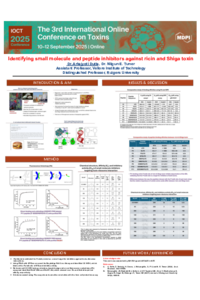
Poster_IOCT 2025_Arkajyoti.pdf
Snake venom toxicity in Artemia salina
Trigonelline, a jellyfish alkaloid, in the restoration of cathepsin B and D activity in the substantia nigra and caudate putamen in a rat model of Parkinson’s disease