Event submissions
Published
This submission belongs to the session S3. Use of Toxins as Tools for Research, Drug Discovery, and Therapeutics of the event The 3rd International Online Conference on Toxins
Published date
03 Sep, 2025
Academic Editor
'%3e%3cpath%20d='M12.6657%2010.9104C12.4185%2010.325%2012.0599%209.79327%2011.6097%209.34482C11.1609%208.89508%2010.6293%208.5365%2010.0442%208.28888C10.0389%208.28626%2010.0337%208.28495%2010.0285%208.28233C10.8446%207.69279%2011.3752%206.73249%2011.3752%205.64904C11.3752%203.8542%209.92103%202.39999%208.1262%202.39999C6.33136%202.39999%204.87715%203.8542%204.87715%205.64904C4.87715%206.73249%205.40774%207.69279%206.22393%208.28364C6.21869%208.28626%206.21345%208.28757%206.20821%208.29019C5.62129%208.5378%205.09463%208.89284%204.64265%209.34613C4.1929%209.79493%203.83432%2010.3266%203.58671%2010.9117C3.34345%2011.4845%203.21226%2012.0987%203.20023%2012.7209C3.19988%2012.7349%203.20233%2012.7488%203.20744%2012.7619C3.21255%2012.7749%203.22022%2012.7867%203.22998%2012.7968C3.23975%2012.8068%203.25142%2012.8147%203.26431%2012.8202C3.2772%2012.8256%203.29105%2012.8284%203.30504%2012.8284H4.09109C4.14874%2012.8284%204.19459%2012.7825%204.1959%2012.7262C4.2221%2011.7148%204.62823%2010.7676%205.34617%2010.0497C6.08899%209.30683%207.0755%208.89808%208.1262%208.89808C9.17689%208.89808%2010.1634%209.30683%2010.9062%2010.0497C11.6242%2010.7676%2012.0303%2011.7148%2012.0565%2012.7262C12.0578%2012.7838%2012.1037%2012.8284%2012.1613%2012.8284H12.9474C12.9613%2012.8284%2012.9752%2012.8256%2012.9881%2012.8202C13.001%2012.8147%2013.0126%2012.8068%2013.0224%2012.7968C13.0322%2012.7867%2013.0398%2012.7749%2013.0449%2012.7619C13.0501%2012.7488%2013.0525%2012.7349%2013.0522%2012.7209C13.0391%2012.0947%2012.9094%2011.4855%2012.6657%2010.9104ZM8.1262%207.9024C7.52486%207.9024%206.9589%207.6679%206.53312%207.24211C6.10733%206.81633%205.87283%206.25037%205.87283%205.64904C5.87283%205.0477%206.10733%204.48174%206.53312%204.05596C6.9589%203.63018%207.52486%203.39567%208.1262%203.39567C8.72753%203.39567%209.29349%203.63018%209.71927%204.05596C10.1451%204.48174%2010.3796%205.0477%2010.3796%205.64904C10.3796%206.25037%2010.1451%206.81633%209.71927%207.24211C9.29349%207.6679%208.72753%207.9024%208.1262%207.9024Z'%20fill='%235D1EE1'/%3e%3c/g%3e%3c/svg%3e) Nilgun E. Tumer
Nilgun E. TumerCitation
Juliana Guanaes Pina, Alquiandra Stefani Ferreira Mançano, Juliana Mozer Sciani, Molecules from marine invertebrate venoms recover cathepsin D activity, impaired by oligomerized Aβ42, in a neuronal cell model of Alzheimer’s disease, in Proceedings of The 3rd International Online Conference on Toxins, 10 September–12 September 2025, MDPI: Basel, Switzerland
Share
Email
Facebook
Twitter
LinkedIn
Molecules from marine invertebrate venoms recover cathepsin D activity, impaired by oligomerized Aβ42, in a neuronal cell model of Alzheimer’s disease
'%3e%3cpath%20d='M12.6647%2010.9104C12.4176%2010.325%2012.0589%209.7933%2011.6088%209.34485C11.16%208.89511%2010.6283%208.53653%2010.0432%208.28891C10.038%208.28629%2010.0327%208.28498%2010.0275%208.28236C10.8437%207.69282%2011.3743%206.73252%2011.3743%205.64907C11.3743%203.85423%209.92005%202.40002%208.12522%202.40002C6.33038%202.40002%204.87618%203.85423%204.87618%205.64907C4.87618%206.73252%205.40677%207.69282%206.22296%208.28367C6.21772%208.28629%206.21248%208.2876%206.20724%208.29022C5.62031%208.53783%205.09365%208.89287%204.64167%209.34616C4.19192%209.79496%203.83334%2010.3266%203.58573%2010.9117C3.34247%2011.4846%203.21128%2012.0987%203.19925%2012.721C3.1989%2012.735%203.20135%2012.7489%203.20646%2012.7619C3.21157%2012.7749%203.21924%2012.7868%203.22901%2012.7968C3.23877%2012.8068%203.25045%2012.8148%203.26334%2012.8202C3.27623%2012.8256%203.29007%2012.8284%203.30406%2012.8284H4.09012C4.14776%2012.8284%204.19362%2012.7825%204.19493%2012.7262C4.22113%2011.7148%204.62726%2010.7676%205.34519%2010.0497C6.08802%209.30686%207.07452%208.89811%208.12522%208.89811C9.17592%208.89811%2010.1624%209.30686%2010.9052%2010.0497C11.6232%2010.7676%2012.0293%2011.7148%2012.0555%2012.7262C12.0568%2012.7839%2012.1027%2012.8284%2012.1603%2012.8284H12.9464C12.9604%2012.8284%2012.9742%2012.8256%2012.9871%2012.8202C13%2012.8148%2013.0117%2012.8068%2013.0214%2012.7968C13.0312%2012.7868%2013.0389%2012.7749%2013.044%2012.7619C13.0491%2012.7489%2013.0515%2012.735%2013.0512%2012.721C13.0381%2012.0947%2012.9084%2011.4856%2012.6647%2010.9104ZM8.12522%207.90243C7.52388%207.90243%206.95792%207.66793%206.53214%207.24215C6.10636%206.81636%205.87185%206.2504%205.87185%205.64907C5.87185%205.04773%206.10636%204.48177%206.53214%204.05599C6.95792%203.63021%207.52388%203.3957%208.12522%203.3957C8.72655%203.3957%209.29252%203.63021%209.7183%204.05599C10.1441%204.48177%2010.3786%205.04773%2010.3786%205.64907C10.3786%206.2504%2010.1441%206.81636%209.7183%207.24215C9.29252%207.66793%208.72655%207.90243%208.12522%207.90243Z'%20fill='%235D1EE1'/%3e%3c/g%3e%3c/svg%3e)
Juliana Guanaes Pina 1
Alquiandra Stefani Ferreira Mançano 1
Juliana Mozer Sciani 1
1. Natural Products Lab,University São Francisco, Bragança Paulista-SP, 12916-900, Brazil
Abstract
Introduction: Alzheimer's disease (AD) is characterized by the accumulation of the amyloid-β (Aβ) peptide in its oligomeric and fibrillar conformations, which disrupts several neuronal functions, including the autophagy–lysosomal pathway, essential for eliminating misfolded, aggregated, or mutated proteins and maintaining proteostasis. Cathepsin D, the most abundant lysosomal peptidase, is dysfunctional in AD, and in this study, we evaluated the effects of molecules from marine invertebrates on restoring its activity. Methods: Differentiated SH-SY5Y cells were pre-treated with oAβ42 (5 μM) for 48 hours, followed by treatment with venom from six Brazilian marine invertebrate species (1 mg/mL) for 24 hours. After the treatment, cell lysates were obtained, and the cathepsin D activity was measured using a specific substrate (GKPILFFRLK(Dnp)-D-R-NH2-MCA) and the fluorescence intensity monitored every five minutes (λex =: 405 nm, λem: 495 nm). The secretions were fractionated through solid-phase extraction in a C18 cartridge, eluted using acetonitrile/0.1% trifluoroacetic acid, and tested again. Results: oAβ42 decreased the velocity of cathepsin D's enzymatic reactions by 40% compared to those in the control (cells without treatment). Venom from the corals Renilla reniformis and Tubastraea tagusensis the sea anemone Anthopleura cascaia; and the sea urchin Echinometra lucunter restored the cathepsin D activity, bringing it back to the control levels or even exceeding them. The venom from A. cascaia, which exhibited the most intense activity, was fractionated further and analyzed, and an active fraction rich in peptides and small molecules was identified. Conclusion: Marine-derived molecules could restore the activity of the main lysosomal enzyme, cathepsin D, important for the elimination of the amyloid peptide and reductions in neuron death, which could contribute significantly to new therapies for the treatment of AD.
Keywords
Alzheimer disease
cathepsin D
marine animals
Poster
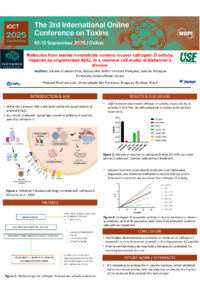
Molecules from marine invertebrate venoms recover cathepsin D activity, impaired by oligomerized A42, in a neuronal cell model.pdf
Trigonelline, a jellyfish alkaloid, in the restoration of cathepsin B and D activity in the substantia nigra and caudate putamen in a rat model of Parkinson’s disease
Protective effect of curcumin against zearalenone-induced liver injury in weaned piglets