Event submissions
Published
This submission belongs to the session 4. Pesticides, Pollutants, and Health Risk of the event The 2nd International Online Conference on Toxics
Published date
03 Sep, 2025
Academic Editor
'%3e%3cpath%20d='M12.6657%2010.9104C12.4185%2010.325%2012.0599%209.79327%2011.6097%209.34482C11.1609%208.89508%2010.6293%208.5365%2010.0442%208.28888C10.0389%208.28626%2010.0337%208.28495%2010.0285%208.28233C10.8446%207.69279%2011.3752%206.73249%2011.3752%205.64904C11.3752%203.8542%209.92103%202.39999%208.1262%202.39999C6.33136%202.39999%204.87715%203.8542%204.87715%205.64904C4.87715%206.73249%205.40774%207.69279%206.22393%208.28364C6.21869%208.28626%206.21345%208.28757%206.20821%208.29019C5.62129%208.5378%205.09463%208.89284%204.64265%209.34613C4.1929%209.79493%203.83432%2010.3266%203.58671%2010.9117C3.34345%2011.4845%203.21226%2012.0987%203.20023%2012.7209C3.19988%2012.7349%203.20233%2012.7488%203.20744%2012.7619C3.21255%2012.7749%203.22022%2012.7867%203.22998%2012.7968C3.23975%2012.8068%203.25142%2012.8147%203.26431%2012.8202C3.2772%2012.8256%203.29105%2012.8284%203.30504%2012.8284H4.09109C4.14874%2012.8284%204.19459%2012.7825%204.1959%2012.7262C4.2221%2011.7148%204.62823%2010.7676%205.34617%2010.0497C6.08899%209.30683%207.0755%208.89808%208.1262%208.89808C9.17689%208.89808%2010.1634%209.30683%2010.9062%2010.0497C11.6242%2010.7676%2012.0303%2011.7148%2012.0565%2012.7262C12.0578%2012.7838%2012.1037%2012.8284%2012.1613%2012.8284H12.9474C12.9613%2012.8284%2012.9752%2012.8256%2012.9881%2012.8202C13.001%2012.8147%2013.0126%2012.8068%2013.0224%2012.7968C13.0322%2012.7867%2013.0398%2012.7749%2013.0449%2012.7619C13.0501%2012.7488%2013.0525%2012.7349%2013.0522%2012.7209C13.0391%2012.0947%2012.9094%2011.4855%2012.6657%2010.9104ZM8.1262%207.9024C7.52486%207.9024%206.9589%207.6679%206.53312%207.24211C6.10733%206.81633%205.87283%206.25037%205.87283%205.64904C5.87283%205.0477%206.10733%204.48174%206.53312%204.05596C6.9589%203.63018%207.52486%203.39567%208.1262%203.39567C8.72753%203.39567%209.29349%203.63018%209.71927%204.05596C10.1451%204.48174%2010.3796%205.0477%2010.3796%205.64904C10.3796%206.25037%2010.1451%206.81633%209.71927%207.24211C9.29349%207.6679%208.72753%207.9024%208.1262%207.9024Z'%20fill='%235D1EE1'/%3e%3c/g%3e%3c/svg%3e) Virgínia Cruz Fernandes
Virgínia Cruz FernandesCitation
Gisele Alborghetti Nai, Fernanda Maria Bottino Vizzotto Toreto, Maria Eduarda Silva Souza, Gabriela Hernandes Ribeiro, Renata Calciolari Rossi, ARTERIAL DAMAGE ASSOCIATED WITH CHRONIC EXPOSURE TO GLYPHOSATE AND DICHLOROPHENOXYACETIC ACID: A STUDY IN RATS, in Proceedings of The 2nd International Online Conference on Toxics, 8 September–10 September 2025, MDPI: Basel, Switzerland
Share
Email
Facebook
Twitter
LinkedIn
ARTERIAL DAMAGE ASSOCIATED WITH CHRONIC EXPOSURE TO GLYPHOSATE AND DICHLOROPHENOXYACETIC ACID: A STUDY IN RATS
'%3e%3cpath%20d='M12.6647%2010.9104C12.4176%2010.325%2012.0589%209.7933%2011.6088%209.34485C11.16%208.89511%2010.6283%208.53653%2010.0432%208.28891C10.038%208.28629%2010.0327%208.28498%2010.0275%208.28236C10.8437%207.69282%2011.3743%206.73252%2011.3743%205.64907C11.3743%203.85423%209.92005%202.40002%208.12522%202.40002C6.33038%202.40002%204.87618%203.85423%204.87618%205.64907C4.87618%206.73252%205.40677%207.69282%206.22296%208.28367C6.21772%208.28629%206.21248%208.2876%206.20724%208.29022C5.62031%208.53783%205.09365%208.89287%204.64167%209.34616C4.19192%209.79496%203.83334%2010.3266%203.58573%2010.9117C3.34247%2011.4846%203.21128%2012.0987%203.19925%2012.721C3.1989%2012.735%203.20135%2012.7489%203.20646%2012.7619C3.21157%2012.7749%203.21924%2012.7868%203.22901%2012.7968C3.23877%2012.8068%203.25045%2012.8148%203.26334%2012.8202C3.27623%2012.8256%203.29007%2012.8284%203.30406%2012.8284H4.09012C4.14776%2012.8284%204.19362%2012.7825%204.19493%2012.7262C4.22113%2011.7148%204.62726%2010.7676%205.34519%2010.0497C6.08802%209.30686%207.07452%208.89811%208.12522%208.89811C9.17592%208.89811%2010.1624%209.30686%2010.9052%2010.0497C11.6232%2010.7676%2012.0293%2011.7148%2012.0555%2012.7262C12.0568%2012.7839%2012.1027%2012.8284%2012.1603%2012.8284H12.9464C12.9604%2012.8284%2012.9742%2012.8256%2012.9871%2012.8202C13%2012.8148%2013.0117%2012.8068%2013.0214%2012.7968C13.0312%2012.7868%2013.0389%2012.7749%2013.044%2012.7619C13.0491%2012.7489%2013.0515%2012.735%2013.0512%2012.721C13.0381%2012.0947%2012.9084%2011.4856%2012.6647%2010.9104ZM8.12522%207.90243C7.52388%207.90243%206.95792%207.66793%206.53214%207.24215C6.10636%206.81636%205.87185%206.2504%205.87185%205.64907C5.87185%205.04773%206.10636%204.48177%206.53214%204.05599C6.95792%203.63021%207.52388%203.3957%208.12522%203.3957C8.72655%203.3957%209.29252%203.63021%209.7183%204.05599C10.1441%204.48177%2010.3786%205.04773%2010.3786%205.64907C10.3786%206.2504%2010.1441%206.81636%209.7183%207.24215C9.29252%207.66793%208.72655%207.90243%208.12522%207.90243Z'%20fill='%235D1EE1'/%3e%3c/g%3e%3c/svg%3e)
Gisele Alborghetti Nai 1
Fernanda Maria Bottino Vizzotto Toreto 2
Maria Eduarda Silva Souza 3
Gabriela Hernandes Ribeiro 3
Renata Calciolari Rossi 4
1. Department of Pathology / Medical College of Presidente Prudente, Universidade do Oeste Paulista (UNOESTE), Presidente Prudente - SP, 19050-680, Brazil
2. Department of surgery of the Medical College, Universidade do Oeste Paulista (UNOESTE), Presidente Prudente - SP, 19050-680, Brazil.
3. Medical College of Presidente Prudente, Universidade do Oeste Paulista (UNOESTE), Presidente Prudente - SP, 19050-680, Brazil.
4. Graduate Program on Environment and Regional Development , Universidade do Oeste Paulista (UNOESTE), Presidente Prudente - SP, 19050-680, Brazil.
Abstract
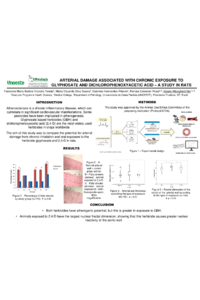
Introduction: Atherosclerosis is a chronic inflammatory disease which can culminate in significant cardiovascular manifestations. Some pesticides have been implicated in atherogenesis. Glyphosate and dichlorophenoxyacetic acid (2,4-D) are the most widely used herbicides in crops worldwide. The objective of this study was to compare the potential for arterial damage from chronic inhalation and oral exposure to the herbicide glyphosate and 2,4-D in rats. Methods: This study was approved by the Animal Use Ethics Committee of the proposing institution (Protocol 6724). Seventy adult male Wistar rats were distributed into 14 groups: 2 control groups (exposed to distilled water via inhalation and oral route), 6 groups exposed to glyphosate, and 6 exposed to 2,4-D (n=10/group). The animals were exposed to three doses of each herbicide via inhalation (inhalation groups) and in the diet (oral groups): low concentration, 3.71 x 10⁻³ grams of active ingredient per hectare (g.a.i./ha); medium concentration, 6.19 x 10⁻³ g.a.i./ha; and high concentration, 9.28 x 10⁻³ g.a.i./ha. The experiment lasted six months. The aorta was collected for histological analysis. Results: Fatty streaks were observed only in animals exposed to herbicides (p<0.0001), with no difference regarding the route of exposure (oral or inhalation) (p>0.05). Animals exposed to GBH had twice as many cases of cholesterol streaks than those exposed to 2,4-D (p<0.05). There was no significant difference in the thickness of the aorta between those exposed and those not exposed (p>0.05). Animals exposed to 2,4-D showed a greater fractal dimension of the nuclei when compared to animals exposed to GBH and those in the control group (p<0.05). Conclusions: Both herbicides have atherogenic potential, but this is greater in exposure to GBH. Animals exposed to 2,4-D have the largest nuclear fractal dimension, showing that this herbicide causes greater nuclear reactivity of the aortic wall.
Keywords
cardiovascular diseases
oxidative stress
exposure to pesticides
occupational exposure
chronic toxicity.
Poster
Poster IOCT 2025.pdf
Dietary Exposure to Arsenic in the Cuban Population: Results from a Total Diet Study
In silico study of organophosphorus pesticides' ability to bind to the ABCG2 transporter in the context of health risks associated with breastfeeding.