Event submissions
Published
This submission belongs to the session S5. Cardio-vascular Diseases of the event The 1st International Online Conference on Diseases
Published date
04 Sep, 2025
Academic Editor
'%3e%3cpath%20d='M12.6657%2010.9104C12.4185%2010.325%2012.0599%209.79327%2011.6097%209.34482C11.1609%208.89508%2010.6293%208.5365%2010.0442%208.28888C10.0389%208.28626%2010.0337%208.28495%2010.0285%208.28233C10.8446%207.69279%2011.3752%206.73249%2011.3752%205.64904C11.3752%203.8542%209.92103%202.39999%208.1262%202.39999C6.33136%202.39999%204.87715%203.8542%204.87715%205.64904C4.87715%206.73249%205.40774%207.69279%206.22393%208.28364C6.21869%208.28626%206.21345%208.28757%206.20821%208.29019C5.62129%208.5378%205.09463%208.89284%204.64265%209.34613C4.1929%209.79493%203.83432%2010.3266%203.58671%2010.9117C3.34345%2011.4845%203.21226%2012.0987%203.20023%2012.7209C3.19988%2012.7349%203.20233%2012.7488%203.20744%2012.7619C3.21255%2012.7749%203.22022%2012.7867%203.22998%2012.7968C3.23975%2012.8068%203.25142%2012.8147%203.26431%2012.8202C3.2772%2012.8256%203.29105%2012.8284%203.30504%2012.8284H4.09109C4.14874%2012.8284%204.19459%2012.7825%204.1959%2012.7262C4.2221%2011.7148%204.62823%2010.7676%205.34617%2010.0497C6.08899%209.30683%207.0755%208.89808%208.1262%208.89808C9.17689%208.89808%2010.1634%209.30683%2010.9062%2010.0497C11.6242%2010.7676%2012.0303%2011.7148%2012.0565%2012.7262C12.0578%2012.7838%2012.1037%2012.8284%2012.1613%2012.8284H12.9474C12.9613%2012.8284%2012.9752%2012.8256%2012.9881%2012.8202C13.001%2012.8147%2013.0126%2012.8068%2013.0224%2012.7968C13.0322%2012.7867%2013.0398%2012.7749%2013.0449%2012.7619C13.0501%2012.7488%2013.0525%2012.7349%2013.0522%2012.7209C13.0391%2012.0947%2012.9094%2011.4855%2012.6657%2010.9104ZM8.1262%207.9024C7.52486%207.9024%206.9589%207.6679%206.53312%207.24211C6.10733%206.81633%205.87283%206.25037%205.87283%205.64904C5.87283%205.0477%206.10733%204.48174%206.53312%204.05596C6.9589%203.63018%207.52486%203.39567%208.1262%203.39567C8.72753%203.39567%209.29349%203.63018%209.71927%204.05596C10.1451%204.48174%2010.3796%205.0477%2010.3796%205.64904C10.3796%206.25037%2010.1451%206.81633%209.71927%207.24211C9.29349%207.6679%208.72753%207.9024%208.1262%207.9024Z'%20fill='%235D1EE1'/%3e%3c/g%3e%3c/svg%3e) Jason Ali
Jason AliCitation
Lin Wang, Mingjin Huang, Latent Class Profiles of Comorbidity and Cognitive Function Among Hypertensive Adults in China: Evidence from CHARLS 2020, in Proceedings of The 1st International Online Conference on Diseases, 9 September–11 September 2025, MDPI: Basel, Switzerland
Share
Email
Facebook
Twitter
LinkedIn
Latent Class Profiles of Comorbidity and Cognitive Function Among Hypertensive Adults in China: Evidence from CHARLS 2020
'%3e%3cpath%20d='M12.6647%2010.9104C12.4176%2010.325%2012.0589%209.7933%2011.6088%209.34485C11.16%208.89511%2010.6283%208.53653%2010.0432%208.28891C10.038%208.28629%2010.0327%208.28498%2010.0275%208.28236C10.8437%207.69282%2011.3743%206.73252%2011.3743%205.64907C11.3743%203.85423%209.92005%202.40002%208.12522%202.40002C6.33038%202.40002%204.87618%203.85423%204.87618%205.64907C4.87618%206.73252%205.40677%207.69282%206.22296%208.28367C6.21772%208.28629%206.21248%208.2876%206.20724%208.29022C5.62031%208.53783%205.09365%208.89287%204.64167%209.34616C4.19192%209.79496%203.83334%2010.3266%203.58573%2010.9117C3.34247%2011.4846%203.21128%2012.0987%203.19925%2012.721C3.1989%2012.735%203.20135%2012.7489%203.20646%2012.7619C3.21157%2012.7749%203.21924%2012.7868%203.22901%2012.7968C3.23877%2012.8068%203.25045%2012.8148%203.26334%2012.8202C3.27623%2012.8256%203.29007%2012.8284%203.30406%2012.8284H4.09012C4.14776%2012.8284%204.19362%2012.7825%204.19493%2012.7262C4.22113%2011.7148%204.62726%2010.7676%205.34519%2010.0497C6.08802%209.30686%207.07452%208.89811%208.12522%208.89811C9.17592%208.89811%2010.1624%209.30686%2010.9052%2010.0497C11.6232%2010.7676%2012.0293%2011.7148%2012.0555%2012.7262C12.0568%2012.7839%2012.1027%2012.8284%2012.1603%2012.8284H12.9464C12.9604%2012.8284%2012.9742%2012.8256%2012.9871%2012.8202C13%2012.8148%2013.0117%2012.8068%2013.0214%2012.7968C13.0312%2012.7868%2013.0389%2012.7749%2013.044%2012.7619C13.0491%2012.7489%2013.0515%2012.735%2013.0512%2012.721C13.0381%2012.0947%2012.9084%2011.4856%2012.6647%2010.9104ZM8.12522%207.90243C7.52388%207.90243%206.95792%207.66793%206.53214%207.24215C6.10636%206.81636%205.87185%206.2504%205.87185%205.64907C5.87185%205.04773%206.10636%204.48177%206.53214%204.05599C6.95792%203.63021%207.52388%203.3957%208.12522%203.3957C8.72655%203.3957%209.29252%203.63021%209.7183%204.05599C10.1441%204.48177%2010.3786%205.04773%2010.3786%205.64907C10.3786%206.2504%2010.1441%206.81636%209.7183%207.24215C9.29252%207.66793%208.72655%207.90243%208.12522%207.90243Z'%20fill='%235D1EE1'/%3e%3c/g%3e%3c/svg%3e)
Lin Wang 1
Mingjin Huang 1
1. Mianyang Third People's Hospital, Sichuan Provincial Mental Health Center, Mianyang, Sichuan, China
Abstract
Background:
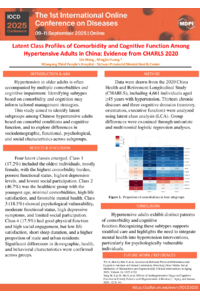
Hypertension in older adults is often accompanied by multiple comorbidities and cognitive impairment. Identifying subtypes based on comorbidity and cognition may inform tailored management strategies.
Objective:
This study aimed to identify latent subgroups among Chinese hypertensive adults based on comorbid conditions and cognitive function and to explore differences in sociodemographic, functional, psychological, and social characteristics across subgroups.
Methods:
Data were drawn from the 2020 China Health and Retirement Longitudinal Study (CHARLS), including 4,661 individuals aged ≥45 years with hypertension. Thirteen chronic diseases and three cognitive domains (memory, orientation, and executive function) were analyzed using latent class analysis (LCA). Group differences were examined through univariate and multinomial logistic regression analyses.
Results:
Four latent classes emerged. Class 1 (17.2%) included the oldest individuals, mostly female, with the highest comorbidity burden, poorest functional status, highest depression levels, and lowest social participation. Class 2 (46.7%) was the healthiest group with the youngest age, minimal comorbidities, high life satisfaction, and favorable mental health. Class 3 (18.5%) showed psychological vulnerability, moderate functional status, high depressive symptoms, and limited social participation. Class 4 (17.5%) had good physical function and high social engagement but low life satisfaction, short sleep duration, and a higher proportion of male and urban residents. Significant differences in demographic, health, and behavioral characteristics were confirmed across groups.
Conclusion:
Hypertensive adults exhibit distinct patterns of comorbidity and cognitive function. Recognizing these subtypes supports stratified care and highlights the need to integrate mental health into hypertension interventions, particularly for psychologically vulnerable individuals.
Keywords
Hypertension
Comorbidity
Cognitive Function
Mental Health
Poster
海报模版.pdf
Metabolic Disease and Coronary Risk: Biomarker and Pathway Signatures in T2DM-Driven Atherosclerosis
Health-Related Quality of Life and Associated Factors among Patients with Pulmonary Tuberculosis in the Tigray Region, Northern Ethiopia: A Cross-Sectional Study Design