Event submissions
Published
This submission belongs to the session 4. Pesticides, Pollutants, and Health Risk of the event The 2nd International Online Conference on Toxics
Published date
04 Sep, 2025
Academic Editor
'%3e%3cpath%20d='M12.6657%2010.9104C12.4185%2010.325%2012.0599%209.79327%2011.6097%209.34482C11.1609%208.89508%2010.6293%208.5365%2010.0442%208.28888C10.0389%208.28626%2010.0337%208.28495%2010.0285%208.28233C10.8446%207.69279%2011.3752%206.73249%2011.3752%205.64904C11.3752%203.8542%209.92103%202.39999%208.1262%202.39999C6.33136%202.39999%204.87715%203.8542%204.87715%205.64904C4.87715%206.73249%205.40774%207.69279%206.22393%208.28364C6.21869%208.28626%206.21345%208.28757%206.20821%208.29019C5.62129%208.5378%205.09463%208.89284%204.64265%209.34613C4.1929%209.79493%203.83432%2010.3266%203.58671%2010.9117C3.34345%2011.4845%203.21226%2012.0987%203.20023%2012.7209C3.19988%2012.7349%203.20233%2012.7488%203.20744%2012.7619C3.21255%2012.7749%203.22022%2012.7867%203.22998%2012.7968C3.23975%2012.8068%203.25142%2012.8147%203.26431%2012.8202C3.2772%2012.8256%203.29105%2012.8284%203.30504%2012.8284H4.09109C4.14874%2012.8284%204.19459%2012.7825%204.1959%2012.7262C4.2221%2011.7148%204.62823%2010.7676%205.34617%2010.0497C6.08899%209.30683%207.0755%208.89808%208.1262%208.89808C9.17689%208.89808%2010.1634%209.30683%2010.9062%2010.0497C11.6242%2010.7676%2012.0303%2011.7148%2012.0565%2012.7262C12.0578%2012.7838%2012.1037%2012.8284%2012.1613%2012.8284H12.9474C12.9613%2012.8284%2012.9752%2012.8256%2012.9881%2012.8202C13.001%2012.8147%2013.0126%2012.8068%2013.0224%2012.7968C13.0322%2012.7867%2013.0398%2012.7749%2013.0449%2012.7619C13.0501%2012.7488%2013.0525%2012.7349%2013.0522%2012.7209C13.0391%2012.0947%2012.9094%2011.4855%2012.6657%2010.9104ZM8.1262%207.9024C7.52486%207.9024%206.9589%207.6679%206.53312%207.24211C6.10733%206.81633%205.87283%206.25037%205.87283%205.64904C5.87283%205.0477%206.10733%204.48174%206.53312%204.05596C6.9589%203.63018%207.52486%203.39567%208.1262%203.39567C8.72753%203.39567%209.29349%203.63018%209.71927%204.05596C10.1451%204.48174%2010.3796%205.0477%2010.3796%205.64904C10.3796%206.25037%2010.1451%206.81633%209.71927%207.24211C9.29349%207.6679%208.72753%207.9024%208.1262%207.9024Z'%20fill='%235D1EE1'/%3e%3c/g%3e%3c/svg%3e) Natalia Garcia-Reyero
Natalia Garcia-ReyeroCitation
Núria Ferrer-Cortés, Andrea López-Botella, María José Gómez-Torres, José -Luis Todolí-Torró, Raquel Sánchez-Romero, Sergio Rogel, Jon Aizpurua, Assessing variability of heavy metal concentrations in follicular fluid: insights from novel ICP-MS/MS methodology and previously published studies, in Proceedings of The 2nd International Online Conference on Toxics, 8 September–10 September 2025, MDPI: Basel, Switzerland
Share
Email
Facebook
Twitter
LinkedIn
Assessing variability of heavy metal concentrations in follicular fluid: insights from novel ICP-MS/MS methodology and previously published studies
'%3e%3cpath%20d='M12.6647%2010.9104C12.4176%2010.325%2012.0589%209.7933%2011.6088%209.34485C11.16%208.89511%2010.6283%208.53653%2010.0432%208.28891C10.038%208.28629%2010.0327%208.28498%2010.0275%208.28236C10.8437%207.69282%2011.3743%206.73252%2011.3743%205.64907C11.3743%203.85423%209.92005%202.40002%208.12522%202.40002C6.33038%202.40002%204.87618%203.85423%204.87618%205.64907C4.87618%206.73252%205.40677%207.69282%206.22296%208.28367C6.21772%208.28629%206.21248%208.2876%206.20724%208.29022C5.62031%208.53783%205.09365%208.89287%204.64167%209.34616C4.19192%209.79496%203.83334%2010.3266%203.58573%2010.9117C3.34247%2011.4846%203.21128%2012.0987%203.19925%2012.721C3.1989%2012.735%203.20135%2012.7489%203.20646%2012.7619C3.21157%2012.7749%203.21924%2012.7868%203.22901%2012.7968C3.23877%2012.8068%203.25045%2012.8148%203.26334%2012.8202C3.27623%2012.8256%203.29007%2012.8284%203.30406%2012.8284H4.09012C4.14776%2012.8284%204.19362%2012.7825%204.19493%2012.7262C4.22113%2011.7148%204.62726%2010.7676%205.34519%2010.0497C6.08802%209.30686%207.07452%208.89811%208.12522%208.89811C9.17592%208.89811%2010.1624%209.30686%2010.9052%2010.0497C11.6232%2010.7676%2012.0293%2011.7148%2012.0555%2012.7262C12.0568%2012.7839%2012.1027%2012.8284%2012.1603%2012.8284H12.9464C12.9604%2012.8284%2012.9742%2012.8256%2012.9871%2012.8202C13%2012.8148%2013.0117%2012.8068%2013.0214%2012.7968C13.0312%2012.7868%2013.0389%2012.7749%2013.044%2012.7619C13.0491%2012.7489%2013.0515%2012.735%2013.0512%2012.721C13.0381%2012.0947%2012.9084%2011.4856%2012.6647%2010.9104ZM8.12522%207.90243C7.52388%207.90243%206.95792%207.66793%206.53214%207.24215C6.10636%206.81636%205.87185%206.2504%205.87185%205.64907C5.87185%205.04773%206.10636%204.48177%206.53214%204.05599C6.95792%203.63021%207.52388%203.3957%208.12522%203.3957C8.72655%203.3957%209.29252%203.63021%209.7183%204.05599C10.1441%204.48177%2010.3786%205.04773%2010.3786%205.64907C10.3786%206.2504%2010.1441%206.81636%209.7183%207.24215C9.29252%207.66793%208.72655%207.90243%208.12522%207.90243Z'%20fill='%235D1EE1'/%3e%3c/g%3e%3c/svg%3e)
Núria Ferrer-Cortés 1
Andrea López-Botella 1,2
María José Gómez-Torres 1,3
José -Luis Todolí-Torró 2

Raquel Sánchez-Romero 2
Sergio Rogel 4
Jon Aizpurua 3,4
1. Biotechnology Department, Faculty of Sciences, University of Alicante, Alicante, Spain
2. Department of Analytical Chemistry, Nutrition and Food Sciences, University of Alicante, Alicante, Spain
3. Catedra Human Fertility, University of Alicante, Alicante, Carretera de San Vicente s/n, P.O. Box 99, 03080, Alicante, Spain
4. IVF Spain Treatment Clinic, Avenida de Ansaldo 13, 03540, Alicante, Spain
Abstract
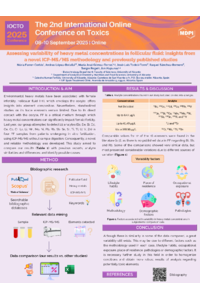
Introduction: Environmental heavy metals have been associated with female infertility. Follicular fluid (FF), which envelops the oocyte, offers insights into element composition. Nevertheless, standardized studies on its trace elements remain limited. Due to its direct contact with the oocyte, FF is a critical medium through which heavy metal concentrations can significantly impact female fertility. Last year, our group attempted to detect 22 analytes (Ba, Be, Bi, Cd, Ce, Co, Cr, La, Li, Mn, Mo, Ni, Pb, Rb, Sb, Sn, Sr, Ti, Tl, U, V, Zn) in four FF samples from patients undergoing in vitro fertilization, using ICP-MS/MS without sample digestion. Consequently, a novel and reliable methodology was developed. This study aimed to compare our results with previous reports, analyze their similarities and differences, and identify possible causes.
Methods: An exhaustive literature search was conducted using adequate keywords. Relevant data were extracted for comparison, considering the type of matrix analyzed, the method used, and the elements detected. Finally, these were compared with those obtained by our group in a database.
Results: Of our 22 analytes, values were available for 16 of them, as the remaining ones were not detected (Be, Ce, Cd, La, Pb, and U). Comparable values for 13 of the 16 elements were found in the literature, as there is no published data on FF regarding Bi, Sb, and Rb. Some of the comparisons showed very similar data, but most presented considerable variations.
Conclusions: Although there is similarity in some of the data compared, great variability still exists. This may be due to different factors, such as the methodology used in each case, lifestyle habits, occupational exposure, place of residence, pathologies, or demographic factors. Further study in this field is necessary in order to homogenize conditions and obtain more robust results of analysis regarding potentially toxic elements.
Keywords
heavy metals
ICP/MS-MS
environmental pollution
toxic contaminants
methodological variability
Poster
Poster IOCTO 2025 Núria Ferrer Cortés.pdf
In silico study of organophosphorus pesticides' ability to bind to the ABCG2 transporter in the context of health risks associated with breastfeeding.
Exploring the association between exposure to multiple toxic metals and endometriosis risk using Bayesian Kernel Machine Regression: evidence from peritoneal fluid