Event submissions
Published
This submission belongs to the session 4. Pesticides, Pollutants, and Health Risk of the event The 2nd International Online Conference on Toxics
Published date
04 Sep, 2025
Academic Editor
'%3e%3cpath%20d='M12.6657%2010.9104C12.4185%2010.325%2012.0599%209.79327%2011.6097%209.34482C11.1609%208.89508%2010.6293%208.5365%2010.0442%208.28888C10.0389%208.28626%2010.0337%208.28495%2010.0285%208.28233C10.8446%207.69279%2011.3752%206.73249%2011.3752%205.64904C11.3752%203.8542%209.92103%202.39999%208.1262%202.39999C6.33136%202.39999%204.87715%203.8542%204.87715%205.64904C4.87715%206.73249%205.40774%207.69279%206.22393%208.28364C6.21869%208.28626%206.21345%208.28757%206.20821%208.29019C5.62129%208.5378%205.09463%208.89284%204.64265%209.34613C4.1929%209.79493%203.83432%2010.3266%203.58671%2010.9117C3.34345%2011.4845%203.21226%2012.0987%203.20023%2012.7209C3.19988%2012.7349%203.20233%2012.7488%203.20744%2012.7619C3.21255%2012.7749%203.22022%2012.7867%203.22998%2012.7968C3.23975%2012.8068%203.25142%2012.8147%203.26431%2012.8202C3.2772%2012.8256%203.29105%2012.8284%203.30504%2012.8284H4.09109C4.14874%2012.8284%204.19459%2012.7825%204.1959%2012.7262C4.2221%2011.7148%204.62823%2010.7676%205.34617%2010.0497C6.08899%209.30683%207.0755%208.89808%208.1262%208.89808C9.17689%208.89808%2010.1634%209.30683%2010.9062%2010.0497C11.6242%2010.7676%2012.0303%2011.7148%2012.0565%2012.7262C12.0578%2012.7838%2012.1037%2012.8284%2012.1613%2012.8284H12.9474C12.9613%2012.8284%2012.9752%2012.8256%2012.9881%2012.8202C13.001%2012.8147%2013.0126%2012.8068%2013.0224%2012.7968C13.0322%2012.7867%2013.0398%2012.7749%2013.0449%2012.7619C13.0501%2012.7488%2013.0525%2012.7349%2013.0522%2012.7209C13.0391%2012.0947%2012.9094%2011.4855%2012.6657%2010.9104ZM8.1262%207.9024C7.52486%207.9024%206.9589%207.6679%206.53312%207.24211C6.10733%206.81633%205.87283%206.25037%205.87283%205.64904C5.87283%205.0477%206.10733%204.48174%206.53312%204.05596C6.9589%203.63018%207.52486%203.39567%208.1262%203.39567C8.72753%203.39567%209.29349%203.63018%209.71927%204.05596C10.1451%204.48174%2010.3796%205.0477%2010.3796%205.64904C10.3796%206.25037%2010.1451%206.81633%209.71927%207.24211C9.29349%207.6679%208.72753%207.9024%208.1262%207.9024Z'%20fill='%235D1EE1'/%3e%3c/g%3e%3c/svg%3e) Natalia Garcia-Reyero
Natalia Garcia-ReyeroCitation
Andrea López-Botella, Raquel Sánchez-Romero, José -Luis Todolí-Torró, Irene Velasco, María José Gómez-Torres, Maribel Acién, Exploring the association between exposure to multiple toxic metals and endometriosis risk using Bayesian Kernel Machine Regression: evidence from peritoneal fluid, in Proceedings of The 2nd International Online Conference on Toxics, 8 September–10 September 2025, MDPI: Basel, Switzerland
Share
Email
Facebook
Twitter
LinkedIn
Exploring the association between exposure to multiple toxic metals and endometriosis risk using Bayesian Kernel Machine Regression: evidence from peritoneal fluid
'%3e%3cpath%20d='M12.6647%2010.9104C12.4176%2010.325%2012.0589%209.7933%2011.6088%209.34485C11.16%208.89511%2010.6283%208.53653%2010.0432%208.28891C10.038%208.28629%2010.0327%208.28498%2010.0275%208.28236C10.8437%207.69282%2011.3743%206.73252%2011.3743%205.64907C11.3743%203.85423%209.92005%202.40002%208.12522%202.40002C6.33038%202.40002%204.87618%203.85423%204.87618%205.64907C4.87618%206.73252%205.40677%207.69282%206.22296%208.28367C6.21772%208.28629%206.21248%208.2876%206.20724%208.29022C5.62031%208.53783%205.09365%208.89287%204.64167%209.34616C4.19192%209.79496%203.83334%2010.3266%203.58573%2010.9117C3.34247%2011.4846%203.21128%2012.0987%203.19925%2012.721C3.1989%2012.735%203.20135%2012.7489%203.20646%2012.7619C3.21157%2012.7749%203.21924%2012.7868%203.22901%2012.7968C3.23877%2012.8068%203.25045%2012.8148%203.26334%2012.8202C3.27623%2012.8256%203.29007%2012.8284%203.30406%2012.8284H4.09012C4.14776%2012.8284%204.19362%2012.7825%204.19493%2012.7262C4.22113%2011.7148%204.62726%2010.7676%205.34519%2010.0497C6.08802%209.30686%207.07452%208.89811%208.12522%208.89811C9.17592%208.89811%2010.1624%209.30686%2010.9052%2010.0497C11.6232%2010.7676%2012.0293%2011.7148%2012.0555%2012.7262C12.0568%2012.7839%2012.1027%2012.8284%2012.1603%2012.8284H12.9464C12.9604%2012.8284%2012.9742%2012.8256%2012.9871%2012.8202C13%2012.8148%2013.0117%2012.8068%2013.0214%2012.7968C13.0312%2012.7868%2013.0389%2012.7749%2013.044%2012.7619C13.0491%2012.7489%2013.0515%2012.735%2013.0512%2012.721C13.0381%2012.0947%2012.9084%2011.4856%2012.6647%2010.9104ZM8.12522%207.90243C7.52388%207.90243%206.95792%207.66793%206.53214%207.24215C6.10636%206.81636%205.87185%206.2504%205.87185%205.64907C5.87185%205.04773%206.10636%204.48177%206.53214%204.05599C6.95792%203.63021%207.52388%203.3957%208.12522%203.3957C8.72655%203.3957%209.29252%203.63021%209.7183%204.05599C10.1441%204.48177%2010.3786%205.04773%2010.3786%205.64907C10.3786%206.2504%2010.1441%206.81636%209.7183%207.24215C9.29252%207.66793%208.72655%207.90243%208.12522%207.90243Z'%20fill='%235D1EE1'/%3e%3c/g%3e%3c/svg%3e)
Andrea López-Botella 1,2

Raquel Sánchez-Romero 2
José -Luis Todolí-Torró 2
Irene Velasco 1,3
María José Gómez-Torres 1
Maribel Acién 3,4
1. Biotechnology Department, Faculty of Sciences, University of Alicante, Alicante, Spain
2. Department of Analytical Chemistry, Nutrition and Food Sciences, University of Alicante, Alicante, Spain
3. Unit of Human Reproduction, Service of Obstetrics and Gynecology, FISABIO, Valencia, Spain
4. Gynecology Division, Faculty of Medicine, Miguel Hernández University, Elche, Spain
Abstract
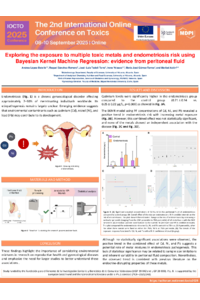
Introduction: Endometriosis is a chronic gynecological disorder affecting approximately 7–10% of menstruating individuals worldwide. Despite its high prevalence, the etiopathogenesis of endometriosis remains largely unclear. Emerging evidence suggests that environmental contaminants such as cadmium (Cd), nickel (Ni), and lead (Pb) may contribute to its development.
Methods: Peritoneal fluid (PF) samples were obtained from 50 subjects (25 controls and 25 patients with endometriosis) attending the Gynecology Service of San Juan University Hospital in Spain between June 2020 and September 2022. Samples were processed and analyzed by inductively coupled plasma tandem mass spectrometry (Agilent 8900 ICP-MS/MS). Statistical analyses were conducted using IBM SPSS Statistics version 28.0 (IBM, Armonk, NY, USA) and Bayesian Kernel Machine Regression (BKMR) was performed in R (version 4.4.3, package “bkmr” and “ggplot2”) to provide new insights into the effects of Cd, Pb, and Ni on endometriosis risk.
Results: Cadmium levels were significantly higher in the endometriosis group compared to the control group (0.71 ± 0.94 vs. 0.25 ± 0.22 µg/L, p=0.009). The BKMR model using PF concentrations of Cd, Ni, and Pb revealed a positive trend in endometriosis risk with increasing metal exposure. However, this combined effect was not statistically significant, and none of the metals showed an independent association with the disease.
Conclusions: Although no statistically significant associations were observed, the positive trend in the combined effect of Cd, Ni, and Pb suggests a potential role of metal mixtures in endometriosis pathogenesis. This lack of statistical significance may be related to sample size limitations and inherent variability in peritoneal fluid composition. Nevertheless, the observed trend is consistent with the previous literature on the endocrine-disrupting properties of these metals. These findings highlight the importance of considering environmental mixtures in research on reproductive health and gynecological diseases, and emphasize the need for larger studies to better understand these associations.
Keywords
potentially toxic elements
endometriosis
icp-ms/ms
gynaecological disease
bkmr
Poster
Exploring the exposure to multiple toxic metals and endometriosis risk using Bayesian Kernel Machine Regression evidence from peritoneal fluid.pdf
Assessing variability of heavy metal concentrations in follicular fluid: insights from novel ICP-MS/MS methodology and previously published studies
Comparative Proteomic Analysis of Cadmium Stress Response in a Newly Identified Paramecium Species isolated from industrial wastewater