Event submissions
Published
This submission belongs to the session S1. Plant, Animal, Insect and Microbial Toxins: New Developments of the event The 3rd International Online Conference on Toxins
Published date
04 Sep, 2025
Academic Editor
'%3e%3cpath%20d='M12.6657%2010.9104C12.4185%2010.325%2012.0599%209.79327%2011.6097%209.34482C11.1609%208.89508%2010.6293%208.5365%2010.0442%208.28888C10.0389%208.28626%2010.0337%208.28495%2010.0285%208.28233C10.8446%207.69279%2011.3752%206.73249%2011.3752%205.64904C11.3752%203.8542%209.92103%202.39999%208.1262%202.39999C6.33136%202.39999%204.87715%203.8542%204.87715%205.64904C4.87715%206.73249%205.40774%207.69279%206.22393%208.28364C6.21869%208.28626%206.21345%208.28757%206.20821%208.29019C5.62129%208.5378%205.09463%208.89284%204.64265%209.34613C4.1929%209.79493%203.83432%2010.3266%203.58671%2010.9117C3.34345%2011.4845%203.21226%2012.0987%203.20023%2012.7209C3.19988%2012.7349%203.20233%2012.7488%203.20744%2012.7619C3.21255%2012.7749%203.22022%2012.7867%203.22998%2012.7968C3.23975%2012.8068%203.25142%2012.8147%203.26431%2012.8202C3.2772%2012.8256%203.29105%2012.8284%203.30504%2012.8284H4.09109C4.14874%2012.8284%204.19459%2012.7825%204.1959%2012.7262C4.2221%2011.7148%204.62823%2010.7676%205.34617%2010.0497C6.08899%209.30683%207.0755%208.89808%208.1262%208.89808C9.17689%208.89808%2010.1634%209.30683%2010.9062%2010.0497C11.6242%2010.7676%2012.0303%2011.7148%2012.0565%2012.7262C12.0578%2012.7838%2012.1037%2012.8284%2012.1613%2012.8284H12.9474C12.9613%2012.8284%2012.9752%2012.8256%2012.9881%2012.8202C13.001%2012.8147%2013.0126%2012.8068%2013.0224%2012.7968C13.0322%2012.7867%2013.0398%2012.7749%2013.0449%2012.7619C13.0501%2012.7488%2013.0525%2012.7349%2013.0522%2012.7209C13.0391%2012.0947%2012.9094%2011.4855%2012.6657%2010.9104ZM8.1262%207.9024C7.52486%207.9024%206.9589%207.6679%206.53312%207.24211C6.10733%206.81633%205.87283%206.25037%205.87283%205.64904C5.87283%205.0477%206.10733%204.48174%206.53312%204.05596C6.9589%203.63018%207.52486%203.39567%208.1262%203.39567C8.72753%203.39567%209.29349%203.63018%209.71927%204.05596C10.1451%204.48174%2010.3796%205.0477%2010.3796%205.64904C10.3796%206.25037%2010.1451%206.81633%209.71927%207.24211C9.29349%207.6679%208.72753%207.9024%208.1262%207.9024Z'%20fill='%235D1EE1'/%3e%3c/g%3e%3c/svg%3e) Joseph Barbieri
Joseph BarbieriCitation
Salvina Panebianco, Maria Cristina Caggiani, Germana Barone, Claudio Finocchiaro, Gabriele Lanzafame, Agatino Musumarra, Paolo Mazzoleni, Maria Grazia Pellegriti, Gabriella Cirvilleri, Discrimination of geographical origin and detection of aflatoxins in pistachio seeds using FT-IR spectroscopy, in Proceedings of The 3rd International Online Conference on Toxins, 10 September–12 September 2025, MDPI: Basel, Switzerland
Share
Email
Facebook
Twitter
LinkedIn
Discrimination of geographical origin and detection of aflatoxins in pistachio seeds using FT-IR spectroscopy
'%3e%3cpath%20d='M12.6647%2010.9104C12.4176%2010.325%2012.0589%209.7933%2011.6088%209.34485C11.16%208.89511%2010.6283%208.53653%2010.0432%208.28891C10.038%208.28629%2010.0327%208.28498%2010.0275%208.28236C10.8437%207.69282%2011.3743%206.73252%2011.3743%205.64907C11.3743%203.85423%209.92005%202.40002%208.12522%202.40002C6.33038%202.40002%204.87618%203.85423%204.87618%205.64907C4.87618%206.73252%205.40677%207.69282%206.22296%208.28367C6.21772%208.28629%206.21248%208.2876%206.20724%208.29022C5.62031%208.53783%205.09365%208.89287%204.64167%209.34616C4.19192%209.79496%203.83334%2010.3266%203.58573%2010.9117C3.34247%2011.4846%203.21128%2012.0987%203.19925%2012.721C3.1989%2012.735%203.20135%2012.7489%203.20646%2012.7619C3.21157%2012.7749%203.21924%2012.7868%203.22901%2012.7968C3.23877%2012.8068%203.25045%2012.8148%203.26334%2012.8202C3.27623%2012.8256%203.29007%2012.8284%203.30406%2012.8284H4.09012C4.14776%2012.8284%204.19362%2012.7825%204.19493%2012.7262C4.22113%2011.7148%204.62726%2010.7676%205.34519%2010.0497C6.08802%209.30686%207.07452%208.89811%208.12522%208.89811C9.17592%208.89811%2010.1624%209.30686%2010.9052%2010.0497C11.6232%2010.7676%2012.0293%2011.7148%2012.0555%2012.7262C12.0568%2012.7839%2012.1027%2012.8284%2012.1603%2012.8284H12.9464C12.9604%2012.8284%2012.9742%2012.8256%2012.9871%2012.8202C13%2012.8148%2013.0117%2012.8068%2013.0214%2012.7968C13.0312%2012.7868%2013.0389%2012.7749%2013.044%2012.7619C13.0491%2012.7489%2013.0515%2012.735%2013.0512%2012.721C13.0381%2012.0947%2012.9084%2011.4856%2012.6647%2010.9104ZM8.12522%207.90243C7.52388%207.90243%206.95792%207.66793%206.53214%207.24215C6.10636%206.81636%205.87185%206.2504%205.87185%205.64907C5.87185%205.04773%206.10636%204.48177%206.53214%204.05599C6.95792%203.63021%207.52388%203.3957%208.12522%203.3957C8.72655%203.3957%209.29252%203.63021%209.7183%204.05599C10.1441%204.48177%2010.3786%205.04773%2010.3786%205.64907C10.3786%206.2504%2010.1441%206.81636%209.7183%207.24215C9.29252%207.66793%208.72655%207.90243%208.12522%207.90243Z'%20fill='%235D1EE1'/%3e%3c/g%3e%3c/svg%3e)
Salvina Panebianco 1
Maria Cristina Caggiani 2
Germana Barone 2

Claudio Finocchiaro 2

Gabriele Lanzafame 2
Agatino Musumarra 3,4
Paolo Mazzoleni 2
Maria Grazia Pellegriti 4

Gabriella Cirvilleri 1
1. Department of Agriculture, Food and Environment, University of Catania, Via S. Sofia 100, 95123, Catania, Italy
2. Department of Biological, Geological and Environmental Sciences, University of Catania, Corso Italia 57, 95129, Catania, Italy
3. Department of Physics and Astronomy, University of Catania, Via S. Sofia 64, 95123, Catania, Italy
4. Istituto Nazionale di Fisica Nucleare – Sezione di Catania, 95123 Catania, Italy
Abstract
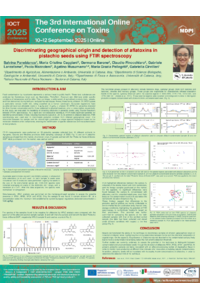
Food contamination risks from mycotoxins pose a serious threat to public health. These toxic compounds are produced by filamentous fungi such as Aspergillus, Penicillium, Fusarium and Alternaria under specific temperature and humidity conditions. They can affect a wide range of agricultural products (nuts, cereals and their derivatives) during both the pre- and post-harvest stages. Among these, aflatoxin B1 is especially dangerous and has been classified as carcinogenic to humans. As part of the project PRIN 2022 PNRR “P20223P48S” entitled “Implementing advanced elemental and chemical analysis for quality, safety and traceability assessment of PGI and PDO agri-food products” funded by the European Union NextGenerationEU, we evaluated the feasibility of detecting aflatoxins in pistachio seeds using Fourier-Transform Infrared (FT-IR) spectroscopy. As a rapid and non-destructive technique, FT-IR holds significant potential for identifying contaminants in food, including mycotoxins. In the framework of the above project, FT-IR spectroscopy was initially applied to investigating the responses of pistachio samples from different locations in Sicily. The results demonstrate the ability of the FT-IR technique to discriminate between pistachios of different geographical origins, highlighting the connection between terroir and the chemical composition of the crops. Further studies are underway to evaluate the method’s potential to distinguish between contaminated and uncontaminated seeds by detecting the presence of aflatoxins B1, B2, G1, and G2. FT-IR analysis is being used to compare the chemical profiles of contaminated samples with those of mycotoxin-free ones.
Keywords
aflatoxins
Fourier-Transform Infrared (FT-IR) spectroscopy
pistachio seeds
food quality
food safety
Poster
Toxins_Panebianco_poster.pdf
No gain from pain: lack of nociceptor activation suggests no selection for defence in the evolution of European viper venoms
Purification and Biochemical Characterization of a Probable P-IIId Class Metalloprotease from Bothrops atrox Venom Active in Platelet Aggregation