Event submissions
Published
This submission belongs to the session S7. Endocrine and Metabolic Disorders of the event The 1st International Online Conference on Diseases
Published date
04 Sep, 2025
Academic Editor
'%3e%3cpath%20d='M12.6657%2010.9104C12.4185%2010.325%2012.0599%209.79327%2011.6097%209.34482C11.1609%208.89508%2010.6293%208.5365%2010.0442%208.28888C10.0389%208.28626%2010.0337%208.28495%2010.0285%208.28233C10.8446%207.69279%2011.3752%206.73249%2011.3752%205.64904C11.3752%203.8542%209.92103%202.39999%208.1262%202.39999C6.33136%202.39999%204.87715%203.8542%204.87715%205.64904C4.87715%206.73249%205.40774%207.69279%206.22393%208.28364C6.21869%208.28626%206.21345%208.28757%206.20821%208.29019C5.62129%208.5378%205.09463%208.89284%204.64265%209.34613C4.1929%209.79493%203.83432%2010.3266%203.58671%2010.9117C3.34345%2011.4845%203.21226%2012.0987%203.20023%2012.7209C3.19988%2012.7349%203.20233%2012.7488%203.20744%2012.7619C3.21255%2012.7749%203.22022%2012.7867%203.22998%2012.7968C3.23975%2012.8068%203.25142%2012.8147%203.26431%2012.8202C3.2772%2012.8256%203.29105%2012.8284%203.30504%2012.8284H4.09109C4.14874%2012.8284%204.19459%2012.7825%204.1959%2012.7262C4.2221%2011.7148%204.62823%2010.7676%205.34617%2010.0497C6.08899%209.30683%207.0755%208.89808%208.1262%208.89808C9.17689%208.89808%2010.1634%209.30683%2010.9062%2010.0497C11.6242%2010.7676%2012.0303%2011.7148%2012.0565%2012.7262C12.0578%2012.7838%2012.1037%2012.8284%2012.1613%2012.8284H12.9474C12.9613%2012.8284%2012.9752%2012.8256%2012.9881%2012.8202C13.001%2012.8147%2013.0126%2012.8068%2013.0224%2012.7968C13.0322%2012.7867%2013.0398%2012.7749%2013.0449%2012.7619C13.0501%2012.7488%2013.0525%2012.7349%2013.0522%2012.7209C13.0391%2012.0947%2012.9094%2011.4855%2012.6657%2010.9104ZM8.1262%207.9024C7.52486%207.9024%206.9589%207.6679%206.53312%207.24211C6.10733%206.81633%205.87283%206.25037%205.87283%205.64904C5.87283%205.0477%206.10733%204.48174%206.53312%204.05596C6.9589%203.63018%207.52486%203.39567%208.1262%203.39567C8.72753%203.39567%209.29349%203.63018%209.71927%204.05596C10.1451%204.48174%2010.3796%205.0477%2010.3796%205.64904C10.3796%206.25037%2010.1451%206.81633%209.71927%207.24211C9.29349%207.6679%208.72753%207.9024%208.1262%207.9024Z'%20fill='%235D1EE1'/%3e%3c/g%3e%3c/svg%3e) Andrea Cabrera-Pastor
Andrea Cabrera-PastorCitation
Boukil Noura, El Mlili Nisrin, Oudghiri Diae Eddine, Bendriss El khalil, Medicinal plants used by hemodialysis patients in public centers in the Tangier-Tetouan-Al Hoceima region: Awareness of potential toxicity, in Proceedings of The 1st International Online Conference on Diseases, 9 September–11 September 2025, MDPI: Basel, Switzerland
Share
Email
Facebook
Twitter
LinkedIn
Medicinal plants used by hemodialysis patients in public centers in the Tangier-Tetouan-Al Hoceima region: Awareness of potential toxicity
'%3e%3cpath%20d='M12.6647%2010.9104C12.4176%2010.325%2012.0589%209.7933%2011.6088%209.34485C11.16%208.89511%2010.6283%208.53653%2010.0432%208.28891C10.038%208.28629%2010.0327%208.28498%2010.0275%208.28236C10.8437%207.69282%2011.3743%206.73252%2011.3743%205.64907C11.3743%203.85423%209.92005%202.40002%208.12522%202.40002C6.33038%202.40002%204.87618%203.85423%204.87618%205.64907C4.87618%206.73252%205.40677%207.69282%206.22296%208.28367C6.21772%208.28629%206.21248%208.2876%206.20724%208.29022C5.62031%208.53783%205.09365%208.89287%204.64167%209.34616C4.19192%209.79496%203.83334%2010.3266%203.58573%2010.9117C3.34247%2011.4846%203.21128%2012.0987%203.19925%2012.721C3.1989%2012.735%203.20135%2012.7489%203.20646%2012.7619C3.21157%2012.7749%203.21924%2012.7868%203.22901%2012.7968C3.23877%2012.8068%203.25045%2012.8148%203.26334%2012.8202C3.27623%2012.8256%203.29007%2012.8284%203.30406%2012.8284H4.09012C4.14776%2012.8284%204.19362%2012.7825%204.19493%2012.7262C4.22113%2011.7148%204.62726%2010.7676%205.34519%2010.0497C6.08802%209.30686%207.07452%208.89811%208.12522%208.89811C9.17592%208.89811%2010.1624%209.30686%2010.9052%2010.0497C11.6232%2010.7676%2012.0293%2011.7148%2012.0555%2012.7262C12.0568%2012.7839%2012.1027%2012.8284%2012.1603%2012.8284H12.9464C12.9604%2012.8284%2012.9742%2012.8256%2012.9871%2012.8202C13%2012.8148%2013.0117%2012.8068%2013.0214%2012.7968C13.0312%2012.7868%2013.0389%2012.7749%2013.044%2012.7619C13.0491%2012.7489%2013.0515%2012.735%2013.0512%2012.721C13.0381%2012.0947%2012.9084%2011.4856%2012.6647%2010.9104ZM8.12522%207.90243C7.52388%207.90243%206.95792%207.66793%206.53214%207.24215C6.10636%206.81636%205.87185%206.2504%205.87185%205.64907C5.87185%205.04773%206.10636%204.48177%206.53214%204.05599C6.95792%203.63021%207.52388%203.3957%208.12522%203.3957C8.72655%203.3957%209.29252%203.63021%209.7183%204.05599C10.1441%204.48177%2010.3786%205.04773%2010.3786%205.64907C10.3786%206.2504%2010.1441%206.81636%209.7183%207.24215C9.29252%207.66793%208.72655%207.90243%208.12522%207.90243Z'%20fill='%235D1EE1'/%3e%3c/g%3e%3c/svg%3e)
Boukil Noura 1
El Mlili Nisrin 1

Oudghiri Diae Eddine 1
Bendriss El khalil 2
1. The Higher Institute of Nursing Professions and Health Techniques, Tetouan, Morocco
2. Biology and Health Laboratory, Faculty of Science, Tetouan, Morocco
Abstract
Background:
End-Stage Renal Disease (ESRD) has been declared as a major public health priority in Morocco and worldwide. Medicinal plants (MPs) are very commonly used by ESRD patients. However, these plants contain active substances that can lead to very serious toxic incidents among hemodialysis patients.
To identify MPs used by hemodialysis patients and assess their awareness of the potential toxicities associated with certain plants, an ethnobotanical and descriptive study was carried out in public hemodialysis centers in the Tangier-Tetouan-Al Hoceima (TTA) region.
Methodology:
A cross-sectional ethnobotanical and descriptive study was conducted between September 2024 and March 2025 to investigate MPs used by patients with ESRD in public hemodialysis centers in the TTA region, as well as to assess their awareness of the potential toxicity associated with these plants. Data were collected from 323 patients using a comprehensive set of questionnaires derived from Benkhnigue’s “Questionnaire on MP and Phytotherapy” (2022).
Results:
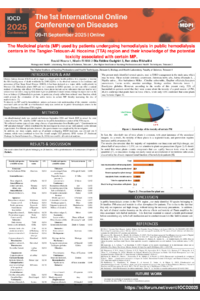
This study identified 53 plants belonging to 26 families, with a predominance of Lamiaceae (10 species). Among them, several species may pose toxicity risks. Notably, the findings revealed that 52% of hemodialysis patients expressed uncertainty regarding the toxicity of many of these plants, 46.4% believed that these plants are non-toxic, while only 1.6% acknowledged the potential toxicity of certain plants.
The findings also indicated that a majority of respondents tended to use incorrect dosages, with nearly half (42.3%) failing to adhere to safety precautions when using these plants
Conclusions:
In public hemodialysis centers within the TTA region, our study identified 53 species from 26 families utilized by patients with end-stage renal disease. The potential toxicity associated with these plants is often underestimated by patients, who tend to rely on imprecise dosages and neglect necessary precautions.
Keywords
Medicinal plants
hemodialysis patients
awarness
toxicity
Poster
poster noura Sciforum 2025 MAI.pdf
Mediterranean Diet adherence among medical students in southern Italy
Revolutionizing Diets: AI for Personalized Metabolic Health - A Review of Recent Advances