Event submissions
Published
This submission belongs to the session S3. Use of Toxins as Tools for Research, Drug Discovery, and Therapeutics of the event The 3rd International Online Conference on Toxins
Published date
04 Sep, 2025
Academic Editor
'%3e%3cpath%20d='M12.6657%2010.9104C12.4185%2010.325%2012.0599%209.79327%2011.6097%209.34482C11.1609%208.89508%2010.6293%208.5365%2010.0442%208.28888C10.0389%208.28626%2010.0337%208.28495%2010.0285%208.28233C10.8446%207.69279%2011.3752%206.73249%2011.3752%205.64904C11.3752%203.8542%209.92103%202.39999%208.1262%202.39999C6.33136%202.39999%204.87715%203.8542%204.87715%205.64904C4.87715%206.73249%205.40774%207.69279%206.22393%208.28364C6.21869%208.28626%206.21345%208.28757%206.20821%208.29019C5.62129%208.5378%205.09463%208.89284%204.64265%209.34613C4.1929%209.79493%203.83432%2010.3266%203.58671%2010.9117C3.34345%2011.4845%203.21226%2012.0987%203.20023%2012.7209C3.19988%2012.7349%203.20233%2012.7488%203.20744%2012.7619C3.21255%2012.7749%203.22022%2012.7867%203.22998%2012.7968C3.23975%2012.8068%203.25142%2012.8147%203.26431%2012.8202C3.2772%2012.8256%203.29105%2012.8284%203.30504%2012.8284H4.09109C4.14874%2012.8284%204.19459%2012.7825%204.1959%2012.7262C4.2221%2011.7148%204.62823%2010.7676%205.34617%2010.0497C6.08899%209.30683%207.0755%208.89808%208.1262%208.89808C9.17689%208.89808%2010.1634%209.30683%2010.9062%2010.0497C11.6242%2010.7676%2012.0303%2011.7148%2012.0565%2012.7262C12.0578%2012.7838%2012.1037%2012.8284%2012.1613%2012.8284H12.9474C12.9613%2012.8284%2012.9752%2012.8256%2012.9881%2012.8202C13.001%2012.8147%2013.0126%2012.8068%2013.0224%2012.7968C13.0322%2012.7867%2013.0398%2012.7749%2013.0449%2012.7619C13.0501%2012.7488%2013.0525%2012.7349%2013.0522%2012.7209C13.0391%2012.0947%2012.9094%2011.4855%2012.6657%2010.9104ZM8.1262%207.9024C7.52486%207.9024%206.9589%207.6679%206.53312%207.24211C6.10733%206.81633%205.87283%206.25037%205.87283%205.64904C5.87283%205.0477%206.10733%204.48174%206.53312%204.05596C6.9589%203.63018%207.52486%203.39567%208.1262%203.39567C8.72753%203.39567%209.29349%203.63018%209.71927%204.05596C10.1451%204.48174%2010.3796%205.0477%2010.3796%205.64904C10.3796%206.25037%2010.1451%206.81633%209.71927%207.24211C9.29349%207.6679%208.72753%207.9024%208.1262%207.9024Z'%20fill='%235D1EE1'/%3e%3c/g%3e%3c/svg%3e) Nilgun E. Tumer
Nilgun E. TumerCitation
Belen Gonzalez Viacava, Christian Leandro Macoretta, Carla Mariel Falcon, Adolfo Rafael de Roodt, Leonardo Gabriel Alonso, Matias Fingermann, Refolding of recombinant Tityus toxins improves antigen quality for their use as immunogens in Antivenom production, in Proceedings of The 3rd International Online Conference on Toxins, 10 September–12 September 2025, MDPI: Basel, Switzerland
Share
Email
Facebook
Twitter
LinkedIn
Refolding of recombinant Tityus toxins improves antigen quality for their use as immunogens in Antivenom production
'%3e%3cpath%20d='M12.6647%2010.9104C12.4176%2010.325%2012.0589%209.7933%2011.6088%209.34485C11.16%208.89511%2010.6283%208.53653%2010.0432%208.28891C10.038%208.28629%2010.0327%208.28498%2010.0275%208.28236C10.8437%207.69282%2011.3743%206.73252%2011.3743%205.64907C11.3743%203.85423%209.92005%202.40002%208.12522%202.40002C6.33038%202.40002%204.87618%203.85423%204.87618%205.64907C4.87618%206.73252%205.40677%207.69282%206.22296%208.28367C6.21772%208.28629%206.21248%208.2876%206.20724%208.29022C5.62031%208.53783%205.09365%208.89287%204.64167%209.34616C4.19192%209.79496%203.83334%2010.3266%203.58573%2010.9117C3.34247%2011.4846%203.21128%2012.0987%203.19925%2012.721C3.1989%2012.735%203.20135%2012.7489%203.20646%2012.7619C3.21157%2012.7749%203.21924%2012.7868%203.22901%2012.7968C3.23877%2012.8068%203.25045%2012.8148%203.26334%2012.8202C3.27623%2012.8256%203.29007%2012.8284%203.30406%2012.8284H4.09012C4.14776%2012.8284%204.19362%2012.7825%204.19493%2012.7262C4.22113%2011.7148%204.62726%2010.7676%205.34519%2010.0497C6.08802%209.30686%207.07452%208.89811%208.12522%208.89811C9.17592%208.89811%2010.1624%209.30686%2010.9052%2010.0497C11.6232%2010.7676%2012.0293%2011.7148%2012.0555%2012.7262C12.0568%2012.7839%2012.1027%2012.8284%2012.1603%2012.8284H12.9464C12.9604%2012.8284%2012.9742%2012.8256%2012.9871%2012.8202C13%2012.8148%2013.0117%2012.8068%2013.0214%2012.7968C13.0312%2012.7868%2013.0389%2012.7749%2013.044%2012.7619C13.0491%2012.7489%2013.0515%2012.735%2013.0512%2012.721C13.0381%2012.0947%2012.9084%2011.4856%2012.6647%2010.9104ZM8.12522%207.90243C7.52388%207.90243%206.95792%207.66793%206.53214%207.24215C6.10636%206.81636%205.87185%206.2504%205.87185%205.64907C5.87185%205.04773%206.10636%204.48177%206.53214%204.05599C6.95792%203.63021%207.52388%203.3957%208.12522%203.3957C8.72655%203.3957%209.29252%203.63021%209.7183%204.05599C10.1441%204.48177%2010.3786%205.04773%2010.3786%205.64907C10.3786%206.2504%2010.1441%206.81636%209.7183%207.24215C9.29252%207.66793%208.72655%207.90243%208.12522%207.90243Z'%20fill='%235D1EE1'/%3e%3c/g%3e%3c/svg%3e)
Belen Gonzalez Viacava 1
Christian Leandro Macoretta 1
Carla Mariel Falcon 2
Adolfo Rafael de Roodt 3
Leonardo Gabriel Alonso 4
Matias Fingermann 5
1. R&D in Biotechnology and Vaccines, National Institute of Biological Products (INPB) – ANLIS "Dr. Carlos G. Malbrán", Buenos Aires, Argentina.
2. Central Animal Facility, National Institute of Biological Products (INPB) – ANLIS "Dr. Carlos G. Malbrán", Buenos Aires, Argentina.
3. R&D in Venoms, National Institute of Biological Products (INPB) – ANLIS "Dr. Carlos G. Malbrán", Buenos Aires, Argentina.
4. Protein Chemistry Laboratory, NANOBIOTEC, UBA–CONICET, Buenos Aires, Argentina.
5. R&D in Biotechnology and Vaccines, National Institute of Biological Products (INPB) – ANLIS "Dr. Carlos G. Malbrán" – CONICET, Buenos Aires, Argentina.
Abstract
Introduction
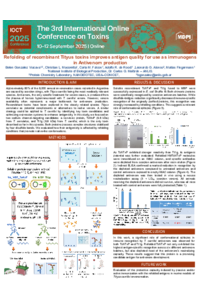
Approximately 80% of the 8,000 annual envenomation cases reported in Argentina are attributed to scorpion stings, with Tityus carrilloi being the most medically significant species. Antivenom is the only specific treatment for severe cases. It is produced from the plasma of horses hyperimmunized with T. carrilloi venom. However, the venom supply represents a bottleneck in antivenom production. In Tityus serrulatus, a related species, recombinant toxins have been investigated as potential replacements or complements for native venom. A similar approach could be applied to T. carrilloi by identifying key toxin candidates and optimizing expression systems to improve antigenicity. Sodium channel-targeting toxins, which drive the most severe symptoms, have complex structures stabilized by four disulfide bonds. This study evaluated how antigenicity is influenced by refolding conditions that promote native-like conformations.
Methods
Fusion proteins 6xHis_MBP_TsNTxP and 6xHis_MBP_Tt1G were expressed in E. coli Shuffle® cells and purified using immobilized metal affinity chromatography under denaturing conditions. Protein expression, molecular weight, and purity were confirmed via SDS–PAGE and Western blotting. Antigenic recognition was assessed via ELISA using six independent antivenom batches against reduced/alkylated, refolded, and non-refolded protein versions.
Results
Soluble recombinant TsNTxP and Tt1G fused to MBP were successfully expressed in E. coli. All six antivenom batches showed stronger recognition of the refolded proteins, confirming the relevance of conformational epitopes. Moreover, TsNTxP exhibited stronger reactivity than Tt1G, supporting its potential as a complementary immunogen to T. carrilloi venom in antivenom production.
Conclusions
Our findings demonstrate that refolding significantly increased recognition by T. carrilloi antivenom for both TsNTxP (from T. serrulatus) and Tt1G (from T. carrilloi), highlighting the role of conformational epitopes in immune recognition.
Keywords
Scorpion
venom
Tityus carrilloi
Antivenom
Recombinant
toxins
refolding
ELISA
Westernblot
SDS-PAGE
E.coli
Hyperimmunization
immunotherapeutics
Poster
Belen Gonzalez Viacava Poster IOCT 2025 .pdf
In Vitro Neuromuscular Blockade Caused by Micrurus surinamensis Venom
Toxin tools for functional nanocrystal production