Event submissions
Published
This submission belongs to the session S1. Infectious Diseases of the event The 1st International Online Conference on Diseases
Published date
04 Sep, 2025
Academic Editor
'%3e%3cpath%20d='M12.6657%2010.9104C12.4185%2010.325%2012.0599%209.79327%2011.6097%209.34482C11.1609%208.89508%2010.6293%208.5365%2010.0442%208.28888C10.0389%208.28626%2010.0337%208.28495%2010.0285%208.28233C10.8446%207.69279%2011.3752%206.73249%2011.3752%205.64904C11.3752%203.8542%209.92103%202.39999%208.1262%202.39999C6.33136%202.39999%204.87715%203.8542%204.87715%205.64904C4.87715%206.73249%205.40774%207.69279%206.22393%208.28364C6.21869%208.28626%206.21345%208.28757%206.20821%208.29019C5.62129%208.5378%205.09463%208.89284%204.64265%209.34613C4.1929%209.79493%203.83432%2010.3266%203.58671%2010.9117C3.34345%2011.4845%203.21226%2012.0987%203.20023%2012.7209C3.19988%2012.7349%203.20233%2012.7488%203.20744%2012.7619C3.21255%2012.7749%203.22022%2012.7867%203.22998%2012.7968C3.23975%2012.8068%203.25142%2012.8147%203.26431%2012.8202C3.2772%2012.8256%203.29105%2012.8284%203.30504%2012.8284H4.09109C4.14874%2012.8284%204.19459%2012.7825%204.1959%2012.7262C4.2221%2011.7148%204.62823%2010.7676%205.34617%2010.0497C6.08899%209.30683%207.0755%208.89808%208.1262%208.89808C9.17689%208.89808%2010.1634%209.30683%2010.9062%2010.0497C11.6242%2010.7676%2012.0303%2011.7148%2012.0565%2012.7262C12.0578%2012.7838%2012.1037%2012.8284%2012.1613%2012.8284H12.9474C12.9613%2012.8284%2012.9752%2012.8256%2012.9881%2012.8202C13.001%2012.8147%2013.0126%2012.8068%2013.0224%2012.7968C13.0322%2012.7867%2013.0398%2012.7749%2013.0449%2012.7619C13.0501%2012.7488%2013.0525%2012.7349%2013.0522%2012.7209C13.0391%2012.0947%2012.9094%2011.4855%2012.6657%2010.9104ZM8.1262%207.9024C7.52486%207.9024%206.9589%207.6679%206.53312%207.24211C6.10733%206.81633%205.87283%206.25037%205.87283%205.64904C5.87283%205.0477%206.10733%204.48174%206.53312%204.05596C6.9589%203.63018%207.52486%203.39567%208.1262%203.39567C8.72753%203.39567%209.29349%203.63018%209.71927%204.05596C10.1451%204.48174%2010.3796%205.0477%2010.3796%205.64904C10.3796%206.25037%2010.1451%206.81633%209.71927%207.24211C9.29349%207.6679%208.72753%207.9024%208.1262%207.9024Z'%20fill='%235D1EE1'/%3e%3c/g%3e%3c/svg%3e) Omar Cauli
Omar CauliCitation
Antonio Peña-Fernández, María de los Ángeles Peña, Fostering reflective learning in Masters students through CDC clinical case studies in clinical parasitology, in Proceedings of The 1st International Online Conference on Diseases, 9 September–11 September 2025, MDPI: Basel, Switzerland
Share
Email
Facebook
Twitter
LinkedIn
Fostering reflective learning in Masters students through CDC clinical case studies in clinical parasitology

Antonio Peña-Fernández 1,2

María de los Ángeles Peña 3
1. Department of Surgery, Medical and Social Sciences, Faculty of Medicine and Health Sciences, University of Alcalá, Ctra. Madrid-Barcelona, Km. 33.600, 28871 Alcalá de Henares, Madrid, Spain.
2. Leicester School of Allied Health Sciences, De Montfort University. The Gateway, Leicester LE19BH, UK.
3. Departamento de Ciencias Biomédicas, Universidad de Alcalá, Crta. Madrid-Barcelona Km, 33.6, 28871 Alcalá de Henares, Madrid, Spain
Abstract
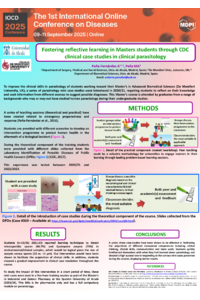
To improve the clinical skills in parasitology of students working toward their Master's in Advanced Biomedical Sciences (De Montfort University, UK), a series of parasitology mini case studies were introduced in 2020/21, requiring students to reflect on their knowledge and seek information from different sources to suggest possible diagnoses. This Master's course is attended by graduates from a range of backgrounds who may or may not have studied human parasitology during their undergraduate studies. During theory classes, students were given a series of parasitology mini clinical cases from the Laboratory for the Detection of Parasitic Diseases of Public Health Interest of the US Centers for Disease Control and Prevention. These mini cases consisted of a brief medical history and a series of virtual micrographs. Environmental micrographs were also used to familiarise the students with the characteristics of these parasites in environmental samples. Students were asked to provide a possible 'diagnosis' for each case, encouraging critical thinking. This experience was tested between 2020/21 and 2022/2023. Students (n=15/36; 2021-23) reported learning techniques to detect microsporidia spores (66.7%) and Cyclospora oocysts (75%) in environmental/clinical samples, which would be logical given the size of oocysts versus spores (10 vs. <1 μm). Our intervention would have been shown to facilitate the acquisition of clinical skills. In addition, students showed a gradual improvement in clinical case resolution throughout the course. To study the impact of this intervention in a short period of time, these mini cases were used in a five-hour training session as part of the Master's in Industrial and Galenic Pharmacy at the Spanish University of Alcalá (2023/24). This MSc is for pharmacists only and has a full compulsory module on parasitology. Students quickly familiarised themselves with what they had learned about parasitology and showed a high success rate in responding to the various mini cases presented during the session, displaying similar results.
Keywords
Clinical parasitology
emerging human parasites
reflection
case studies
learning clinical skills.
Poster
MDPI 2025 Poster CDC case studies APF.pdf
Tumor Cell-Intrinsic NIK Shapes Metabolic Crosstalk Between Tumors and Brown Adipose Tissue
Computational approaches for structure-based characterization and functional elucidation of a protein from Acinetobacter baumannii involved in siroheme biosynthesis