Event submissions
Published
This submission belongs to the session S1. Infectious Diseases of the event The 1st International Online Conference on Diseases
Published date
04 Sep, 2025
Academic Editor
'%3e%3cpath%20d='M12.6657%2010.9104C12.4185%2010.325%2012.0599%209.79327%2011.6097%209.34482C11.1609%208.89508%2010.6293%208.5365%2010.0442%208.28888C10.0389%208.28626%2010.0337%208.28495%2010.0285%208.28233C10.8446%207.69279%2011.3752%206.73249%2011.3752%205.64904C11.3752%203.8542%209.92103%202.39999%208.1262%202.39999C6.33136%202.39999%204.87715%203.8542%204.87715%205.64904C4.87715%206.73249%205.40774%207.69279%206.22393%208.28364C6.21869%208.28626%206.21345%208.28757%206.20821%208.29019C5.62129%208.5378%205.09463%208.89284%204.64265%209.34613C4.1929%209.79493%203.83432%2010.3266%203.58671%2010.9117C3.34345%2011.4845%203.21226%2012.0987%203.20023%2012.7209C3.19988%2012.7349%203.20233%2012.7488%203.20744%2012.7619C3.21255%2012.7749%203.22022%2012.7867%203.22998%2012.7968C3.23975%2012.8068%203.25142%2012.8147%203.26431%2012.8202C3.2772%2012.8256%203.29105%2012.8284%203.30504%2012.8284H4.09109C4.14874%2012.8284%204.19459%2012.7825%204.1959%2012.7262C4.2221%2011.7148%204.62823%2010.7676%205.34617%2010.0497C6.08899%209.30683%207.0755%208.89808%208.1262%208.89808C9.17689%208.89808%2010.1634%209.30683%2010.9062%2010.0497C11.6242%2010.7676%2012.0303%2011.7148%2012.0565%2012.7262C12.0578%2012.7838%2012.1037%2012.8284%2012.1613%2012.8284H12.9474C12.9613%2012.8284%2012.9752%2012.8256%2012.9881%2012.8202C13.001%2012.8147%2013.0126%2012.8068%2013.0224%2012.7968C13.0322%2012.7867%2013.0398%2012.7749%2013.0449%2012.7619C13.0501%2012.7488%2013.0525%2012.7349%2013.0522%2012.7209C13.0391%2012.0947%2012.9094%2011.4855%2012.6657%2010.9104ZM8.1262%207.9024C7.52486%207.9024%206.9589%207.6679%206.53312%207.24211C6.10733%206.81633%205.87283%206.25037%205.87283%205.64904C5.87283%205.0477%206.10733%204.48174%206.53312%204.05596C6.9589%203.63018%207.52486%203.39567%208.1262%203.39567C8.72753%203.39567%209.29349%203.63018%209.71927%204.05596C10.1451%204.48174%2010.3796%205.0477%2010.3796%205.64904C10.3796%206.25037%2010.1451%206.81633%209.71927%207.24211C9.29349%207.6679%208.72753%207.9024%208.1262%207.9024Z'%20fill='%235D1EE1'/%3e%3c/g%3e%3c/svg%3e) Omar Cauli
Omar CauliCitation
Nafisa Tabassum, Sadia Yasmin, Md. Meraz, Mst. Ismat Zarin Eva, Abdullah Al Noman, Choyan Biswas, Abu Saim Mohammad Saikat, Computational approaches for structure-based characterization and functional elucidation of a protein from Acinetobacter baumannii involved in siroheme biosynthesis, in Proceedings of The 1st International Online Conference on Diseases, 9 September–11 September 2025, MDPI: Basel, Switzerland
Share
Email
Facebook
Twitter
LinkedIn
Computational approaches for structure-based characterization and functional elucidation of a protein from Acinetobacter baumannii involved in siroheme biosynthesis
'%3e%3cpath%20d='M12.6647%2010.9104C12.4176%2010.325%2012.0589%209.7933%2011.6088%209.34485C11.16%208.89511%2010.6283%208.53653%2010.0432%208.28891C10.038%208.28629%2010.0327%208.28498%2010.0275%208.28236C10.8437%207.69282%2011.3743%206.73252%2011.3743%205.64907C11.3743%203.85423%209.92005%202.40002%208.12522%202.40002C6.33038%202.40002%204.87618%203.85423%204.87618%205.64907C4.87618%206.73252%205.40677%207.69282%206.22296%208.28367C6.21772%208.28629%206.21248%208.2876%206.20724%208.29022C5.62031%208.53783%205.09365%208.89287%204.64167%209.34616C4.19192%209.79496%203.83334%2010.3266%203.58573%2010.9117C3.34247%2011.4846%203.21128%2012.0987%203.19925%2012.721C3.1989%2012.735%203.20135%2012.7489%203.20646%2012.7619C3.21157%2012.7749%203.21924%2012.7868%203.22901%2012.7968C3.23877%2012.8068%203.25045%2012.8148%203.26334%2012.8202C3.27623%2012.8256%203.29007%2012.8284%203.30406%2012.8284H4.09012C4.14776%2012.8284%204.19362%2012.7825%204.19493%2012.7262C4.22113%2011.7148%204.62726%2010.7676%205.34519%2010.0497C6.08802%209.30686%207.07452%208.89811%208.12522%208.89811C9.17592%208.89811%2010.1624%209.30686%2010.9052%2010.0497C11.6232%2010.7676%2012.0293%2011.7148%2012.0555%2012.7262C12.0568%2012.7839%2012.1027%2012.8284%2012.1603%2012.8284H12.9464C12.9604%2012.8284%2012.9742%2012.8256%2012.9871%2012.8202C13%2012.8148%2013.0117%2012.8068%2013.0214%2012.7968C13.0312%2012.7868%2013.0389%2012.7749%2013.044%2012.7619C13.0491%2012.7489%2013.0515%2012.735%2013.0512%2012.721C13.0381%2012.0947%2012.9084%2011.4856%2012.6647%2010.9104ZM8.12522%207.90243C7.52388%207.90243%206.95792%207.66793%206.53214%207.24215C6.10636%206.81636%205.87185%206.2504%205.87185%205.64907C5.87185%205.04773%206.10636%204.48177%206.53214%204.05599C6.95792%203.63021%207.52388%203.3957%208.12522%203.3957C8.72655%203.3957%209.29252%203.63021%209.7183%204.05599C10.1441%204.48177%2010.3786%205.04773%2010.3786%205.64907C10.3786%206.2504%2010.1441%206.81636%209.7183%207.24215C9.29252%207.66793%208.72655%207.90243%208.12522%207.90243Z'%20fill='%235D1EE1'/%3e%3c/g%3e%3c/svg%3e)
Nafisa Tabassum 1,2
Sadia Yasmin 1,3
Md. Meraz 1,2
Mst. Ismat Zarin Eva 1,2
Abdullah Al Noman 1,2
Choyan Biswas 1,2

Abu Saim Mohammad Saikat 2
1. Department of Computational Biology and Bioinformatics, Advanced Bioscience Center for Collaborative Research (ABSCCR), Rajshahi 6250, Bangladesh
2. Department of Biochemistry and Molecular Biology, Bangabandhu Sheikh Mujibur Rahman Science and Technology University, Gopalganj 8100, Bangladesh
3. Department of Biochemistry and Biotechnology, University of Science and Technology Chittagong, Chittagong 4202, Bangladesh
Abstract
The opportunistic bacterial pathogen Acinetobacter baumannii (A. baumannii) is mostly linked to infections acquired in hospitals. Recent increases in incidence, primarily associated with sick combat troops returning from conflict zones, and a dramatic rise in the incidence of multidrug-resistant (MDR) strains have significantly increased the frequency of this emerging opportunistic infection. The goal of the study is to look into A. baumannii's protein sequence in order to learn more about its physiochemical properties, functional assessments based on structure, domain anticipation for certain functional forecasts, secondary and tertiary structures, and the PPI network. The protein's physiochemical characteristics showed that its sequence contains more negatively charged residues than positively charged residues. This protein is stable and has suitable thermostability, according to the aliphatic index and instability index. Documentation further supports the protein's hydrophilic nature. The siroheme synthase enzyme catalyzes the protein's siroheme synthase CysG domain, which facilitates three stages of siroheme biosynthesis: methylation, oxidation, and iron insertion into the tetrapyrrole uroporphyrinogen III (Uro-III). Gene ontology analyses have revealed the protein interactions in molecular and biological processes. The chosen protein and 10 additional proteins formed an interaction network according to the PPI network. The secondary structural assessment revealed the alpha helix as the most prevalent structural element, followed by random coils and extended strands. Additionally, three distinct programs—AlphaFold, I-TASSER, and SWISS-MODEL—modeled the protein's tertiary structure. Upon examining various structures, the structural assessment study determined that the SWISS-MODEL program's predicted structure was the most optimal. This conclusion was drawn from the values of the most desired and extra-allowed areas in the plot statistics results. We can target the selected protein, associated with siroheme biosynthesis, for further study, including the development of drugs and vaccine candidates to combat diseases caused by this protein.
Keywords
Acinetobacter baumannii
Uncharacterized protein
Functional annotation
Structure prediction
Siroheme synthase
CysG domain
Poster
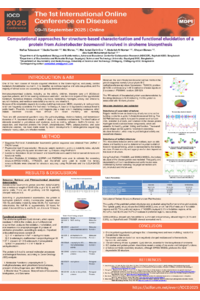
Poster Presentation of Helix_Hunters.pdf
Fostering reflective learning in Masters students through CDC clinical case studies in clinical parasitology
Efficacy and safety of adding ribavirin to direct-acting antivirals (DAAs) in re-treating non-genotype1 hepatitis C- a systematic review and meta-analysis.