Event submissions
Published
This submission belongs to the session 2. Molecular Stressors – Nanoparticles, Mixtures, and Persistent Pollutants of the event The 2nd International Online Conference on Toxics
Published date
04 Sep, 2025
Academic Editor
'%3e%3cpath%20d='M12.6657%2010.9104C12.4185%2010.325%2012.0599%209.79327%2011.6097%209.34482C11.1609%208.89508%2010.6293%208.5365%2010.0442%208.28888C10.0389%208.28626%2010.0337%208.28495%2010.0285%208.28233C10.8446%207.69279%2011.3752%206.73249%2011.3752%205.64904C11.3752%203.8542%209.92103%202.39999%208.1262%202.39999C6.33136%202.39999%204.87715%203.8542%204.87715%205.64904C4.87715%206.73249%205.40774%207.69279%206.22393%208.28364C6.21869%208.28626%206.21345%208.28757%206.20821%208.29019C5.62129%208.5378%205.09463%208.89284%204.64265%209.34613C4.1929%209.79493%203.83432%2010.3266%203.58671%2010.9117C3.34345%2011.4845%203.21226%2012.0987%203.20023%2012.7209C3.19988%2012.7349%203.20233%2012.7488%203.20744%2012.7619C3.21255%2012.7749%203.22022%2012.7867%203.22998%2012.7968C3.23975%2012.8068%203.25142%2012.8147%203.26431%2012.8202C3.2772%2012.8256%203.29105%2012.8284%203.30504%2012.8284H4.09109C4.14874%2012.8284%204.19459%2012.7825%204.1959%2012.7262C4.2221%2011.7148%204.62823%2010.7676%205.34617%2010.0497C6.08899%209.30683%207.0755%208.89808%208.1262%208.89808C9.17689%208.89808%2010.1634%209.30683%2010.9062%2010.0497C11.6242%2010.7676%2012.0303%2011.7148%2012.0565%2012.7262C12.0578%2012.7838%2012.1037%2012.8284%2012.1613%2012.8284H12.9474C12.9613%2012.8284%2012.9752%2012.8256%2012.9881%2012.8202C13.001%2012.8147%2013.0126%2012.8068%2013.0224%2012.7968C13.0322%2012.7867%2013.0398%2012.7749%2013.0449%2012.7619C13.0501%2012.7488%2013.0525%2012.7349%2013.0522%2012.7209C13.0391%2012.0947%2012.9094%2011.4855%2012.6657%2010.9104ZM8.1262%207.9024C7.52486%207.9024%206.9589%207.6679%206.53312%207.24211C6.10733%206.81633%205.87283%206.25037%205.87283%205.64904C5.87283%205.0477%206.10733%204.48174%206.53312%204.05596C6.9589%203.63018%207.52486%203.39567%208.1262%203.39567C8.72753%203.39567%209.29349%203.63018%209.71927%204.05596C10.1451%204.48174%2010.3796%205.0477%2010.3796%205.64904C10.3796%206.25037%2010.1451%206.81633%209.71927%207.24211C9.29349%207.6679%208.72753%207.9024%208.1262%207.9024Z'%20fill='%235D1EE1'/%3e%3c/g%3e%3c/svg%3e) Xiaojun Luo
Xiaojun LuoCitation
Carolina Mota, Ana Margarida Araújo, Maria Enea, Eulália Pereira, Ana Reis Mendes, Rui Fernandes, Sofia Pacheco, Marlene Lúcio, Carla Martins Lopes, Isabel M.P.L.V.O. Ferreira, Márcia Carvalho, When nanoplastics meet neurons: the impact of functionalized polystyrene nanoplastics on human neuroblastoma cells, in Proceedings of The 2nd International Online Conference on Toxics, 8 September–10 September 2025, MDPI: Basel, Switzerland
Share
Email
Facebook
Twitter
LinkedIn
When nanoplastics meet neurons: the impact of functionalized polystyrene nanoplastics on human neuroblastoma cells
'%3e%3cpath%20d='M12.6647%2010.9104C12.4176%2010.325%2012.0589%209.7933%2011.6088%209.34485C11.16%208.89511%2010.6283%208.53653%2010.0432%208.28891C10.038%208.28629%2010.0327%208.28498%2010.0275%208.28236C10.8437%207.69282%2011.3743%206.73252%2011.3743%205.64907C11.3743%203.85423%209.92005%202.40002%208.12522%202.40002C6.33038%202.40002%204.87618%203.85423%204.87618%205.64907C4.87618%206.73252%205.40677%207.69282%206.22296%208.28367C6.21772%208.28629%206.21248%208.2876%206.20724%208.29022C5.62031%208.53783%205.09365%208.89287%204.64167%209.34616C4.19192%209.79496%203.83334%2010.3266%203.58573%2010.9117C3.34247%2011.4846%203.21128%2012.0987%203.19925%2012.721C3.1989%2012.735%203.20135%2012.7489%203.20646%2012.7619C3.21157%2012.7749%203.21924%2012.7868%203.22901%2012.7968C3.23877%2012.8068%203.25045%2012.8148%203.26334%2012.8202C3.27623%2012.8256%203.29007%2012.8284%203.30406%2012.8284H4.09012C4.14776%2012.8284%204.19362%2012.7825%204.19493%2012.7262C4.22113%2011.7148%204.62726%2010.7676%205.34519%2010.0497C6.08802%209.30686%207.07452%208.89811%208.12522%208.89811C9.17592%208.89811%2010.1624%209.30686%2010.9052%2010.0497C11.6232%2010.7676%2012.0293%2011.7148%2012.0555%2012.7262C12.0568%2012.7839%2012.1027%2012.8284%2012.1603%2012.8284H12.9464C12.9604%2012.8284%2012.9742%2012.8256%2012.9871%2012.8202C13%2012.8148%2013.0117%2012.8068%2013.0214%2012.7968C13.0312%2012.7868%2013.0389%2012.7749%2013.044%2012.7619C13.0491%2012.7489%2013.0515%2012.735%2013.0512%2012.721C13.0381%2012.0947%2012.9084%2011.4856%2012.6647%2010.9104ZM8.12522%207.90243C7.52388%207.90243%206.95792%207.66793%206.53214%207.24215C6.10636%206.81636%205.87185%206.2504%205.87185%205.64907C5.87185%205.04773%206.10636%204.48177%206.53214%204.05599C6.95792%203.63021%207.52388%203.3957%208.12522%203.3957C8.72655%203.3957%209.29252%203.63021%209.7183%204.05599C10.1441%204.48177%2010.3786%205.04773%2010.3786%205.64907C10.3786%206.2504%2010.1441%206.81636%209.7183%207.24215C9.29252%207.66793%208.72655%207.90243%208.12522%207.90243Z'%20fill='%235D1EE1'/%3e%3c/g%3e%3c/svg%3e)
Carolina Mota 1

Ana Margarida Araújo 1
Maria Enea 2
Eulália Pereira 2
Ana Reis Mendes 1
Rui Fernandes 3
Sofia Pacheco 3

Marlene Lúcio 4,5

Carla Martins Lopes 6,7

Isabel M.P.L.V.O. Ferreira 1

Márcia Carvalho 1,6,8
1. LAQV/REQUIMTE, Bromatology and Hydrology Laboratory, Faculty of Pharmacy, University of Porto, Porto, Portugal
2. LAQV/REQUIMTE, Department of Chemistry and Biochemistry, Faculty of Sciences, University of Porto, Porto, Portugal
3. HEMS-Histology and Electron Microscopy, Instituto de Investigação e Inovação em Saúde (I3S), University of Porto
4. CF-UM-UP – Physics Center of the Universities of Minho and Porto, Department of Physics, University of Minho, Braga, Portugal
5. CBMA – Center for Molecular and Environmental Biology, University of Minho, Braga, Portugal
6. FFP-I3ID, FP-BHS, Faculty of Health Sciences, Fernando Pessoa University, Porto, Portugal
7. UCIBIO-Applied Molecular Biosciences Unit, MedTech-Laboratory of Pharmaceutical Technology, Faculty of Pharmacy, University of Porto, Porto, Portugal
8. RISE-Health, Faculty of Health Sciences, Fernando Pessoa University, Fernando Pessoa Teaching and Culture Foundation, Porto, Portugal
Abstract
Nanoplastics (NPs) have emerged as a growing environmental and health concern due to their widespread presence in various environmental matrices, including food, water, and air. They are inadvertently ingested, inhaled, or absorbed through the skin, raising concerns about their potential to interact with cellular systems, including the nervous system. Despite increasing awareness, their neurotoxic potential, particularly the effects of functionalized NPs, remains poorly understood. This study provides novel insights into the neurotoxicity of four types of polystyrene nanoplastic (PS-NPs)—plain PS-NPs (50 nm and 100 nm) and amine- and carboxyl-functionalized PS-NPs (100 nm)—on human SH-SY5Y cells. Cells were exposed to NP concentrations ranging from 1 to 500 µg/mL for 24 and 48 hours, with NP characterization and stability assessments conducted in culture media prior to toxicity evaluations (cell viability, ROS/RNS production, NP internalization, morphological and ultrastructural changes). In-depth toxicity assessments revealed that functionalized NPs, particularly amine-modified ones, induced greater cytotoxicity than their plain counterparts. Cellular viability assays demonstrated a concentration- and time-dependent reduction, with significant cytotoxicity observed at 200-500 µg/mL. ROS/RNS production was markedly elevated in plain 100 nm and amine-functionalized NPs at concentrations of 200-500 µg/mL, with oxidative stress intensifying over time. Transmission electron microscopy uncovered distinct subcellular damage patterns, including endoplasmic reticulum dilation, mitochondrial impairment, and Golgi fragmentation, correlating with NP size, concentration and functionalization. Notably, functionalized NPs exhibited greater cellular uptake, with amine-modified NPs showing the highest internalization. Further mechanistic analyses revealed that PS-NPs induced apoptosis, autophagy, and lysosomal dysfunction, with functionalized variants exhibiting more pronounced effects. These findings underscore the critical influence of NP functionalization on neurotoxicity and highlight the urgent need for further investigation into their potential health implications, particularly concerning human exposure and neurodegenerative risk.
Acknowledgments: This work received support from PT national funds through the UID/50006 project and FCT/MCTES through the SALIVA+ project (DOI 705 10.54499/2022.08978.PTDC).
Keywords
nanoplastics
polystyrene
surface functionalization
neurotoxicity
Poster
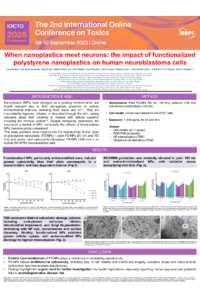
Poster The 2nd International Online Conference on Toxics (2).pdf
Scientific Validation of a Cortical Neurosphere Model for Developmental Neurotoxicity Assessment and Evaluation of Chronic PFAS Mixture Exposure
Microbiota Shifts in Vicia faba Exposed to Microcystin-Contaminated Water