Event submissions
Published
This submission belongs to the session 4. Pesticides, Pollutants, and Health Risk of the event The 2nd International Online Conference on Toxics
Published date
04 Sep, 2025
Academic Editor
'%3e%3cpath%20d='M12.6657%2010.9104C12.4185%2010.325%2012.0599%209.79327%2011.6097%209.34482C11.1609%208.89508%2010.6293%208.5365%2010.0442%208.28888C10.0389%208.28626%2010.0337%208.28495%2010.0285%208.28233C10.8446%207.69279%2011.3752%206.73249%2011.3752%205.64904C11.3752%203.8542%209.92103%202.39999%208.1262%202.39999C6.33136%202.39999%204.87715%203.8542%204.87715%205.64904C4.87715%206.73249%205.40774%207.69279%206.22393%208.28364C6.21869%208.28626%206.21345%208.28757%206.20821%208.29019C5.62129%208.5378%205.09463%208.89284%204.64265%209.34613C4.1929%209.79493%203.83432%2010.3266%203.58671%2010.9117C3.34345%2011.4845%203.21226%2012.0987%203.20023%2012.7209C3.19988%2012.7349%203.20233%2012.7488%203.20744%2012.7619C3.21255%2012.7749%203.22022%2012.7867%203.22998%2012.7968C3.23975%2012.8068%203.25142%2012.8147%203.26431%2012.8202C3.2772%2012.8256%203.29105%2012.8284%203.30504%2012.8284H4.09109C4.14874%2012.8284%204.19459%2012.7825%204.1959%2012.7262C4.2221%2011.7148%204.62823%2010.7676%205.34617%2010.0497C6.08899%209.30683%207.0755%208.89808%208.1262%208.89808C9.17689%208.89808%2010.1634%209.30683%2010.9062%2010.0497C11.6242%2010.7676%2012.0303%2011.7148%2012.0565%2012.7262C12.0578%2012.7838%2012.1037%2012.8284%2012.1613%2012.8284H12.9474C12.9613%2012.8284%2012.9752%2012.8256%2012.9881%2012.8202C13.001%2012.8147%2013.0126%2012.8068%2013.0224%2012.7968C13.0322%2012.7867%2013.0398%2012.7749%2013.0449%2012.7619C13.0501%2012.7488%2013.0525%2012.7349%2013.0522%2012.7209C13.0391%2012.0947%2012.9094%2011.4855%2012.6657%2010.9104ZM8.1262%207.9024C7.52486%207.9024%206.9589%207.6679%206.53312%207.24211C6.10733%206.81633%205.87283%206.25037%205.87283%205.64904C5.87283%205.0477%206.10733%204.48174%206.53312%204.05596C6.9589%203.63018%207.52486%203.39567%208.1262%203.39567C8.72753%203.39567%209.29349%203.63018%209.71927%204.05596C10.1451%204.48174%2010.3796%205.0477%2010.3796%205.64904C10.3796%206.25037%2010.1451%206.81633%209.71927%207.24211C9.29349%207.6679%208.72753%207.9024%208.1262%207.9024Z'%20fill='%235D1EE1'/%3e%3c/g%3e%3c/svg%3e) Virgínia Cruz Fernandes
Virgínia Cruz FernandesCitation
Andrea López-Botella, Raquel Sánchez-Romero, José -Luis Todolí-Torró, Irene Velasco, Maribel Acién, María José Gómez-Torres, Assessment of potentially toxic elements in the peritoneal fluid of patients with ovarian endometrioma, peritoneal endometriosis, and deeply infiltrative endometriosis: differences between entities, in Proceedings of The 2nd International Online Conference on Toxics, 8 September–10 September 2025, MDPI: Basel, Switzerland
Share
Email
Facebook
Twitter
LinkedIn
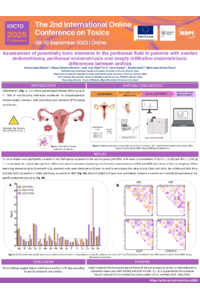
Assessment of potentially toxic elements in the peritoneal fluid of patients with ovarian endometrioma, peritoneal endometriosis, and deeply infiltrative endometriosis: differences between entities
'%3e%3cpath%20d='M12.6647%2010.9104C12.4176%2010.325%2012.0589%209.7933%2011.6088%209.34485C11.16%208.89511%2010.6283%208.53653%2010.0432%208.28891C10.038%208.28629%2010.0327%208.28498%2010.0275%208.28236C10.8437%207.69282%2011.3743%206.73252%2011.3743%205.64907C11.3743%203.85423%209.92005%202.40002%208.12522%202.40002C6.33038%202.40002%204.87618%203.85423%204.87618%205.64907C4.87618%206.73252%205.40677%207.69282%206.22296%208.28367C6.21772%208.28629%206.21248%208.2876%206.20724%208.29022C5.62031%208.53783%205.09365%208.89287%204.64167%209.34616C4.19192%209.79496%203.83334%2010.3266%203.58573%2010.9117C3.34247%2011.4846%203.21128%2012.0987%203.19925%2012.721C3.1989%2012.735%203.20135%2012.7489%203.20646%2012.7619C3.21157%2012.7749%203.21924%2012.7868%203.22901%2012.7968C3.23877%2012.8068%203.25045%2012.8148%203.26334%2012.8202C3.27623%2012.8256%203.29007%2012.8284%203.30406%2012.8284H4.09012C4.14776%2012.8284%204.19362%2012.7825%204.19493%2012.7262C4.22113%2011.7148%204.62726%2010.7676%205.34519%2010.0497C6.08802%209.30686%207.07452%208.89811%208.12522%208.89811C9.17592%208.89811%2010.1624%209.30686%2010.9052%2010.0497C11.6232%2010.7676%2012.0293%2011.7148%2012.0555%2012.7262C12.0568%2012.7839%2012.1027%2012.8284%2012.1603%2012.8284H12.9464C12.9604%2012.8284%2012.9742%2012.8256%2012.9871%2012.8202C13%2012.8148%2013.0117%2012.8068%2013.0214%2012.7968C13.0312%2012.7868%2013.0389%2012.7749%2013.044%2012.7619C13.0491%2012.7489%2013.0515%2012.735%2013.0512%2012.721C13.0381%2012.0947%2012.9084%2011.4856%2012.6647%2010.9104ZM8.12522%207.90243C7.52388%207.90243%206.95792%207.66793%206.53214%207.24215C6.10636%206.81636%205.87185%206.2504%205.87185%205.64907C5.87185%205.04773%206.10636%204.48177%206.53214%204.05599C6.95792%203.63021%207.52388%203.3957%208.12522%203.3957C8.72655%203.3957%209.29252%203.63021%209.7183%204.05599C10.1441%204.48177%2010.3786%205.04773%2010.3786%205.64907C10.3786%206.2504%2010.1441%206.81636%209.7183%207.24215C9.29252%207.66793%208.72655%207.90243%208.12522%207.90243Z'%20fill='%235D1EE1'/%3e%3c/g%3e%3c/svg%3e)
Andrea López-Botella 1,2

Raquel Sánchez-Romero 2
José -Luis Todolí-Torró 2
Irene Velasco 1,3
Maribel Acién 3,4
María José Gómez-Torres 1
1. Biotechnology Department, Faculty of Sciences, University of Alicante, Alicante, Spain
2. Department of Analytical Chemistry, Nutrition and Food Sciences, University of Alicante, Alicante, Spain
3. Service of Obstetrics and Gynecology, Unit of Human Reproduction, FISABIO—San Juan University Hospital, Carretera Alicante-Valencia s/n, 03550 Alicante, Spain
4. Gynecology Division, Faculty of Medicine, Miguel Hernández University, Elche, Spain
Abstract
Introduction: Endometriosis is a chronic gynecological disease affecting up to 7 - 10% of menstruating individuals worldwide. To date, its etiopathogenesis remains largely unknown, with environmental factors such as potentially toxic elements (PTEs) being contributors.
Methods: Peritoneal fluid (PF) samples were collected from 13 patients with superficial peritoneal endometriosis (SUP), 13 with ovarian endometrioma (OMA), 4 with deeply infiltrative endometriosis (DEEP), and 13 non-endometriosis controls. The samples were collected between June 2020 and September 2022 from patients who underwent laparoscopic procedures within the Gynecology Service of a University Hospital in San Juan (Spain). The group classification was based on surgical findings and histopathological reports. After sample processing, the PF was stored in the dark at -20°C until analysis by inductively coupled plasma tandem mass spectrometry (Agilent 8900 ICP-MS/MS). Statistical analyses were performed using IBM SPSS Statistics version 28.0 (IBM, Armonk, NY, USA). Elemental ratios were calculated by normalizing the average concentration of each element to that of the control group.
Results: The concentration of Fe was significantly elevated in the OMA group compared to the control group (p=0.005), with mean concentrations of 8,172 ± 13,361 and 967 ± 1,524 µg L−1, respectively. No statistically significant differences were found when comparing the elemental concentrations in SUP and DEEP with those in the control group. When examining the elemental ratios (threshold of >1.5), elevated levels were observed as follows: the levels of Fe and Co were above average in SUP, OMA, and DEEP; the level of Ba was above average in OMA and SUP; the level of Pb was above average in SUP and DEEP; the levels of Cd and Mn were above average in OMA; and finally, the levels of Cu and Zn were above average in DEEP. Distinct patterns of Spearman correlations between the elements were identified depending on the specific endometriosis entity.
Conclusions: These findings suggest that multielemental profiles in peritoneal fluid vary according to the specific endometriosis entity.
Keywords
potentially toxic elements
endometriosis
icp-ms/ms
gynaecological disease
lead
cadmium
iron
Poster
Assessment of potentially toxic elements in the peritoneal fluid in patients with ovarian endometrioma, peritoneal endometriosis and deeply infiltrative endometriosis differences between entities.pdf
Impact of persistent organic pollutants and preexisting steatosis on drug hepatotoxicity in cultured human hepatocytes
Exposure assessment outside and inside firefighters’ respiratory protection system: Levels of PAHs and associated in vitro toxicity