Event submissions
Published
This submission belongs to the session 2. Molecular Stressors – Nanoparticles, Mixtures, and Persistent Pollutants of the event The 2nd International Online Conference on Toxics
Published date
04 Sep, 2025
Academic Editor
'%3e%3cpath%20d='M12.6657%2010.9104C12.4185%2010.325%2012.0599%209.79327%2011.6097%209.34482C11.1609%208.89508%2010.6293%208.5365%2010.0442%208.28888C10.0389%208.28626%2010.0337%208.28495%2010.0285%208.28233C10.8446%207.69279%2011.3752%206.73249%2011.3752%205.64904C11.3752%203.8542%209.92103%202.39999%208.1262%202.39999C6.33136%202.39999%204.87715%203.8542%204.87715%205.64904C4.87715%206.73249%205.40774%207.69279%206.22393%208.28364C6.21869%208.28626%206.21345%208.28757%206.20821%208.29019C5.62129%208.5378%205.09463%208.89284%204.64265%209.34613C4.1929%209.79493%203.83432%2010.3266%203.58671%2010.9117C3.34345%2011.4845%203.21226%2012.0987%203.20023%2012.7209C3.19988%2012.7349%203.20233%2012.7488%203.20744%2012.7619C3.21255%2012.7749%203.22022%2012.7867%203.22998%2012.7968C3.23975%2012.8068%203.25142%2012.8147%203.26431%2012.8202C3.2772%2012.8256%203.29105%2012.8284%203.30504%2012.8284H4.09109C4.14874%2012.8284%204.19459%2012.7825%204.1959%2012.7262C4.2221%2011.7148%204.62823%2010.7676%205.34617%2010.0497C6.08899%209.30683%207.0755%208.89808%208.1262%208.89808C9.17689%208.89808%2010.1634%209.30683%2010.9062%2010.0497C11.6242%2010.7676%2012.0303%2011.7148%2012.0565%2012.7262C12.0578%2012.7838%2012.1037%2012.8284%2012.1613%2012.8284H12.9474C12.9613%2012.8284%2012.9752%2012.8256%2012.9881%2012.8202C13.001%2012.8147%2013.0126%2012.8068%2013.0224%2012.7968C13.0322%2012.7867%2013.0398%2012.7749%2013.0449%2012.7619C13.0501%2012.7488%2013.0525%2012.7349%2013.0522%2012.7209C13.0391%2012.0947%2012.9094%2011.4855%2012.6657%2010.9104ZM8.1262%207.9024C7.52486%207.9024%206.9589%207.6679%206.53312%207.24211C6.10733%206.81633%205.87283%206.25037%205.87283%205.64904C5.87283%205.0477%206.10733%204.48174%206.53312%204.05596C6.9589%203.63018%207.52486%203.39567%208.1262%203.39567C8.72753%203.39567%209.29349%203.63018%209.71927%204.05596C10.1451%204.48174%2010.3796%205.0477%2010.3796%205.64904C10.3796%206.25037%2010.1451%206.81633%209.71927%207.24211C9.29349%207.6679%208.72753%207.9024%208.1262%207.9024Z'%20fill='%235D1EE1'/%3e%3c/g%3e%3c/svg%3e) Xiaojun Luo
Xiaojun LuoCitation
Newton Neogi, Kristi Priya Choudhury, Sabbir Hossain, MD. Golam Sazid, Ibrahim Hossain, Advancing Nanotoxicology: High-Throughput Screening for Assessing the Toxicity of Nanoparticle Mixtures, in Proceedings of The 2nd International Online Conference on Toxics, 8 September–10 September 2025, MDPI: Basel, Switzerland
Share
Email
Facebook
Twitter
LinkedIn
Advancing Nanotoxicology: High-Throughput Screening for Assessing the Toxicity of Nanoparticle Mixtures
'%3e%3cpath%20d='M12.6647%2010.9104C12.4176%2010.325%2012.0589%209.7933%2011.6088%209.34485C11.16%208.89511%2010.6283%208.53653%2010.0432%208.28891C10.038%208.28629%2010.0327%208.28498%2010.0275%208.28236C10.8437%207.69282%2011.3743%206.73252%2011.3743%205.64907C11.3743%203.85423%209.92005%202.40002%208.12522%202.40002C6.33038%202.40002%204.87618%203.85423%204.87618%205.64907C4.87618%206.73252%205.40677%207.69282%206.22296%208.28367C6.21772%208.28629%206.21248%208.2876%206.20724%208.29022C5.62031%208.53783%205.09365%208.89287%204.64167%209.34616C4.19192%209.79496%203.83334%2010.3266%203.58573%2010.9117C3.34247%2011.4846%203.21128%2012.0987%203.19925%2012.721C3.1989%2012.735%203.20135%2012.7489%203.20646%2012.7619C3.21157%2012.7749%203.21924%2012.7868%203.22901%2012.7968C3.23877%2012.8068%203.25045%2012.8148%203.26334%2012.8202C3.27623%2012.8256%203.29007%2012.8284%203.30406%2012.8284H4.09012C4.14776%2012.8284%204.19362%2012.7825%204.19493%2012.7262C4.22113%2011.7148%204.62726%2010.7676%205.34519%2010.0497C6.08802%209.30686%207.07452%208.89811%208.12522%208.89811C9.17592%208.89811%2010.1624%209.30686%2010.9052%2010.0497C11.6232%2010.7676%2012.0293%2011.7148%2012.0555%2012.7262C12.0568%2012.7839%2012.1027%2012.8284%2012.1603%2012.8284H12.9464C12.9604%2012.8284%2012.9742%2012.8256%2012.9871%2012.8202C13%2012.8148%2013.0117%2012.8068%2013.0214%2012.7968C13.0312%2012.7868%2013.0389%2012.7749%2013.044%2012.7619C13.0491%2012.7489%2013.0515%2012.735%2013.0512%2012.721C13.0381%2012.0947%2012.9084%2011.4856%2012.6647%2010.9104ZM8.12522%207.90243C7.52388%207.90243%206.95792%207.66793%206.53214%207.24215C6.10636%206.81636%205.87185%206.2504%205.87185%205.64907C5.87185%205.04773%206.10636%204.48177%206.53214%204.05599C6.95792%203.63021%207.52388%203.3957%208.12522%203.3957C8.72655%203.3957%209.29252%203.63021%209.7183%204.05599C10.1441%204.48177%2010.3786%205.04773%2010.3786%205.64907C10.3786%206.2504%2010.1441%206.81636%209.7183%207.24215C9.29252%207.66793%208.72655%207.90243%208.12522%207.90243Z'%20fill='%235D1EE1'/%3e%3c/g%3e%3c/svg%3e)
Newton Neogi 1
Kristi Priya Choudhury 1

Sabbir Hossain 1
MD. Golam Sazid 1

Ibrahim Hossain 1
1. Department of Environmental Research, Nano Research Centre, Sylhet 3114, Bangladesh
Abstract
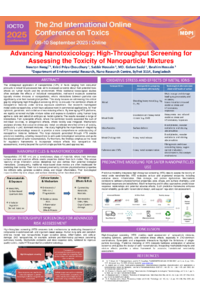
The widespread application of nanoparticles (NPs) in fields ranging from consumer products to industrial processes has led to increased concerns about their potential toxic effects on human health and the environment. While traditional toxicological studies often evaluate the effects of individual nanoparticles, real-world exposure scenarios typically involve mixtures of nanoparticles, where interactions between particles can significantly alter their toxicological profiles. This study focuses on addressing this critical gap by employing high-throughput screening (HTS) to evaluate the combined effects of nanoparticle mixtures under various exposure conditions. Our research investigated how metal oxide nanoparticles can provide advancements in commercial applications thanks to their cytotoxic, genotoxic, and oxidative stress-inducing effects. By leveraging HTS platforms, we rapidly screened multiple mixture ratios and exposure durations using human lung epithelial cells and zebrafish embryos as model systems. The results revealed a range of interactions, from synergistic effects, where the combined toxicity exceeded the sum of individual toxicities, to antagonistic effects, where toxicity was mitigated. Mechanistic analyses showed that oxidative stress and metal ion release were key drivers of toxicity, particularly in ZnO-dominant mixtures. This study highlights the importance of integrating HTS into nanotoxicology research to provide a more comprehensive understanding of nanoparticle mixtures' behavior. The large datasets generated through HTS enable predictive modeling, allowing researchers to anticipate toxicological outcomes and guide the development of safer nanomaterials. Furthermore, the findings emphasize the need for regulatory frameworks to incorporate mixture effects into nanoparticle risk assessments, moving beyond the current single-particle-focused approaches.
Keywords
nanoparticles
high-throughput screening
Toxicology
nanotoxicology
Poster
s2 sciforum-115186 poster.pdf
Phytoremediation of Cobalt Nanoparticles by Lemna minor: Insights into Uptake Mechanisms and Toxicity Responses
How polluted is the Black Sea?: A pilot assessment of heavy metals, toxic elements, and persistent organic pollutants in surface waters, sediments, and mussels