Event submissions
Published
This submission belongs to the session S3. Immune and Inflammatory Diseases of the event The 1st International Online Conference on Diseases
Published date
05 Sep, 2025
Academic Editor
'%3e%3cpath%20d='M12.6657%2010.9104C12.4185%2010.325%2012.0599%209.79327%2011.6097%209.34482C11.1609%208.89508%2010.6293%208.5365%2010.0442%208.28888C10.0389%208.28626%2010.0337%208.28495%2010.0285%208.28233C10.8446%207.69279%2011.3752%206.73249%2011.3752%205.64904C11.3752%203.8542%209.92103%202.39999%208.1262%202.39999C6.33136%202.39999%204.87715%203.8542%204.87715%205.64904C4.87715%206.73249%205.40774%207.69279%206.22393%208.28364C6.21869%208.28626%206.21345%208.28757%206.20821%208.29019C5.62129%208.5378%205.09463%208.89284%204.64265%209.34613C4.1929%209.79493%203.83432%2010.3266%203.58671%2010.9117C3.34345%2011.4845%203.21226%2012.0987%203.20023%2012.7209C3.19988%2012.7349%203.20233%2012.7488%203.20744%2012.7619C3.21255%2012.7749%203.22022%2012.7867%203.22998%2012.7968C3.23975%2012.8068%203.25142%2012.8147%203.26431%2012.8202C3.2772%2012.8256%203.29105%2012.8284%203.30504%2012.8284H4.09109C4.14874%2012.8284%204.19459%2012.7825%204.1959%2012.7262C4.2221%2011.7148%204.62823%2010.7676%205.34617%2010.0497C6.08899%209.30683%207.0755%208.89808%208.1262%208.89808C9.17689%208.89808%2010.1634%209.30683%2010.9062%2010.0497C11.6242%2010.7676%2012.0303%2011.7148%2012.0565%2012.7262C12.0578%2012.7838%2012.1037%2012.8284%2012.1613%2012.8284H12.9474C12.9613%2012.8284%2012.9752%2012.8256%2012.9881%2012.8202C13.001%2012.8147%2013.0126%2012.8068%2013.0224%2012.7968C13.0322%2012.7867%2013.0398%2012.7749%2013.0449%2012.7619C13.0501%2012.7488%2013.0525%2012.7349%2013.0522%2012.7209C13.0391%2012.0947%2012.9094%2011.4855%2012.6657%2010.9104ZM8.1262%207.9024C7.52486%207.9024%206.9589%207.6679%206.53312%207.24211C6.10733%206.81633%205.87283%206.25037%205.87283%205.64904C5.87283%205.0477%206.10733%204.48174%206.53312%204.05596C6.9589%203.63018%207.52486%203.39567%208.1262%203.39567C8.72753%203.39567%209.29349%203.63018%209.71927%204.05596C10.1451%204.48174%2010.3796%205.0477%2010.3796%205.64904C10.3796%206.25037%2010.1451%206.81633%209.71927%207.24211C9.29349%207.6679%208.72753%207.9024%208.1262%207.9024Z'%20fill='%235D1EE1'/%3e%3c/g%3e%3c/svg%3e) Veysel Tahan
Veysel TahanCitation
Ekaterina Dmitrievna Savina, Ekaterina Mikhailovna Zhidkova, Daria Vladimirovna Stepanycheva, Pavel Aleksandrovich Kusov, Kirill Vladimirovich Gordeev, Andrey Valerievich Matveev, Marianna Gennadievna Yakubovskaya, Ekaterina Andreevna Lesovaya, Anti-cancer activity of novel selective glucocorticoid receptor agonist 13S-G2 in vitro on the model of blood cancer, in Proceedings of The 1st International Online Conference on Diseases, 9 September–11 September 2025, MDPI: Basel, Switzerland
Share
Email
Facebook
Twitter
LinkedIn
Anti-cancer activity of novel selective glucocorticoid receptor agonist 13S-G2 in vitro on the model of blood cancer
'%3e%3cpath%20d='M12.6647%2010.9104C12.4176%2010.325%2012.0589%209.7933%2011.6088%209.34485C11.16%208.89511%2010.6283%208.53653%2010.0432%208.28891C10.038%208.28629%2010.0327%208.28498%2010.0275%208.28236C10.8437%207.69282%2011.3743%206.73252%2011.3743%205.64907C11.3743%203.85423%209.92005%202.40002%208.12522%202.40002C6.33038%202.40002%204.87618%203.85423%204.87618%205.64907C4.87618%206.73252%205.40677%207.69282%206.22296%208.28367C6.21772%208.28629%206.21248%208.2876%206.20724%208.29022C5.62031%208.53783%205.09365%208.89287%204.64167%209.34616C4.19192%209.79496%203.83334%2010.3266%203.58573%2010.9117C3.34247%2011.4846%203.21128%2012.0987%203.19925%2012.721C3.1989%2012.735%203.20135%2012.7489%203.20646%2012.7619C3.21157%2012.7749%203.21924%2012.7868%203.22901%2012.7968C3.23877%2012.8068%203.25045%2012.8148%203.26334%2012.8202C3.27623%2012.8256%203.29007%2012.8284%203.30406%2012.8284H4.09012C4.14776%2012.8284%204.19362%2012.7825%204.19493%2012.7262C4.22113%2011.7148%204.62726%2010.7676%205.34519%2010.0497C6.08802%209.30686%207.07452%208.89811%208.12522%208.89811C9.17592%208.89811%2010.1624%209.30686%2010.9052%2010.0497C11.6232%2010.7676%2012.0293%2011.7148%2012.0555%2012.7262C12.0568%2012.7839%2012.1027%2012.8284%2012.1603%2012.8284H12.9464C12.9604%2012.8284%2012.9742%2012.8256%2012.9871%2012.8202C13%2012.8148%2013.0117%2012.8068%2013.0214%2012.7968C13.0312%2012.7868%2013.0389%2012.7749%2013.044%2012.7619C13.0491%2012.7489%2013.0515%2012.735%2013.0512%2012.721C13.0381%2012.0947%2012.9084%2011.4856%2012.6647%2010.9104ZM8.12522%207.90243C7.52388%207.90243%206.95792%207.66793%206.53214%207.24215C6.10636%206.81636%205.87185%206.2504%205.87185%205.64907C5.87185%205.04773%206.10636%204.48177%206.53214%204.05599C6.95792%203.63021%207.52388%203.3957%208.12522%203.3957C8.72655%203.3957%209.29252%203.63021%209.7183%204.05599C10.1441%204.48177%2010.3786%205.04773%2010.3786%205.64907C10.3786%206.2504%2010.1441%206.81636%209.7183%207.24215C9.29252%207.66793%208.72655%207.90243%208.12522%207.90243Z'%20fill='%235D1EE1'/%3e%3c/g%3e%3c/svg%3e)
Ekaterina Dmitrievna Savina 1
Ekaterina Mikhailovna Zhidkova 1
Daria Vladimirovna Stepanycheva 1
Pavel Aleksandrovich Kusov 2
Kirill Vladimirovich Gordeev 3
Andrey Valerievich Matveev 4
Marianna Gennadievna Yakubovskaya 1,5
Ekaterina Andreevna Lesovaya 1,5,6
1. Department of Chemical Carcinogenesis, Institute of Carcinogenesis, N.N. Blokhin National Medical Research Center for Oncology, Kashirskoe Shosse 24-15, Moscow 115478, Russia
2. Independent researcher, Moscow, Russia
3. Faculty of Pharmacy, Kuban State Medical University, Ministry of Health of Russia, 4 Mitrofan Sedin Str., Krasnodar 350063, Russia
4. Department of Biotechnology and Industrial Pharmacy, Lomonosov Institute of Fine Chemical Technologies, MIREA—Russian Technological University, 86 Vernadsky Prospekt, Moscow 119571, Russia
5. Institute of Medicine, Peoples’ Friendship University of Russia, Miklukho-Maklaya St. 6, Moscow 117198, Russia
6. Faculty of Oncology, I.P. Pavlov Ryazan State Medical University, Vysokovol’tnaya Str. 9, Ryazan 390026, Russia
Abstract
Background
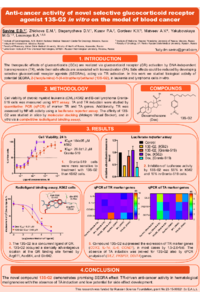
Glucocorticoids (GCs) are widely used in the treatment of hematological malignancies as well as in the systemic therapy of autoimmune and inflammatory diseases. The therapeutic effects of GCs are realized via glucocorticoid receptor (GR) activation by DNA-independent transrepression (TR), while their side effects are associated with transactivation (TA). Side effects could be reduced by developing selective glucocorticoid receptor agonists (SEGRAs), acting via the activation of TR. Recently, we synthesized a novel compound, 2-(hexylamino)-1-(4-nitrophenyl)ethanol (13S-G2), which was a derivative of synephrine, and its biological activity was studied in leukemia and lymphoma cells in vitro.
Methodology
The effect of 13S-G2 on the viability of chronic myeloid leukemia (CML) K562 cells and B-cell lymphoma Granta-519 cells was evaluated using the MTT assay. TA induction was assessed by quantitative PCR (qPCR) of GR-dependent genes (GILZ, FKBP51, REDD1/DDIT4). TR induction was studied using a luciferase reporter assay (with NF-κB reporter construct) and qPCR analysis of key TR marker genes (COX2, IL-1α, IL-6, CCNE1). The affinity of 13S-G2 was assessed in silico by molecular docking (Molegro Virtual Docker), and in vitro via a radioligand binding assay.
Results
Compound 13S-G2 showed cytotoxicity with IC50 values of 184±95 μM in K562 and 26.8±1.2 μM in Granta-519. In silico, we demonstrated that 13S-G2 occupied a sterically advantageous location at the GR binding site formed by the amino acid residues Arg611, Asn564, and Gln642. In a radioligand binding assay (IC50), the radiolabeled Dexamethasone displacement in K562 cells by 13S-G2 was 0.69 μM. The inhibitory effect of 13S-G2 on luciferase activity was 55% in K562 and 15% in Granta-519. Compound 13S-G2 suppressed the expression of TR marker genes, in most cases by 1.5-2.0 fold. The absence of TA induction was proved for 13S-G2.
Conclusions
The novel SEGRA 13S-G2 demonstrates promising transrepression-driven anti-cancer activity in hematological malignancies with the absence of TA induction and low potential for side effect development.
Keywords
glucocorticoids
glucocorticoid receptor
selective glucocorticoid receptor agonist
synephrine
hematological malignancies
transrepression
transactivation
Poster
Savina_E_D_Anti-cancer_activity_of_novel_selective_glucocorticoid_receptor_agonist_13S-G2.pdf
Multivariate models based on biomarkers and metabolites in the cerebrospinal fluid for the diagnosis of secondary bacterial meningitis
Exploring the Key Success Factors in Home-Based Occupational Therapy for People with Dementia: A Qualitative Study from Italy