Event submissions
Published
This submission belongs to the session S1. Infectious Diseases of the event The 1st International Online Conference on Diseases
Published date
05 Sep, 2025
Academic Editor
'%3e%3cpath%20d='M12.6657%2010.9104C12.4185%2010.325%2012.0599%209.79327%2011.6097%209.34482C11.1609%208.89508%2010.6293%208.5365%2010.0442%208.28888C10.0389%208.28626%2010.0337%208.28495%2010.0285%208.28233C10.8446%207.69279%2011.3752%206.73249%2011.3752%205.64904C11.3752%203.8542%209.92103%202.39999%208.1262%202.39999C6.33136%202.39999%204.87715%203.8542%204.87715%205.64904C4.87715%206.73249%205.40774%207.69279%206.22393%208.28364C6.21869%208.28626%206.21345%208.28757%206.20821%208.29019C5.62129%208.5378%205.09463%208.89284%204.64265%209.34613C4.1929%209.79493%203.83432%2010.3266%203.58671%2010.9117C3.34345%2011.4845%203.21226%2012.0987%203.20023%2012.7209C3.19988%2012.7349%203.20233%2012.7488%203.20744%2012.7619C3.21255%2012.7749%203.22022%2012.7867%203.22998%2012.7968C3.23975%2012.8068%203.25142%2012.8147%203.26431%2012.8202C3.2772%2012.8256%203.29105%2012.8284%203.30504%2012.8284H4.09109C4.14874%2012.8284%204.19459%2012.7825%204.1959%2012.7262C4.2221%2011.7148%204.62823%2010.7676%205.34617%2010.0497C6.08899%209.30683%207.0755%208.89808%208.1262%208.89808C9.17689%208.89808%2010.1634%209.30683%2010.9062%2010.0497C11.6242%2010.7676%2012.0303%2011.7148%2012.0565%2012.7262C12.0578%2012.7838%2012.1037%2012.8284%2012.1613%2012.8284H12.9474C12.9613%2012.8284%2012.9752%2012.8256%2012.9881%2012.8202C13.001%2012.8147%2013.0126%2012.8068%2013.0224%2012.7968C13.0322%2012.7867%2013.0398%2012.7749%2013.0449%2012.7619C13.0501%2012.7488%2013.0525%2012.7349%2013.0522%2012.7209C13.0391%2012.0947%2012.9094%2011.4855%2012.6657%2010.9104ZM8.1262%207.9024C7.52486%207.9024%206.9589%207.6679%206.53312%207.24211C6.10733%206.81633%205.87283%206.25037%205.87283%205.64904C5.87283%205.0477%206.10733%204.48174%206.53312%204.05596C6.9589%203.63018%207.52486%203.39567%208.1262%203.39567C8.72753%203.39567%209.29349%203.63018%209.71927%204.05596C10.1451%204.48174%2010.3796%205.0477%2010.3796%205.64904C10.3796%206.25037%2010.1451%206.81633%209.71927%207.24211C9.29349%207.6679%208.72753%207.9024%208.1262%207.9024Z'%20fill='%235D1EE1'/%3e%3c/g%3e%3c/svg%3e) Omar Cauli
Omar CauliCitation
Igor Mokrousov, Daria Tkachuk, Violeta Valcheva, Svetlana Zhdanova, Oleg Ogarkov, Anna Vyazovaya, Robust detection of Mycobacterium tuberculosis Haarlem genotype by real-time PCR assay, in Proceedings of The 1st International Online Conference on Diseases, 9 September–11 September 2025, MDPI: Basel, Switzerland
Share
Email
Facebook
Twitter
LinkedIn
Robust detection of Mycobacterium tuberculosis Haarlem genotype by real-time PCR assay
'%3e%3cpath%20d='M12.6647%2010.9104C12.4176%2010.325%2012.0589%209.7933%2011.6088%209.34485C11.16%208.89511%2010.6283%208.53653%2010.0432%208.28891C10.038%208.28629%2010.0327%208.28498%2010.0275%208.28236C10.8437%207.69282%2011.3743%206.73252%2011.3743%205.64907C11.3743%203.85423%209.92005%202.40002%208.12522%202.40002C6.33038%202.40002%204.87618%203.85423%204.87618%205.64907C4.87618%206.73252%205.40677%207.69282%206.22296%208.28367C6.21772%208.28629%206.21248%208.2876%206.20724%208.29022C5.62031%208.53783%205.09365%208.89287%204.64167%209.34616C4.19192%209.79496%203.83334%2010.3266%203.58573%2010.9117C3.34247%2011.4846%203.21128%2012.0987%203.19925%2012.721C3.1989%2012.735%203.20135%2012.7489%203.20646%2012.7619C3.21157%2012.7749%203.21924%2012.7868%203.22901%2012.7968C3.23877%2012.8068%203.25045%2012.8148%203.26334%2012.8202C3.27623%2012.8256%203.29007%2012.8284%203.30406%2012.8284H4.09012C4.14776%2012.8284%204.19362%2012.7825%204.19493%2012.7262C4.22113%2011.7148%204.62726%2010.7676%205.34519%2010.0497C6.08802%209.30686%207.07452%208.89811%208.12522%208.89811C9.17592%208.89811%2010.1624%209.30686%2010.9052%2010.0497C11.6232%2010.7676%2012.0293%2011.7148%2012.0555%2012.7262C12.0568%2012.7839%2012.1027%2012.8284%2012.1603%2012.8284H12.9464C12.9604%2012.8284%2012.9742%2012.8256%2012.9871%2012.8202C13%2012.8148%2013.0117%2012.8068%2013.0214%2012.7968C13.0312%2012.7868%2013.0389%2012.7749%2013.044%2012.7619C13.0491%2012.7489%2013.0515%2012.735%2013.0512%2012.721C13.0381%2012.0947%2012.9084%2011.4856%2012.6647%2010.9104ZM8.12522%207.90243C7.52388%207.90243%206.95792%207.66793%206.53214%207.24215C6.10636%206.81636%205.87185%206.2504%205.87185%205.64907C5.87185%205.04773%206.10636%204.48177%206.53214%204.05599C6.95792%203.63021%207.52388%203.3957%208.12522%203.3957C8.72655%203.3957%209.29252%203.63021%209.7183%204.05599C10.1441%204.48177%2010.3786%205.04773%2010.3786%205.64907C10.3786%206.2504%2010.1441%206.81636%209.7183%207.24215C9.29252%207.66793%208.72655%207.90243%208.12522%207.90243Z'%20fill='%235D1EE1'/%3e%3c/g%3e%3c/svg%3e)
Igor Mokrousov 1
Daria Tkachuk 1
Violeta Valcheva 2
Svetlana Zhdanova 3

Oleg Ogarkov 3
Anna Vyazovaya 1
1. Laboratory of Molecular Epidemiology and Evolutionary Genetics, St. Petersburg Pasteur Institute, 197101 St. Petersburg, Russia
2. The Stephan Angeloff Institute of Microbiology, Bulgarian Academy of Sciences, 1113 Sofia, Bulgaria
3. Scientific Centre for Family Health and Human Reproduction Problems, 664003 Irkutsk, Russia
Abstract
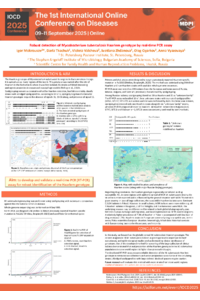
Introduction. The Haarlem genotype of Mycobacterium tuberculosis is spread across many regions of the world. Its strains exhibit interesting pathogenic properties in mouse and macrophage models. Spoligotyping remains a classical method for Haarlem detection, but fails to reliably classify strains with abridged spoligoprofiles. Here, we developed and validated a real-time PCR (RT-PCR) assay for robust identification of the Haarlem genotype.
Materials and methods. M. tuberculosis genotyping was performed using spoligotyping with subsequent comparison against the international SITVIT2 database. Whole-genome sequencing was performed on HiSeq4000. For RT-PCR, we used LNA probes and the RotorGene thermal cycler.
Results. Primers and LNA probes were designed to target a previously reported Haarlem-specific mutation in Rv0282 (Shitikov, Bespiatykh, 2023). The method was optimized using DNA from Haarlem and non-Haarlem strains with available whole-genome sequences. The RT-PCR assay was tested on a collection of 293 isolates from the European and Asian parts of Russia, Belarus, Bulgaria, and Vietnam, previously characterized by spoligotyping and defined as Haarlem, with some strains classified as "unknown genotype" in SITVIT2. Isolates of other genotypes (Beijing, LAM, Ural, EAI) were also included as controls. Among Russian isolates, spoligotyping identified 39 as Haarlem and 35 as “unknown family”. The RT-PCR assay reclassified 10 of these unknown strains with truncated spoligoprofiles (SIT46, SIT237, and SIT1177) as Haarlem. For Belarusian isolates, spoligotyping detected only one Haarlem strain alongside six “unknown family” strains, whereas RT-PCR assigned all seven to Haarlem. All Haarlem isolates from Bulgaria (n=8; SIT47, SIT50) and Vietnam (n=1; SIT50) were correctly and concordantly confirmed by both methods.
Conclusions. The developed RT-PCR assay provides reliable detection of the Haarlem genotype, demonstrating that its true prevalence in certain regions is higher than previous spoligotyping-based estimates. These findings highlight the need for cautious interpretation of truncated spoligoprofiles, particularly those with extensive spacer deletions, in epidemiological studies of M. tuberculosis.
Keywords
Mycobacterium tuberculosis
Haarlem genotype
whole-genome sequencing
spoligotyping
Poster
Mokrousov poster Diseases 2025 sciforum-124528.pdf
Towards a high-resolution genotyping of the Latin American–Mediterranean genotype of Mycobacterium tuberculosis
Potential biomarkers of acute allergic reactions in children