Event submissions
Published
This submission belongs to the session S3. Immune and Inflammatory Diseases of the event The 1st International Online Conference on Diseases
Published date
05 Sep, 2025
Academic Editor
'%3e%3cpath%20d='M12.6657%2010.9104C12.4185%2010.325%2012.0599%209.79327%2011.6097%209.34482C11.1609%208.89508%2010.6293%208.5365%2010.0442%208.28888C10.0389%208.28626%2010.0337%208.28495%2010.0285%208.28233C10.8446%207.69279%2011.3752%206.73249%2011.3752%205.64904C11.3752%203.8542%209.92103%202.39999%208.1262%202.39999C6.33136%202.39999%204.87715%203.8542%204.87715%205.64904C4.87715%206.73249%205.40774%207.69279%206.22393%208.28364C6.21869%208.28626%206.21345%208.28757%206.20821%208.29019C5.62129%208.5378%205.09463%208.89284%204.64265%209.34613C4.1929%209.79493%203.83432%2010.3266%203.58671%2010.9117C3.34345%2011.4845%203.21226%2012.0987%203.20023%2012.7209C3.19988%2012.7349%203.20233%2012.7488%203.20744%2012.7619C3.21255%2012.7749%203.22022%2012.7867%203.22998%2012.7968C3.23975%2012.8068%203.25142%2012.8147%203.26431%2012.8202C3.2772%2012.8256%203.29105%2012.8284%203.30504%2012.8284H4.09109C4.14874%2012.8284%204.19459%2012.7825%204.1959%2012.7262C4.2221%2011.7148%204.62823%2010.7676%205.34617%2010.0497C6.08899%209.30683%207.0755%208.89808%208.1262%208.89808C9.17689%208.89808%2010.1634%209.30683%2010.9062%2010.0497C11.6242%2010.7676%2012.0303%2011.7148%2012.0565%2012.7262C12.0578%2012.7838%2012.1037%2012.8284%2012.1613%2012.8284H12.9474C12.9613%2012.8284%2012.9752%2012.8256%2012.9881%2012.8202C13.001%2012.8147%2013.0126%2012.8068%2013.0224%2012.7968C13.0322%2012.7867%2013.0398%2012.7749%2013.0449%2012.7619C13.0501%2012.7488%2013.0525%2012.7349%2013.0522%2012.7209C13.0391%2012.0947%2012.9094%2011.4855%2012.6657%2010.9104ZM8.1262%207.9024C7.52486%207.9024%206.9589%207.6679%206.53312%207.24211C6.10733%206.81633%205.87283%206.25037%205.87283%205.64904C5.87283%205.0477%206.10733%204.48174%206.53312%204.05596C6.9589%203.63018%207.52486%203.39567%208.1262%203.39567C8.72753%203.39567%209.29349%203.63018%209.71927%204.05596C10.1451%204.48174%2010.3796%205.0477%2010.3796%205.64904C10.3796%206.25037%2010.1451%206.81633%209.71927%207.24211C9.29349%207.6679%208.72753%207.9024%208.1262%207.9024Z'%20fill='%235D1EE1'/%3e%3c/g%3e%3c/svg%3e) Veysel Tahan
Veysel TahanCitation
Irina Dremuk, Anna Ruban, Ekaterina Shamova, Igor Vasilevski, Dmitry Buza, Oksana Ryzhko, Potential biomarkers of acute allergic reactions in children, in Proceedings of The 1st International Online Conference on Diseases, 9 September–11 September 2025, MDPI: Basel, Switzerland
Share
Email
Facebook
Twitter
LinkedIn
Potential biomarkers of acute allergic reactions in children
'%3e%3cpath%20d='M12.6647%2010.9104C12.4176%2010.325%2012.0589%209.7933%2011.6088%209.34485C11.16%208.89511%2010.6283%208.53653%2010.0432%208.28891C10.038%208.28629%2010.0327%208.28498%2010.0275%208.28236C10.8437%207.69282%2011.3743%206.73252%2011.3743%205.64907C11.3743%203.85423%209.92005%202.40002%208.12522%202.40002C6.33038%202.40002%204.87618%203.85423%204.87618%205.64907C4.87618%206.73252%205.40677%207.69282%206.22296%208.28367C6.21772%208.28629%206.21248%208.2876%206.20724%208.29022C5.62031%208.53783%205.09365%208.89287%204.64167%209.34616C4.19192%209.79496%203.83334%2010.3266%203.58573%2010.9117C3.34247%2011.4846%203.21128%2012.0987%203.19925%2012.721C3.1989%2012.735%203.20135%2012.7489%203.20646%2012.7619C3.21157%2012.7749%203.21924%2012.7868%203.22901%2012.7968C3.23877%2012.8068%203.25045%2012.8148%203.26334%2012.8202C3.27623%2012.8256%203.29007%2012.8284%203.30406%2012.8284H4.09012C4.14776%2012.8284%204.19362%2012.7825%204.19493%2012.7262C4.22113%2011.7148%204.62726%2010.7676%205.34519%2010.0497C6.08802%209.30686%207.07452%208.89811%208.12522%208.89811C9.17592%208.89811%2010.1624%209.30686%2010.9052%2010.0497C11.6232%2010.7676%2012.0293%2011.7148%2012.0555%2012.7262C12.0568%2012.7839%2012.1027%2012.8284%2012.1603%2012.8284H12.9464C12.9604%2012.8284%2012.9742%2012.8256%2012.9871%2012.8202C13%2012.8148%2013.0117%2012.8068%2013.0214%2012.7968C13.0312%2012.7868%2013.0389%2012.7749%2013.044%2012.7619C13.0491%2012.7489%2013.0515%2012.735%2013.0512%2012.721C13.0381%2012.0947%2012.9084%2011.4856%2012.6647%2010.9104ZM8.12522%207.90243C7.52388%207.90243%206.95792%207.66793%206.53214%207.24215C6.10636%206.81636%205.87185%206.2504%205.87185%205.64907C5.87185%205.04773%206.10636%204.48177%206.53214%204.05599C6.95792%203.63021%207.52388%203.3957%208.12522%203.3957C8.72655%203.3957%209.29252%203.63021%209.7183%204.05599C10.1441%204.48177%2010.3786%205.04773%2010.3786%205.64907C10.3786%206.2504%2010.1441%206.81636%209.7183%207.24215C9.29252%207.66793%208.72655%207.90243%208.12522%207.90243Z'%20fill='%235D1EE1'/%3e%3c/g%3e%3c/svg%3e)
Irina Dremuk 1,2
Anna Ruban 1,3,4
Ekaterina Shamova 1
Igor Vasilevski 5
Dmitry Buza 6
Oksana Ryzhko 7
1. Institute of Biophysics and Cell Engineering, National Academy of Sciences of Belarus, 27 Akademicheskaya St., Minsk 220072, Belarus
2. Laboratory of Medical Biophysics, National Academy of Sciences of Belarus, 27 Akademicheskaya St., Minsk 220072, Belarus
3. Department of Cell Therapy, National Academy of Sciences of Belarus, 27 Akademicheskaya St., Minsk 220072, Belarus
4. Department of General Medical Practice, Belarusian State Medical University, Bldg. 1, 83 Dzerzhinsky Ave., Minsk 220087, Belarus
5. Department of Clinical Pharmacology, Belarusian State Medical University, Bldg. 1, 83 Dzerzhinsky Ave., Minsk 220087, Belarus
6. Department of the 4th City Children's Clinical Hospital, 24 Shishkina St., Minsk 220036, Belarus
7. Pediatric Department, Brest Regional Children's Hospital, 12 Khalturina St., Brest 224013, Belarus
Abstract
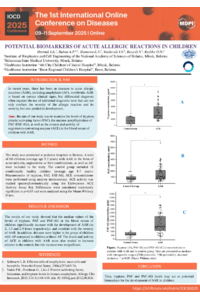
Background. In recent years, there has been an increase in acute allergic reactions (AAR), including anaphylaxis (AF), worldwide. AAR is based on certain clinical signs, but differential diagnosis often requires the use of additional diagnostic tests that can not only confirm the severity of the allergic reaction and its severity, but also predict its development. In this regard, the aim of our study was to examine the levels of tryptase, platelet activating factor (PAF), the enzyme acetylhydrolase of PAF (PAF-AG), and the content and activity of angiotensin-converting enzyme (ACE) in the blood serum of children with AAR.
Methodology. This study was conducted at pediatric hospitals in Belarus. A total of 60 children (average age 9.2 years) with AAR in the form of acute urticaria, angioedema, or their combination, as well as AF, were included in this study. The control group included 18 conditionally healthy children (average age 8.7 years). Measurements of tryptase, FAT, FAT-AG, and ACE concentrations were performed using enzyme immunoassay. ACE activity was studied spectrophotometrically using the Elabscience ACE Activity Assay Kit. Differences were considered statistically significant at p<0,05 and were analyzed using the Mann-Whitney U test.
Results. The results of our study showed that the median values of the levels of tryptase, PAF, and PAF-AG in the blood serum of children significantly increase with the development of AAR (in 2, 1.5, and 2.9 times, respectively), and correlate with the severity of AAR. In addition, these rates were higher in the group of children with AF compared to children without AF. The levels and activity of ACE in children with AAR also tended to increase relative to the control, but this increase was insignificant.
Conclusion(s). In conclusion, tryptase, PAF, and PAF-AG levels may act as potential biomarkers for the development of AAR in children.
Keywords
acute allergic reaction
anaphylaxis
biomarkers
Poster
ICOD_2025_Dremuk_I.pdf
Robust detection of Mycobacterium tuberculosis Haarlem genotype by real-time PCR assay
Platelet microRNA-27 expression in patients with various oncopathologies before and after surgery