Event submissions
Published
This submission belongs to the session S3. Use of Toxins as Tools for Research, Drug Discovery, and Therapeutics of the event The 3rd International Online Conference on Toxins
Published date
08 Sep, 2025
Academic Editor
'%3e%3cpath%20d='M12.6657%2010.9104C12.4185%2010.325%2012.0599%209.79327%2011.6097%209.34482C11.1609%208.89508%2010.6293%208.5365%2010.0442%208.28888C10.0389%208.28626%2010.0337%208.28495%2010.0285%208.28233C10.8446%207.69279%2011.3752%206.73249%2011.3752%205.64904C11.3752%203.8542%209.92103%202.39999%208.1262%202.39999C6.33136%202.39999%204.87715%203.8542%204.87715%205.64904C4.87715%206.73249%205.40774%207.69279%206.22393%208.28364C6.21869%208.28626%206.21345%208.28757%206.20821%208.29019C5.62129%208.5378%205.09463%208.89284%204.64265%209.34613C4.1929%209.79493%203.83432%2010.3266%203.58671%2010.9117C3.34345%2011.4845%203.21226%2012.0987%203.20023%2012.7209C3.19988%2012.7349%203.20233%2012.7488%203.20744%2012.7619C3.21255%2012.7749%203.22022%2012.7867%203.22998%2012.7968C3.23975%2012.8068%203.25142%2012.8147%203.26431%2012.8202C3.2772%2012.8256%203.29105%2012.8284%203.30504%2012.8284H4.09109C4.14874%2012.8284%204.19459%2012.7825%204.1959%2012.7262C4.2221%2011.7148%204.62823%2010.7676%205.34617%2010.0497C6.08899%209.30683%207.0755%208.89808%208.1262%208.89808C9.17689%208.89808%2010.1634%209.30683%2010.9062%2010.0497C11.6242%2010.7676%2012.0303%2011.7148%2012.0565%2012.7262C12.0578%2012.7838%2012.1037%2012.8284%2012.1613%2012.8284H12.9474C12.9613%2012.8284%2012.9752%2012.8256%2012.9881%2012.8202C13.001%2012.8147%2013.0126%2012.8068%2013.0224%2012.7968C13.0322%2012.7867%2013.0398%2012.7749%2013.0449%2012.7619C13.0501%2012.7488%2013.0525%2012.7349%2013.0522%2012.7209C13.0391%2012.0947%2012.9094%2011.4855%2012.6657%2010.9104ZM8.1262%207.9024C7.52486%207.9024%206.9589%207.6679%206.53312%207.24211C6.10733%206.81633%205.87283%206.25037%205.87283%205.64904C5.87283%205.0477%206.10733%204.48174%206.53312%204.05596C6.9589%203.63018%207.52486%203.39567%208.1262%203.39567C8.72753%203.39567%209.29349%203.63018%209.71927%204.05596C10.1451%204.48174%2010.3796%205.0477%2010.3796%205.64904C10.3796%206.25037%2010.1451%206.81633%209.71927%207.24211C9.29349%207.6679%208.72753%207.9024%208.1262%207.9024Z'%20fill='%235D1EE1'/%3e%3c/g%3e%3c/svg%3e) Nilgun E. Tumer
Nilgun E. TumerCitation
María Teresa Romero-Caro, Román Jazahel Guerra-Morales, Jorge Jiménez-Canale, Maritza Lizeth Álvarez-Ainza, Edgar Neri-Castro, José María Gastélum Cano, Rattling Bugs Away: The potential Antibacterial Properties of Crotalus Mictlantecuhtli against S. aureus and E. coli, in Proceedings of The 3rd International Online Conference on Toxins, 10 September–12 September 2025, MDPI: Basel, Switzerland
Share
Email
Facebook
Twitter
LinkedIn
Rattling Bugs Away: The potential Antibacterial Properties of Crotalus Mictlantecuhtli against S. aureus and E. coli
'%3e%3cpath%20d='M12.6647%2010.9104C12.4176%2010.325%2012.0589%209.7933%2011.6088%209.34485C11.16%208.89511%2010.6283%208.53653%2010.0432%208.28891C10.038%208.28629%2010.0327%208.28498%2010.0275%208.28236C10.8437%207.69282%2011.3743%206.73252%2011.3743%205.64907C11.3743%203.85423%209.92005%202.40002%208.12522%202.40002C6.33038%202.40002%204.87618%203.85423%204.87618%205.64907C4.87618%206.73252%205.40677%207.69282%206.22296%208.28367C6.21772%208.28629%206.21248%208.2876%206.20724%208.29022C5.62031%208.53783%205.09365%208.89287%204.64167%209.34616C4.19192%209.79496%203.83334%2010.3266%203.58573%2010.9117C3.34247%2011.4846%203.21128%2012.0987%203.19925%2012.721C3.1989%2012.735%203.20135%2012.7489%203.20646%2012.7619C3.21157%2012.7749%203.21924%2012.7868%203.22901%2012.7968C3.23877%2012.8068%203.25045%2012.8148%203.26334%2012.8202C3.27623%2012.8256%203.29007%2012.8284%203.30406%2012.8284H4.09012C4.14776%2012.8284%204.19362%2012.7825%204.19493%2012.7262C4.22113%2011.7148%204.62726%2010.7676%205.34519%2010.0497C6.08802%209.30686%207.07452%208.89811%208.12522%208.89811C9.17592%208.89811%2010.1624%209.30686%2010.9052%2010.0497C11.6232%2010.7676%2012.0293%2011.7148%2012.0555%2012.7262C12.0568%2012.7839%2012.1027%2012.8284%2012.1603%2012.8284H12.9464C12.9604%2012.8284%2012.9742%2012.8256%2012.9871%2012.8202C13%2012.8148%2013.0117%2012.8068%2013.0214%2012.7968C13.0312%2012.7868%2013.0389%2012.7749%2013.044%2012.7619C13.0491%2012.7489%2013.0515%2012.735%2013.0512%2012.721C13.0381%2012.0947%2012.9084%2011.4856%2012.6647%2010.9104ZM8.12522%207.90243C7.52388%207.90243%206.95792%207.66793%206.53214%207.24215C6.10636%206.81636%205.87185%206.2504%205.87185%205.64907C5.87185%205.04773%206.10636%204.48177%206.53214%204.05599C6.95792%203.63021%207.52388%203.3957%208.12522%203.3957C8.72655%203.3957%209.29252%203.63021%209.7183%204.05599C10.1441%204.48177%2010.3786%205.04773%2010.3786%205.64907C10.3786%206.2504%2010.1441%206.81636%209.7183%207.24215C9.29252%207.66793%208.72655%207.90243%208.12522%207.90243Z'%20fill='%235D1EE1'/%3e%3c/g%3e%3c/svg%3e)
María Teresa Romero-Caro 1
Román Jazahel Guerra-Morales 1
Jorge Jiménez-Canale 2
Maritza Lizeth Álvarez-Ainza 1

Edgar Neri-Castro 3
José María Gastélum Cano 1
1. Chemical Biological Sciences Department. Interdisciplinary Faculty of Biological and Health Sciences. University of Sonora. Blvd Luis Encinas, S/N. Centro, 83000. Hermosillo, Sonora. Mexico.
2. Department of Research in Materials and Polymers, University of Sonora. Blvd. Luis Encinas S/N. Hermosillo, Sonora, 83000, Mexico
3. Institute of Biotechnology, National Autonomous University of Mexico. Av. Universidad 2001, Chamilpa, 62210. Cuernavaca, Morelos, Mexico
Abstract
Introduction
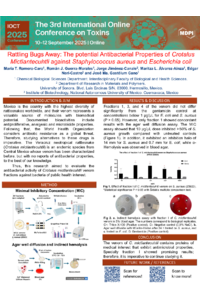
Mexico is the country with the highest diversity of rattlesnakes worldwide, and their venom represents a valuable source of molecules with biomedical potential. Documented bioactivities include antiproliferative, analgesic and microbicide properties. Following that, the World Health Organization considers antibiotic resistance as a global threat. Therefore, studying alternatives to these drugs is imperative. The Veracruz neotropical rattlesnake (Crotalus mictlantecuhtli) is an endemic species from Central Mexico whose venom has been characterized before, but with no reports of its antibacterial properties, to the best of our knowledge.
Methods
Four protein fractions from C. mictlantecuhtli venom were obtained by size exclusion chromatography (SE-LC). The fractions were lyophilized and stored at -20°C until analysis. Protein quantification was performed using a Bicinchoninic Acid (BCA) Protein Assay, with bovine serum albumin (BSA) as a standard. All fractions were adjusted by protein content, diluted with saline solution (NaCl 0.9%) and added to 96-well microplates with Müller–Hinton (MH) in concentrations ranging from 10 to 0.001 µg/µL. To evaluate the antimicrobial activity, the Minimal Inhibitory Concentration (MIC) was determined via the microdilution method, which was performed by inoculating each well with ATCC strains E. coli (25922) or S. aureus (25923) standardized in brain–heart infusion to 0.5 McFarland. The results were corroborated using the agar well diffusion method in MH. Additionally, blood samples were drawn and anticoagulated with calcium-balanced lithium heparin to evaluate indirect hemolysis in 5% blood agar. The data was analyzed by two-way ANOVA and direct observation.
Results
Venom fractions 1, 3 and 4 did not differ significantly from the gentamicin control below 1 µg/µL for E. coli and S. aureus (P > 0.05). Fraction 1 exhibited hemolytic halos with diameters of 0.7 mm and 14 mm, respectively.
Conclusions
C. mictlantecuhtli venom contains proteins of medical interest, showing antimicrobial potential; hence, it is imperative to continue studying it.
Keywords
Crotalus mictlantecuhtli
Venoms
Microbicide properties
Antibacterial activity
Poster
IOCT2025 Poster JMGC.pdf
Crotalus molossus Venom-Loaded PLGA Nanoparticles as potential Drug Delivery Systems for Breast Carcinoma Cells
Evaluation of Antiplatelet Effects of Type C Lectin From Bothrops neuwiedi Venom