Event submissions
Published
This submission belongs to the session S4. Impact of Toxins on Public Health of the event The 3rd International Online Conference on Toxins
Published date
08 Sep, 2025
Academic Editor
'%3e%3cpath%20d='M12.6657%2010.9104C12.4185%2010.325%2012.0599%209.79327%2011.6097%209.34482C11.1609%208.89508%2010.6293%208.5365%2010.0442%208.28888C10.0389%208.28626%2010.0337%208.28495%2010.0285%208.28233C10.8446%207.69279%2011.3752%206.73249%2011.3752%205.64904C11.3752%203.8542%209.92103%202.39999%208.1262%202.39999C6.33136%202.39999%204.87715%203.8542%204.87715%205.64904C4.87715%206.73249%205.40774%207.69279%206.22393%208.28364C6.21869%208.28626%206.21345%208.28757%206.20821%208.29019C5.62129%208.5378%205.09463%208.89284%204.64265%209.34613C4.1929%209.79493%203.83432%2010.3266%203.58671%2010.9117C3.34345%2011.4845%203.21226%2012.0987%203.20023%2012.7209C3.19988%2012.7349%203.20233%2012.7488%203.20744%2012.7619C3.21255%2012.7749%203.22022%2012.7867%203.22998%2012.7968C3.23975%2012.8068%203.25142%2012.8147%203.26431%2012.8202C3.2772%2012.8256%203.29105%2012.8284%203.30504%2012.8284H4.09109C4.14874%2012.8284%204.19459%2012.7825%204.1959%2012.7262C4.2221%2011.7148%204.62823%2010.7676%205.34617%2010.0497C6.08899%209.30683%207.0755%208.89808%208.1262%208.89808C9.17689%208.89808%2010.1634%209.30683%2010.9062%2010.0497C11.6242%2010.7676%2012.0303%2011.7148%2012.0565%2012.7262C12.0578%2012.7838%2012.1037%2012.8284%2012.1613%2012.8284H12.9474C12.9613%2012.8284%2012.9752%2012.8256%2012.9881%2012.8202C13.001%2012.8147%2013.0126%2012.8068%2013.0224%2012.7968C13.0322%2012.7867%2013.0398%2012.7749%2013.0449%2012.7619C13.0501%2012.7488%2013.0525%2012.7349%2013.0522%2012.7209C13.0391%2012.0947%2012.9094%2011.4855%2012.6657%2010.9104ZM8.1262%207.9024C7.52486%207.9024%206.9589%207.6679%206.53312%207.24211C6.10733%206.81633%205.87283%206.25037%205.87283%205.64904C5.87283%205.0477%206.10733%204.48174%206.53312%204.05596C6.9589%203.63018%207.52486%203.39567%208.1262%203.39567C8.72753%203.39567%209.29349%203.63018%209.71927%204.05596C10.1451%204.48174%2010.3796%205.0477%2010.3796%205.64904C10.3796%206.25037%2010.1451%206.81633%209.71927%207.24211C9.29349%207.6679%208.72753%207.9024%208.1262%207.9024Z'%20fill='%235D1EE1'/%3e%3c/g%3e%3c/svg%3e) Panagiota Katikou
Panagiota KatikouCitation
Bouchra Darkaoui, Moulay Abdelmounaim El Hidan, Ayoub Lafnoune, Driss Arourd, Hassan Belli, Rachida Cadi, Ouafaa Aniq Filali, Naoual Oukkache, Public Health Impact of Scorpion Venom in Children: Epidemiological, Clinical, Biological and Evolutionary Profile of Pediatric Envenomation in the Souss Massa Region of Morocco, in Proceedings of The 3rd International Online Conference on Toxins, 10 September–12 September 2025, MDPI: Basel, Switzerland
Share
Email
Facebook
Twitter
LinkedIn
Public Health Impact of Scorpion Venom in Children: Epidemiological, Clinical, Biological and Evolutionary Profile of Pediatric Envenomation in the Souss Massa Region of Morocco
'%3e%3cpath%20d='M12.6647%2010.9104C12.4176%2010.325%2012.0589%209.7933%2011.6088%209.34485C11.16%208.89511%2010.6283%208.53653%2010.0432%208.28891C10.038%208.28629%2010.0327%208.28498%2010.0275%208.28236C10.8437%207.69282%2011.3743%206.73252%2011.3743%205.64907C11.3743%203.85423%209.92005%202.40002%208.12522%202.40002C6.33038%202.40002%204.87618%203.85423%204.87618%205.64907C4.87618%206.73252%205.40677%207.69282%206.22296%208.28367C6.21772%208.28629%206.21248%208.2876%206.20724%208.29022C5.62031%208.53783%205.09365%208.89287%204.64167%209.34616C4.19192%209.79496%203.83334%2010.3266%203.58573%2010.9117C3.34247%2011.4846%203.21128%2012.0987%203.19925%2012.721C3.1989%2012.735%203.20135%2012.7489%203.20646%2012.7619C3.21157%2012.7749%203.21924%2012.7868%203.22901%2012.7968C3.23877%2012.8068%203.25045%2012.8148%203.26334%2012.8202C3.27623%2012.8256%203.29007%2012.8284%203.30406%2012.8284H4.09012C4.14776%2012.8284%204.19362%2012.7825%204.19493%2012.7262C4.22113%2011.7148%204.62726%2010.7676%205.34519%2010.0497C6.08802%209.30686%207.07452%208.89811%208.12522%208.89811C9.17592%208.89811%2010.1624%209.30686%2010.9052%2010.0497C11.6232%2010.7676%2012.0293%2011.7148%2012.0555%2012.7262C12.0568%2012.7839%2012.1027%2012.8284%2012.1603%2012.8284H12.9464C12.9604%2012.8284%2012.9742%2012.8256%2012.9871%2012.8202C13%2012.8148%2013.0117%2012.8068%2013.0214%2012.7968C13.0312%2012.7868%2013.0389%2012.7749%2013.044%2012.7619C13.0491%2012.7489%2013.0515%2012.735%2013.0512%2012.721C13.0381%2012.0947%2012.9084%2011.4856%2012.6647%2010.9104ZM8.12522%207.90243C7.52388%207.90243%206.95792%207.66793%206.53214%207.24215C6.10636%206.81636%205.87185%206.2504%205.87185%205.64907C5.87185%205.04773%206.10636%204.48177%206.53214%204.05599C6.95792%203.63021%207.52388%203.3957%208.12522%203.3957C8.72655%203.3957%209.29252%203.63021%209.7183%204.05599C10.1441%204.48177%2010.3786%205.04773%2010.3786%205.64907C10.3786%206.2504%2010.1441%206.81636%209.7183%207.24215C9.29252%207.66793%208.72655%207.90243%208.12522%207.90243Z'%20fill='%235D1EE1'/%3e%3c/g%3e%3c/svg%3e)
Bouchra Darkaoui 1
Moulay Abdelmounaim El Hidan 2
Ayoub Lafnoune 1,3
Driss Arourd 4
Hassan Belli 4
Rachida Cadi 3
Ouafaa Aniq Filali 3
Naoual Oukkache 1
1. Laboratory of Venoms and Toxins, Pasteur Institute of Morocco, 1 Place Louis Pasteur, Casablanca 20250, Morocco.
2. Laboratory of Biotechnology and Valorization of Natural Resources, Faculty of Applied Sciences, Ibn Zohr University, Agadir, Morocco.
3. Laboratory of Molecular Genetics, Physiopathology and Biotechnology, Faculty of Sciences Ain Chock, Hassan II University of Casablanca, B.P 5366 Maarif, Casablanca 20000, Morocco.
4. The Regional Hospital Hassan II, Agadir, 80000, Morocco.
Abstract
Introduction
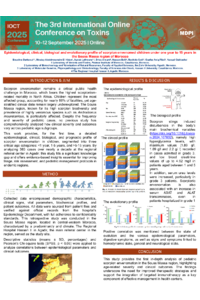
Scorpion envenomation remains a significant public health issue in North Africa, particularly in Morocco, where it accounts for high morbidity and mortality, especially among children. As biological toxins, scorpion venoms can cause severe multisystemic complications, necessitating urgent medical attention. Understanding the clinical and biological impact of these envenomations is essential to improve health responses in affected regions.
Methods
This retrospective study analyzed 383 cases of pediatric scorpion stings recorded at the Regional Hospital Hassan II in Agadir (Souss Massa region) over a period of 9 years and 10 months, from January 2013 to October 2022. The patients were categorized into three age groups: under 1 year, 1–5 years, and over 5 years. Clinical, biological, and evolutionary data were collected and assessed to evaluate the severity and systemic effects of envenomation.
Results
Children under the age of 1 year exhibited the most severe clinical forms and the highest mortality rate. Clinical manifestations showed extensive toxic effects on the cardiovascular, neurological, and pulmonary systems, particularly in grade 2 and 3 cases. Alterations in vital signs (temperature, oxygen saturation, blood pressure, heart, and respiratory rates), biochemical markers (ASAT, ALAT, urea, creatinine, blood glucose), and hematological parameters revealed significant dysfunction in vital organs. A positive correlation was found between clinical evolution and factors such as age, symptom severity, and hemodynamic status.
Conclusions
This study highlights the serious health threat posed by scorpion venom in pediatric populations, especially infants. It underscores the need to strengthen prevention strategies, improve early medical management, and ensure the availability of effective immunotherapy. Scorpion envenomation represents a critical public health challenge in endemic areas and calls for targeted interventions to reduce toxin-related morbidity and mortality.
Keywords
Public health
Pediatric toxicology
Scorpion envenomation
Stings
Mortality.
Poster
Poster Bouchra darkaoui.pdf
The Unexpected Biochemical Repertoire of Mamba Intestinal Toxin
Development and Comparative Evaluation of Antivenoms Targeting the Pathophysiological Effects of Scorpion Venom Toxins in North Africa